
Slowing Down in the Forgotten Mining Town of Tkibuli, Georgia
I can’t pronounce Tkibuli. I have practiced the word with ten Georgians, but I still have not got it right. Now you say it, please!
Tkibuli was a small village with a river running through it, many abandoned homes, and a theatre which I couldn’t see. The theatre is said to be a beautiful structure, but it was always closed, probably temporarily. I tried going in three times.
I had hitchhiked to Tkibuli from Nikortsminda, a town about which I have written in the linked post (coming soon). I had been traveling with a Russian traveler, Rasha, whom I had met through Couchsurfing. She had put out a hitchhiking trip to Racha mountains, looking for travelers to join her. I did, and we had arrived in Tkibuli after visiting the mountains. Tkibuli lies in the Imereti region, right at the foot of the Racha mountains.
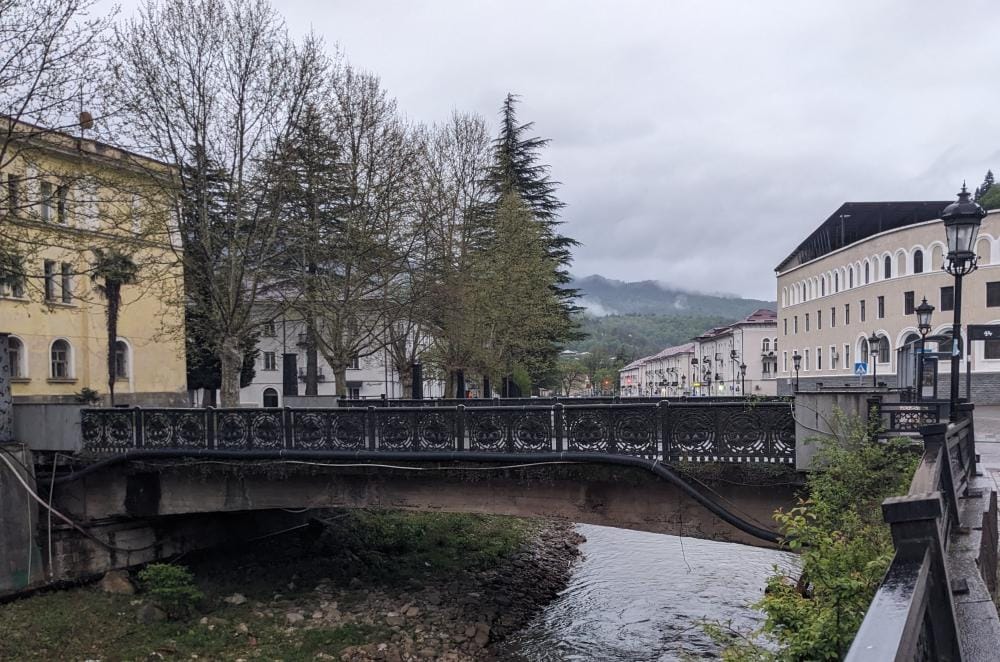
I was slow in Tkibuli. I walked around, stared at the Tkibula river, found the world’s friendliest and best-priced supermarket, rattled my brains over why there were so many forgotten homes with their doors and windows stolen, cooked, and read the book, The Portrait of a Turkish Family by Irfan Olga.
When I researched a bit about Tkibuli, I found that it was an old mining town from the Soviet era whose population has now moved on. That explains the abandoned homes.
On my first evening, I enjoyed a local dinner at a small restaurant. I ordered eggplant with walnut sauce, a local beer, and the corn bread, mchadi, that I had had in Kutaisi, too. Rasha had recommended that small eatery.
The women offered us tea, describing the kind of tea to Rasha. She asked if I would like a cup, and I said, “Yes, I will,” though really I was waiting for my beer, which they weren’t serving me. The tea was a general tea bag tea, not a brewed or special tea. Rasha behaved weirdly at dinner, gobbled her potato fries, packed the intestines she had ordered, and got up and paid, without a word to me. When I asked if she was leaving, she said she was and that she needed to go on a walk by herself.
This wasn’t her first mood swing. While I was surprised, I wasn’t thrown off my feet. She left, creating a lot of confusion about how much she had paid and that I needed to pay for her too.
After dinner, I went on a long walk, wrapping my jacket around me tightly. It was early May. Mountains surrounded the village, and the weather was cold and rainy.
Now I had to buy something for breakfast. I was hoping to find a supermarket or a local grocery store with prices displayed on products. I found a big shop with groceries spilled out on the road, every basket marked with a price. Standing outside, many people were thrilled to see me and said hellos several times, mentioning India too.
This was the best supermarket in all of Tkibuli, no, in all of Georgia. The women inside were giggly, plump, and friendly. I bought cheese, bread, onions, greens, etc. They took card, and I was a happy girl. Everything was well priced.
At night, I had a cup of tea, did some work, and slept off.
In the morning, Rasha got ready, had her tea, and left. I breathed a sigh of relief.
I had decided to stay in Tkibuli that day. At the bus stand, a tourism poster mentioned many things to do in Tkibuli, including a waterfall and a cathedral. I decided to walk around town. What was the point of going outside when I hadn’t seen the village? Also, I wasn’t excited to visit a waterfall in that rainy weather.
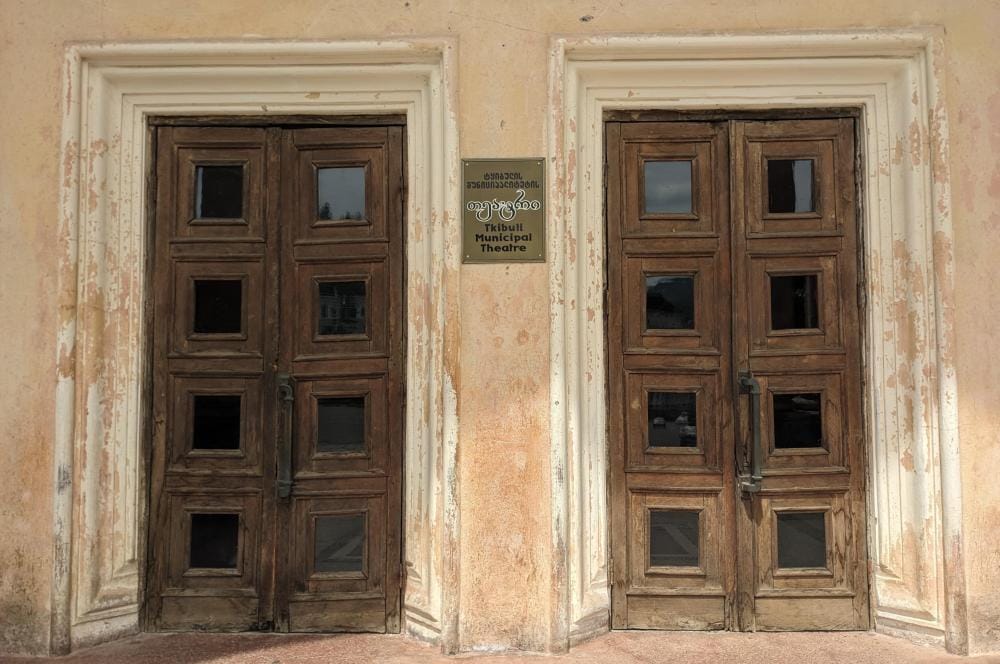
I went to the theatre. It was closed. So I walked up through the park to a road. By the side of the park, a big circular building caught my eye. I went to see it from up close. It was shut. A metal plaque said it was the Civil Defense building. The building was closed as it was Sunday.
From up there, I got a nice view of downtown, which was mainly the brook at the other end, a park below, and the big theatre on the left, with some space to sit outside it.
On the main road above, I walked by simple homes. A tiny little church at the corner of the street. A bench outside a house full of flowers. A man washing his car on the road. This is what I remember.
The locals were staring at me like I was a cartoon, as they did in most of Georgia. There weren’t many Indian travelers in Georgia, though medical students from India were aplenty in the big cities. The old Georgians standing by the side of the brook, women chatting and sunbathing under the trees, people lingering outside supermarkets, cars driving by, kids running along the streets, and grandmothers looking after the grandchildren playing outside their homes were all curious about me, their eyes affixed on me. Sometimes their mouths turned into big smiles.
I enjoyed the attention.
Instead of getting shy about it, I decided to own it, like a celebrity, like a star of the galaxy. “Everyone looks at the moon but the moon keeps shining on. So I will keep shining on. If I am moon they will see me right?” I said to my partner, Sagar, in an audio message while walking around town. I must have been happy.
When I climbed down the road, I crossed a park again. But before the park, a weird structure with many dark vertical cement slabs interested me. I stared at this structure, wondering if it was still under construction. What were they making? There was no worker or construction material around it. While reading a blog post about Tkibuli, I found that it was the lower station of the cable car from the Soviet times, when Tkibuli was a mining town. The cable car went up the hill, carrying workers.
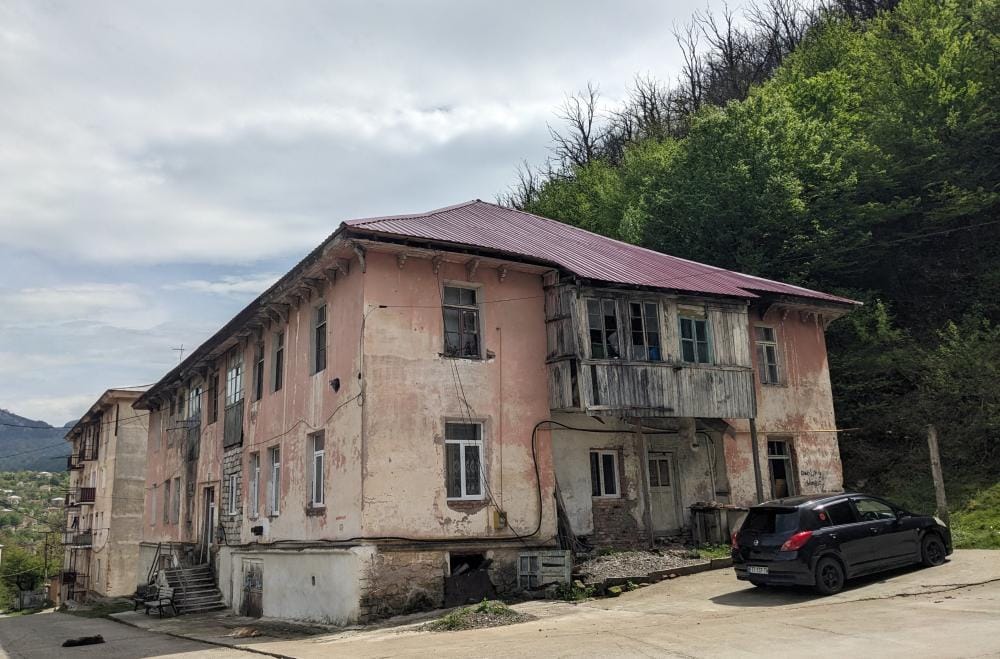
The abandoned homes had missing doors and windows that had probably been stolen, sold, or burned as fuel. I felt that the village must be poor if such was the situation of the homes. So many homes were shabby, with no cement or paint, rusty iron railings, and clothes hanging on those railings.
How would those houses be from the inside? Along the brook, too, even the lived-in cottages were worn down, as if no one had cared for them for a while. Maybe the locals didn’t have the money?
That evening, I tried a new supermarket, whose cauliflowers were shining and which I had seen while passing the shop. I bought a fresh cauliflower and two tomatoes. Slowly, I would learn to see that the unit price and weight of the item were displayed on our side of the weighing machine. But not at that supermarket, not then. I paid five laris and worried that the lady had overcharged me. But the cauliflower was big, and I think she charged me well. From my favorite supermarket, I bought bread and cheese, and they even returned me five tetri.
I was so happy.
Back at home, I picked up my book again and settled into bed. I sent more Couchsurfing messages and researched Borjomi and Tbilisi, deciding between the two as my next destination. I chose Tbilisi, mainly because I realized that traveling anywhere from Tbilisi would be easy. I had had enough time in places where it was hard to figure out my way, and now I was looking at something easy.
I sent some Couchsurfing messages, worked a bit, and cooked the cauliflower with spinach. I enjoyed the curry with bread. It was delicious.
The next morning, I got up, got ready, packed, and made a cup of coffee. But somehow I spilled that coffee in the room. I had opened one window, but the wild Georgian wind had thrown open both, and thus, my coffee cup, which was kept behind the closed window on the sill, was overthrown too.
I cleaned it all up. When I went to the theatre, yes, one more time, it was still closed. I asked many people, who all sent me to the door of the theatre. Finally, I got in from a side door only to be told by a grumpy female employee that it was closed.
I walked back in the sun, stopping by the shining river a few times, my ears tuned to its gurgle. Birds sang morning songs, happy for the nice weather. I was about to start hitchhiking to Tbilisi, but instead I told the owner I would stay one more day. I needed more of the quiet of the village and the sound of the river. The sun was out, too.
I made another cup of coffee, put honey on a piece of toasted bread, and picked up my book again. After sending some more Couchsurfing (CS) messages and finalizing a hotel in case CS didn’t work out, I slept off.
When I woke up after four hours, it was raining outside, and it was cold. I didn’t go out that evening at all. My stomach hurt while sleeping, and it was still hurting. The previous evening I had had spinach and cauliflower vegetable. The whole day I had a lot of white flour bread. I wasn’t sure of the water I was drinking. So I cooked plain rice, made a soup of the leftover green vegetable curry from the previous evening, and had it all with yoghurt. I boiled water to drink, hoping it would suit me better.
I had my dinner while watching a simple movie, a perfect way to close out my simple stay.
I needed a rest day, but I didn’t know it. Thankfully, I had listened to my body and stayed.
The next morning, I wasn’t at my best. My stomach wasn’t well. But I got ready and left to hitchhike to Tbilisi, the capital of Georgia. I was there in four hours, covering a distance of 250 kms in four cars. Not bad, eh?
Where to stay in Tkibuli, Georgia?
Hotel Okriba: Okriba is a nice place to stay right in the center and close to the Tkibuli Theatre. The kitchen had oil, spices, coffee, tea, and sugar in the cabinet. There were three different kinds of teas: clearly, this was the tea region of the country, though I never saw the tea farms. The owner had turned on the heating in the room. He was nice and helpful. The hot water was not working in my bathroom, so he showed me another bathroom. He said, “No one is here apart from you. You can shower easily here.”
He also put slippers for me to use outside my room. I asked him for the washing machine, but he said it wasn’t working. Later, he came in and held out a bag in front of me, “Put your dirty clothes here. I will wash them and bring.” That was sweet of him. I didn’t take him up on his offer because I had washed my mud-stained leggings (thanks to the off roading competition in Nikortsminda) with my hands.
The building isn’t in the best condition, but the rooms are good. The bathrooms could be in better condition, though. The bed was comfortable as well.
You can book Okriba here.
Do you love visiting tiny villages too?
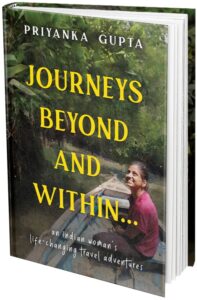
MY FIRST BOOK
Journeys Beyond and Within...
IS HERE!
In my vivid narrative style (that readers love, ahem), I have told my most incredible adventures, including a nine-month solo trip to South America. In the candid book, the scoldings I got from home for not settling down and the fears and obstacles I faced, along with my career experiments, are laid bare. Witty and introspective, the memoir will make you laugh and inspire you to travel, rediscover home, and leap over the boundaries.
Sikkim Express: "Simple, free-flowing, but immensely evocative."
The Telegraph Online: "An introspective as well as an adventurous read."
Grab your copy now!
The memoir is available globally. Search for the title on your country's Amazon.
Or, read a chapter first. Claim your completely free First Chapter here.
Want similar inspiration and ideas in your inbox? Subscribe to my free weekly newsletter, Looking Inwards.