
Things to do in Sarajevo, Bosnia and Herzegovina: Or Rather What I did in the City, In My Own Way
Sarajevo, a city whose pronunciation I had to confirm with my host. Sara-yevo. A city circumscribed by mountains, so that when Serbia laid siege in 1992, they surrounded them for four hundred days, stationing themselves on these very mountains, which are a mix of Alps and some other Bosnian range. The locals built a tunnel to go in and out and bring supplies. My host told me one kilogram of coffee was probably two hundred euros at that time.
It is an old city, probably mentioned for the first time in the 13th century. I am not sure. Ruled by Ottomans, Austrian Hungarians, and then by themselves. It was part of Yugoslavia once. Then broke apart to form an independent nation, but only to first fall under the greedy eye of Serbia.
I was told that now, probably more than eighty percent of people are Bosnian Muslims, and Serbians and Croatians are very few. They still have three presidents, one for each community. Recently, the presidents rejected the 180 or so conditions of the European Union(EU), which they had to agree with to be included in the EU. My young host, Nahid, told me that they would benefit from joining the EU in terms of freedom of movement.
“Do you need a visa to visit, let’s say, Paris?” I asked Nahid as he sat on the couch chair imprinted with blue and red leaves. The World Cup football match between Bosnia and Switzerland was being broadcast live on television. He had come to help me run the match because the remote hadn’t been working. We started talking, and after half an hour, when I couldn’t stand anymore, I sat down on the couch, and said, “I am sitting.” He sat down on the leafy couch chair, too. During the day he had chatted with me for more than an hour, never sitting down.
“No, we don’t need a visa. But there would be many questions, you know. How many days would we stay. Why was I going. Where I would be going. When would I return. And so on. With the EU, we would come in the Schengen zone.”
“Right. But things would become expensive, I think?” I asked.
“Yes. Of course. For example, in Croatia, when they joined EU, their local currency, kuna, were let go and they accepted Euro. So the transition was, like if something was two kuna, it became two euros. That’s how they did it. They had just spent two million something to stabilize their currency and then they took euros.”
“I won’t be able to come here then. I would have to apply for a Schengen visa, and it would be so hard. I have to give bank account statement, Income tax return statements, full itinerary, and so on. It is a long process, and you only get visas for the duration you apply for. You have to give the whole plan.” I told him, thinking of the two times I applied for the Schengen visa in the past, the thick realms of documents I gathered, and how short the visas the EU had granted were.
I was also thinking if every country was trying to become a part of the EU?
Georgia, Armenia, Bosnia and Herzegovina, and which others?
Russia didn’t want them to join the EU, of course. He said, “The EU wanted us to build a gas pipeline and give the contract to a company which is directly related to Trump.”
That sounds weird, but politics is playing a weird role. I am sorry that this piece on Sarajevo is becoming so political. Politics is everything, though. Now their gas comes from Russia. I can’t believe it.
“Russia is so far,” I said.
“Yeah, yeah.”
My host thought a bit and added, Gas is expensive.”
Last month, a few guests from Croatia turned on the heating at high in his house for four days, and he had to pay a bill of fifteen euros, which was a bit much for the month, he told me.
“My parents buy a cylinder of ten euros and it runs us for more than two months. That’s so cheap, right?”
“Yeah, that’s nothing,” he said.
“So do you increase the prices of your accommodation in winter?”
“I close in winter. There is ice on the street.”
“Oh wow! And they don’t clean the ice? So how do the locals manage?”
“They pray to god that they don’t fall.”
I laughed so hard I think the cats ran into their home.
He laughed too.
“My father used to clear the whole street. Now no one does.”
I have written about Nahid’s father in my love letter to Armenia, surprisingly. I was writing the letter in Nahid’s house, and thus my conversation with him got stitched up into the piece, too. Please read if you are curious.
“And how do they drive cars on ice?” I was curious.
“They don’t drive cars on this street. I mean my father was the first one to drive a car on this street. Seeing him, other people started too. Only three people drive their cars on this street now. The roads are cleaned for cars. But not this street, our street. My father used to even turn around from the turn above. That is a very tricky one.”
The street he was talking of, on which I was staying in their apartment, was probably at a sixty or seventy-degree incline. I felt strange just walking on it.
Nahid was proud of his father. Now, after waking up in the morning, he had coffee only with his mother.
“We used to be three, now just two, three if I count the cat too.” He chuckled.
“Yeah, it must be hard to drive on this street. It goes straight up.” I extended my right hand, my right palm slanting at eighty degrees. A few hours before, I had gone to the supermarket above the house. It may have been a hundred meters, as Nahid had said, or less probably, but it was enough. I arrived at the Amko supermarket, panting. Going down, I had been running, without wanting to. And in the morning, I had climbed that very street with my 15-kilo backpack and small bag, bent, stepping like an old woman, sweating, panting, my breath running shallow.
Children were running and playing around on the street. I had heard them while trudging up to the market.
“Not so many children are there now. People either leave Bosnia or don’t marry or don’t have children. So many young people have gone. Most are older people around here now. They go to the US or Europe or Croatia or something.” Nahid continued, “I am happy here. So many girls go to Germany. They work like sisters or something in old age homes. But if they earn more, they spend more too. Like they get 3000 euros or something, but they spend one and a half or two on rent, food, and so on. I am better here.”
“Do you speak the language?” I asked him.
“I learned it as a second language, but I have forgotten most of it. Because I don’t practice. I can understand a few words, maybe. Not much.”
We chatted until almost 11 pm. The football match still showed a score of 0-0, and I was trying to watch it, but was distracted by our conversation.
Remember, this was a host whom I was paying; he wasn’t obliged to speak to me. He could have left earlier, back to the comfort of his home, his mother, and his match. But he chose to stay with me and talk to me.
This was Sarajevo. Locals, especially the women wearing simple head scarves, smiled at me and said hello. They weren’t always the first ones to acknowledge, but they were quick to reply. In supermarkets, the staff or the owner came to see if I needed anything or had a question. They helped me patiently. I was going through another kind of relaxation after Armenia. People were nice and friendly there, but I had to stay away from the men. Too many men, too many times, had asked me out, offered to spend more time, and so on. In Sarajevo, I was not being persuaded in that way. Not that I had had a chance to interact so closely there. In Armenia, I was hitchhiking. In Bosnia and Herzegovina, hitchhiking was not big. I might have gotten rides after a long wait.
I was starting to relax. Also, my Russian host from Armenia had told me that Bosnians might not be the nicest or friendliest. I had to erase that information because it was not true. Maybe the unfriendliness was her experience as a Russian.
In this transition between countries, I lose time. By the time I have adapted and learned a way to navigate the nation, I am out. Hah!
Sarajevo was spread on the mountains, and it was in the valley, too. The Miljacka River ran through the centre, with many historical bridges spanning it. The Latin Bridge, where the archduke of Austria-Hungary was shot by a Serbian student, was a major tourist attraction but also a local commute on which old men still walked bent down, big grocery plastic bags hanging from their hands. On one side of the bridge, you had a park, old important buildings, and mosques, and on the other side, you had the downtown, the fountains, and ancient markets.
The town was established by the Ottoman Empire. The same guy who had designed Istanbul had designed Sarajevo too. Nahid had told me.
Tourists from Europe, Mexico, the US, and, I am sure, from other countries flocked to Sarajevo. China, oh let us not forget China. They get an easy visa, I was told. They all did the same thing. They visited a few museums, sipped coffee at the many cafes, took pictures of the old Ottoman fountain, also known as the Pigeon Square, walked up to the White and Yellow fortresses, and took the cable car up to the Trebević mountain. They saw where the archduke was killed, the replica of the car he had been riding, and entered some mosques. Wrapping up their time in Sarajevo, they rode the train to Mostar, the nearby village.
Every tourist I spoke to went to Mostar. Period.
I didn’t go there.
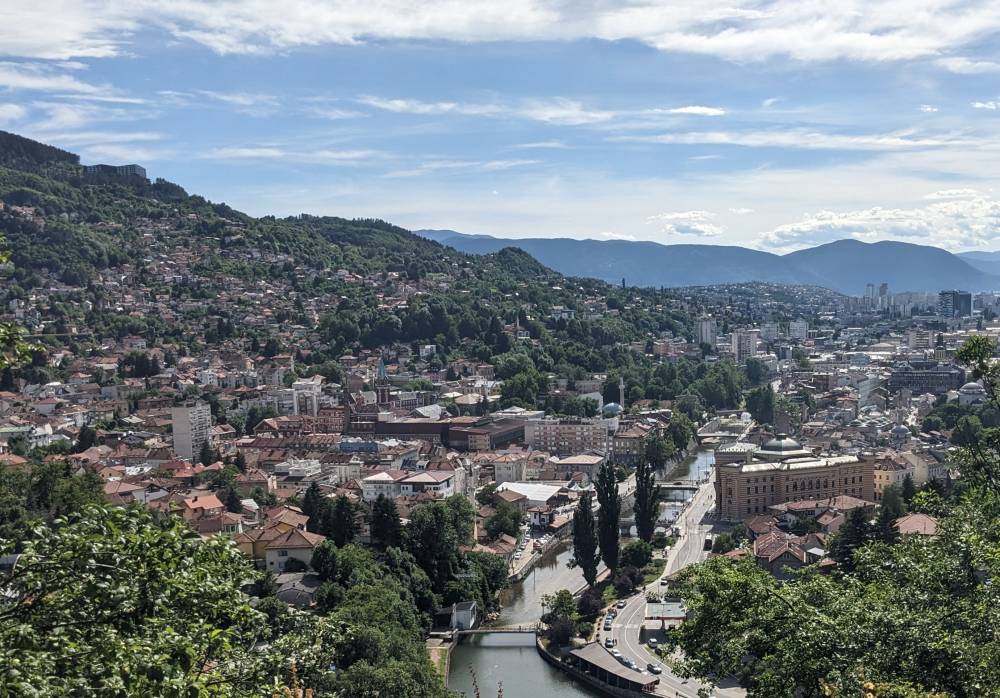
The first day I arrived, I walked up the hill to the yellow fortress, the viewpoint above it, and the white fortress. Those were Ottoman fortresses. They were the access points to the city of Sarajevo. The view from the bastions was awe-inspiring. I saw the whole red city. I say red because all homes had brick tiled roofs. Nahid had told me that there was a brick factory, and so all homes were roofed with the bricks from that factory in the same style. The sky was clear; several mosques and cathedrals, elegant with their minarets and domes, rose in between homes, and white cemeteries flecked the city. Tourists and locals sat beside me on benches. A waiter from a cafe on the yellow fortress had asked me if I needed something.
“Do you have something to eat? A sandwich, perhaps?”
“No, only drinks or sweets.”
“Ah! No, thank you then.”
He smiled and left. No pressure to buy anything. Chinese tourists flocked to nearby benches. A local Muslim family with women in scarves enjoyed tea on my left. Were they Arabic? I didn’t think so. They were locals. The river wasn’t so deep or big that you could see it from up there. But it was there.
From the yellow fortress, I walked up the cobbled street to the viewpoint. Wasn’t the fortress a good viewpoint? What more view would there be? I still walked up. I had the time. A Chinese family had gone ahead of me, too, the young one in jeans and a t-shirt directing her parents. “Viewpoint” was the only English word she had spoken, so I understood that was where they had gone.
On the side of the road, shrubs, sour berry trees, and sour Turkish plums, which I had been finding everywhere in Armenia, were laden with green fruit. I plucked many berries and plums and crunched on them, not minding if anyone would see me. No one cared for those sour fruits. The Chinese tourists were going down. They had seen enough. Now I was at the viewpoint; through the trees, the city of Sarajevo was visible below. Another English-speaking old couple stopped by next to me. They had been going down.
“Nice view, eh?” The man asked, more like declaring it.
“Yeah. Absolutely.” I agreed.
They went by after a few minutes, taking pictures and soaking in.
As I walked down too, a local walked up, returning from his office perhaps. I said hello, and he said hello. People in Sarajevo mostly replied or greeted warmly, not in a superficial way. It was like they liked saying hello.
I was not done yet. Now I took the direction to the White Fortress, unaware that it would be a paid visit. Did I go up the same street? Thankfully, with Google Maps, I didn’t need to remember exactly what direction I had taken. I arrived at a parking lot and a restaurant. Of course, those who could drive up were driving. There were signs of tickets. I started going in, but a friendly man opened his booth, and I had to ask, “Is there a ticket?” He replied affirmatively. “Do I have to pay it?” I was being cheeky. I didn’t care about going in. He chuckled and said, “Yeah.”
“Oh, okay. I didn’t know. What is there to see? Just a view?”
“Yes, there is a museum and also, of course, the view.”
“Okay. Could I just go up there? I motioned a little ahead of me from where I would have gotten a whole glimpse of the arrangement.
“I am sorry. The cameras are on, so I can’t do that.”
He was friendly. I turned around.
“I am sorry,” he said.
I replied, “No worries. Thank you.”
Now it was time for me to go down and eat. Rubbing my eyes, sleepy, I hadn’t lain down in the hostel; I had gone to bed at 9:30 the previous night and gotten up at two am to take my flight to Sarajevo from Yerevan. I was tired, hoping to eat and retire to bed.
Should I buy groceries, go to the hostel and cook and eat? I was seated on a bench by the river. It sounded like a big chore. The hostel was full of tourists that day, mostly from China, and even when I had left, the kitchen was overtaken, with no one moving aside as I tried filling my water bottle from the sink. I sat down and looked for restaurants on Google Maps. Reading the menus and scrolling through the food pictures, I decided upon a place with reasonable prices and vegetarian options.
In the crowded tourist street, the place was empty except for one table. Other places were bustling with tourists. The neighboring restaurant poured wine freely into guests’ glasses from shining carafes. The waitress was putting down glasses full of frothy local beer. I looked at the menu and plonked down. It had been the same as the one uploaded on the internet eight months ago, and I was okay with it. The waitress, tall and with eyeliner on her eyes, her ponytail dangling behind her, came to me, and I asked, “What do you have in vegetarian? She was quick to tell me that only the pasta was vegetarian. There were some cheese balls that weren’t available. Later, I would see a buffet inside the restaurant. When I asked, she said none of it was vegetarian.
I motioned towards the cheese pasta and asked if it was good. She said it was. I ordered a plate. In the neighboring restaurant, a smartly dressed woman was speaking to her friends in Spanish. When she used a Chilean slang word, I couldn’t control myself. I asked her if she was from Chile. No. Mexico, she said while moving her hands, her fingernails painted red like her lips. She had stylish short hair, wore a sleeveless top, and her glasses were perked up on her face. She told me she had been to India, and she loved Rajasthan and so on, and asked me where I was from, and then she suddenly said bye.
So that was about it.
I sat down in my chair again, happy to have tried to speak. As I sipped my limonada, the waitress put the pasta plate on my table and left without a single word. The four-cheese pasta was served with only two kinds of cheeses. There were only a couple of cubes of the smoked cheese. I was hungry and needed the carbs. The big gulps of lemonade helped me push the heavy creamy pasta down my throat. It didn’t have much flavor, but I was used to no flavor by then.
When I went to pay, the waitress told me she didn’t have change for fifty. “Wait please, while my friend brings change.” I obliged and stood near my table, looking at Google Maps. Other tables had bread. Why wasn’t I served bread? Within seven to eight minutes, she handed me a twenty-mark bill and two ten-mark ones.
“Did I give you the fifty?” I asked, a bit sure that I had the fifty in my purse. But I couldn’t be so sure.
She replied, “Yeah, you gave me the fifty.”
“Okay, thank you.”
I left. When I had walked away from the restaurant, I opened my hemp bag and then the orange purse and counted the notes. The fifty was still there. I was happy. I had a slight idea that I had the fifty, but something in me said not to say it.
I hadn’t been given bread like every table, and she had just put down the dish of pasta on my table and left, as if saying, “Here, eat it or not, I don’t care.” I wasn’t feeling friendly or honest.
So I had just been paid forty marks for eating dinner.
Some of you reading this article might hate me. But when you encounter unfriendliness or confusion and you doubt if you had been treated equally as other guests and wonder why you weren’t even given bread, and when every penny that you withdraw incurs an extra charge, and every bite of food you eat you have to pay for, you appreciate these little mishappenings. You tell yourself you deserve them.
I had quickly gotten out of that street, walked towards the river, lined by the interesting buildings from an ancient era. A hamam and spa caught my attention, and I went inside to check prices and offerings. They explained their expensive menu to me, while I wondered why it was so expensive. I took their card, knowing I would never go.
Out on the main road, I admired the old buildings, following the Google Maps. I climbed up to the hostel as a happy girl, passing closed supermarkets, even trying to push the door of one to see if it was closed. It was. I had landed on a Sunday.
At the hostel, I got ready and went to bed early, but couldn’t sleep. My dorm mates, all of them coincidentally Chinese, kept coming in until after 11. Every time someone came in, I had to remind them to close the door.
“The do-or?” Each one of them said when I asked them to close it.
Then, as if understanding dawned upon them, they closed the door, returning to fixing their beds or folding their clothes or whatever they were doing. Then the person who had gone out to shower or brush would come back, leaving the door open again. I was frustrated, but what was the point? At least everyone was quiet.
My dorm mates didn’t understand the concept of a door.
In the morning, first I asked the host for toilet paper, and when I couldn’t take it anymore, I went back down to request her to shift me to the two-bed dorm I had originally booked. She had offered me the five-bed dorm after showing me the two-bed dorm, stating that I could choose, that there was a man in the two-bed, and when I had asked who, she had said, “A Chinese.” Now in the morning, the couple who had slept in the two-bed dorm had left, the room door was left ajar, their beds unmade, an empty water bottle lay in the room, and some other garbage too was strewn around.
The grumpy old woman said she spoke little English, she would have to check reservations, and when I didn’t give in and kept requesting in my squeaky sleepy tired voice, she gave in. “Change bed, okay.” I couldn’t believe her, though. “You mean I can go to the two-bed dorm,” I gestured with my hands to show two beds, holding the palm horizontally and moving it up and down.
“Yes, change bed.”
Ecstatic, I thanked her and sprinted up, as if the room would run away, and one by one shifted all my things to the dirty dorm, occupying the upper locker, hoping it would show the host that I had taken the upper bed. I couldn’t go to her room once more to tell her that I had taken the upper bed. She would have killed me. Not that I didn’t think about it.
Some of my dorm mates were asleep, some were getting ready, and others had left. I didn’t care. I hoped an angel would land in the other dorm with me. Or maybe no one would show up. I left the door to the bigger dorm open and went to the kitchen to make a cup of coffee. I had the coffee in the garden, speaking to my partner, who asked me not to worry and be happy.
“I don’t have breakfast, I would have to go find breakfast first.” The supermarkets were closed the previous evening.
“Don’t worry. Go eat at some nice place. I am sure you’d find something.”
I wasn’t so lucky to have the dorm to myself, though the guy from Paris who shared the dorm with me was respectful and quiet. I was lucky to have two great meals that day. In the morning, I ate at Habitus, somehow thinking that I had eaten at Fabrica, a popular cafe chain in Sarajevo. I even suggested Fabrica to some people later. This was one of those instances when I changed the name of the place to my convenience, and then it became that.
A carrot cake, a cappuccino, and a brioche toast with lettuce, tomatoes, avocados, and some juicy things became my happy morning meal. From Habitus, I walked towards downtown, coming to the old market, the fountain surrounded by pigeons and tourists, shops and cafes, and here I felt completely happy. There was a nice buzz about the place. A long white dress hung from a store. I liked it and would have bought it had it been short-sleeved, though I didn’t have space for anything. Yes, first I arrived at the old square. They say the fountain was built by the Ottomans. Then I was around the cafes, and then around the cloth stores and so on. Music was playing somewhere. People were chilling. I liked the vibe of the city and felt better. As if I could breathe more easily after getting out of the hostel.
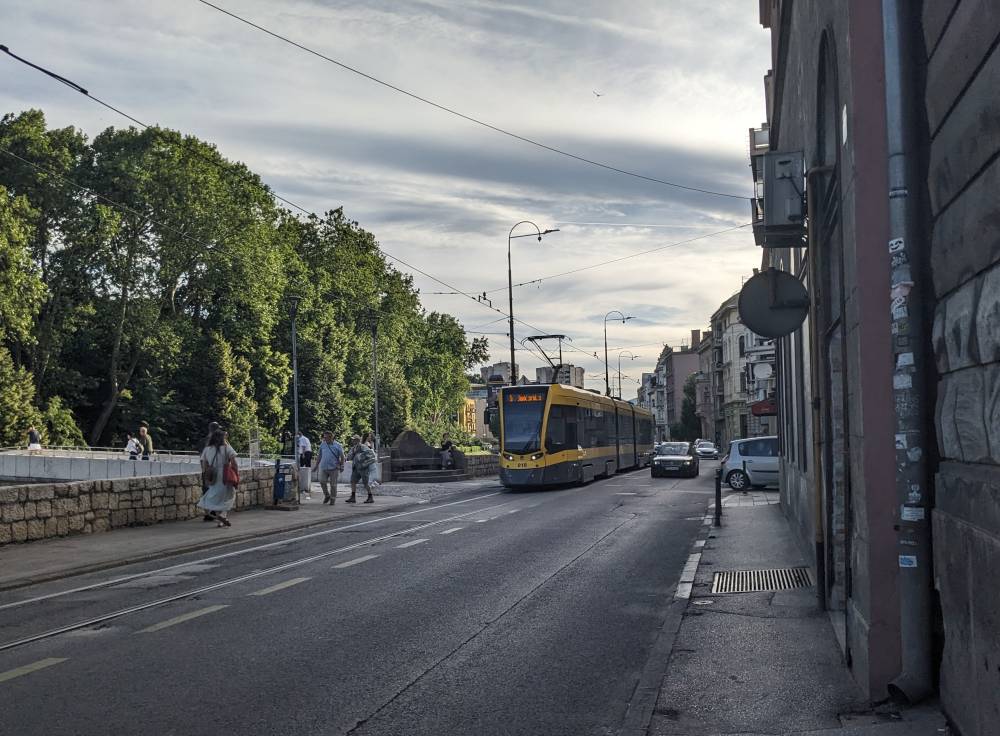
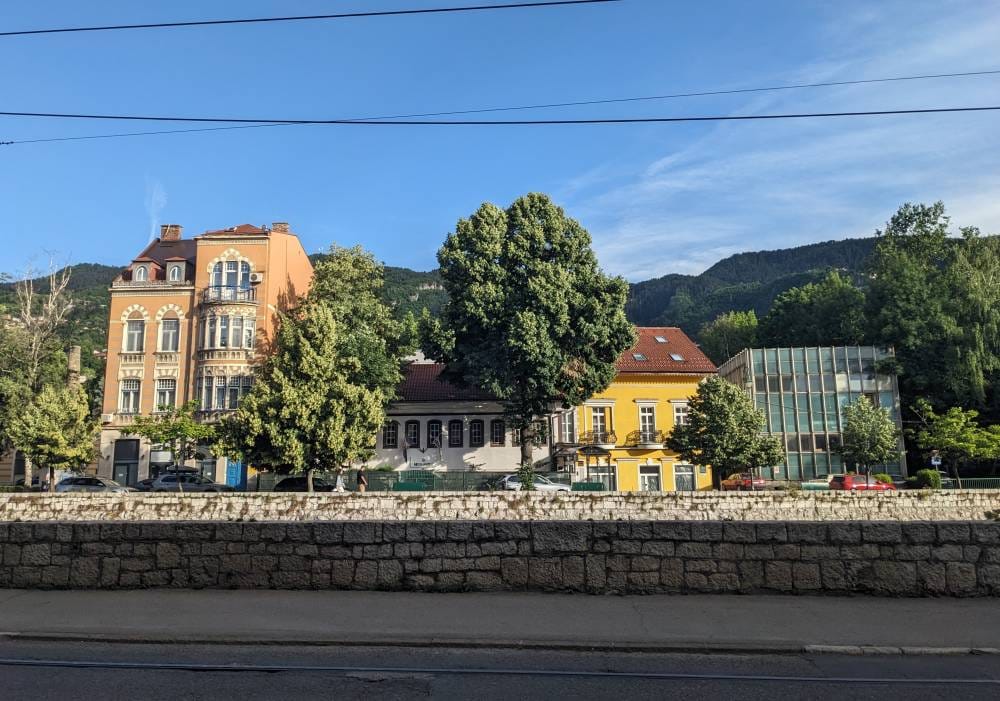
Crossing the bridge and the river, I waited for the tram to pass. Across the road were some fantastic buildings. I had put Trebević on my Google Maps. A part of me wanted to lounge in the cafes, buy that white dress, and soak in the sun, talking to the happy tourists and locals around me. Another part of me wanted to climb up the elusive mountain, away from the people, into nature, making the most of the day, returning to the town in the evening to relax and soak in the evening lights.
The route said the walk to the mountain was about two hours. I didn’t know that that day was going to become very adventurous. Trebević is the second highest mountain of BiH and can not be climbed in two hours from downtown Sarajevo.
But let me write about Trebević in another post. Hope you enjoyed this one.
Would you like to travel to Sarajevo?
MY FIRST BOOK
Journeys Beyond and Within...
IS HERE!
In my vivid narrative style (that readers love, ahem), I have told my most incredible adventures, including a nine-month solo trip to South America. In the candid book, the scoldings I got from home for not settling down and the fears and obstacles I faced, along with my career experiments, are laid bare. Witty and introspective, the memoir will make you laugh and inspire you to travel, rediscover home, and leap over the boundaries.
Sikkim Express: "Simple, free-flowing, but immensely evocative."
The Telegraph Online: "An introspective as well as an adventurous read."
Grab your copy now!
The memoir is available globally. Search for the title on your country's Amazon.
Or, read a chapter first. Claim your completely free First Chapter here.
Want similar inspiration and ideas in your inbox? Subscribe to my free weekly newsletter, Looking Inwards.