
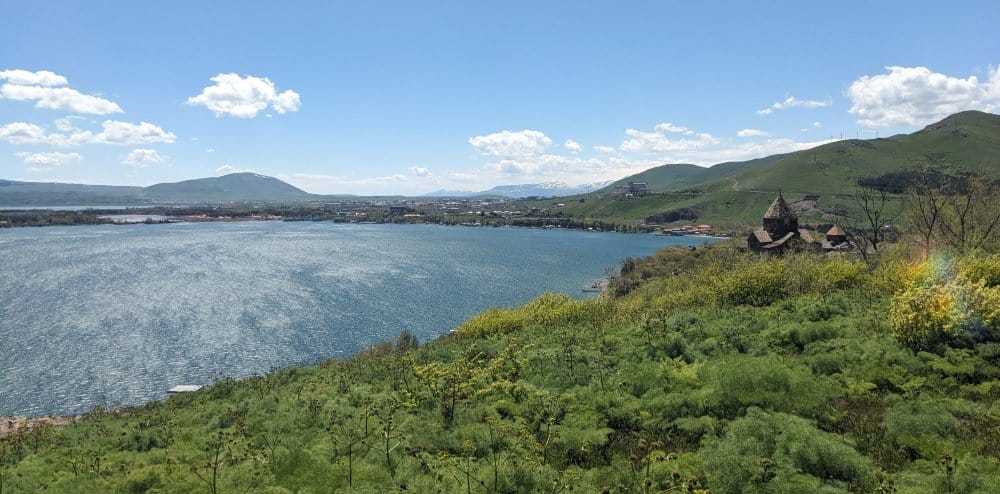
I hitchhiked to Sevan City, the biggest town on the banks of the giant freshwater Sevan Lake in the middle of Armenia, from Alaverdi in the North. The distance was 120km, and I was going down, towards the south of Armenia. First, I got a ride from the upper Alaverdi that dropped me near the bridge in lower Alaverdi. You can read about the fascinating town in the link I shared above (coming soon).
I walked in the direction of Sevan, both my bags strapped onto me. On the highway, I was picked up by two men in a small truck-van sort of thing. The guy sitting between me and the driver flirted with me all the way. He wanted me to stay back with him in Vanadzor so that he could show me the beach and take me out for a drink. I told him I had friends coming to Sevan from Yerevan and I couldn’t hang out with him. The insistence and rejection went back and forth for seventy-five percent of the ride, after which the lover gave up, the driver increased the volume of the music, and we drove on.
They dropped me further along the city, towards Sevan, luckily at a point where I could get a minibus to the outskirts of Vanadzor. My generous host Ekaterina, at whose house I had stayed in Alaverdi, was guiding me on the phone. She was the one who had told me about the minibus 1. Restless, I messaged her my location and asked if I was standing at the right stop for the minibus. The street was hot and dusty, cards sped by while I stuck out my thumb, none stopping for me, and some locals and men had started to help me, telling me how I could go and take a bus, and so on. I think an old drunk man was also trying to send me to the tourist information center.
Minibus 1 came soon. A gentle old man sitting in the front also tried to pull in my backpack when he saw me struggling to put it in. We sped, and I was quickly dropped at the other end of Vanadzor. Dzor means valley, and the drive with the two men had been beautiful.
As was the custom in Armenia, within a couple of minutes, another car driven by a lone respectful man picked me up. He was going to Dilijan, a national park city, which I was skipping.
“Too many Russians and too many ticks.” Ekaterina, my Russian-but-Armenian-at-heart host, had warned me. First, she had let me decide, but when we became friendlier, she said, “Don’t go there.”
As we drove, we passed by beautiful dreamy villages down in the valley, surrounded by fields and grassy green meadows, backdropped by icy peaks. Later, I would message Ekaterina, “What were those villages? They looked so beautiful. I felt I was missing out. I should have stayed there, probably?”
“They are historical Russian villages. From the 17th and 18th century. Belonging to some kind of religious groups in Russia. Because of the conflict with the king they left Russia and since then they have been living here in Armenia. They are like usually eco tourism villages. They have some walks over there. Pine forests. I doubt if there are places to stay there. If any, would be expensive. You could for sure visit for a day trip or so. Up to you.” She replied with an audio message and also shared their locations and names.
I wouldn’t visit them. But with the permission of the driver, I rolled down the window, gasped, and took some photos and videos.
The highway was simple and straight, and my host quiet and easy.
Close to Dilijan, he stopped the car and told me he was turning left. I got down and thanked him. Now I was on the highway. Further ahead, the road would turn right. The road to Sevan, and also to Yerevan.
As long as you have to go in the direction of Yerevan, you are good. Everyone goes to Yerevan. All the tourists and all the locals. Several travelers I met in Georgia were all heading to Armenia, all to Yerevan. All the blog posts and articles I read were about how to go from Tbilisi to Yerevan. They drove me crazy. Why would one just want to travel from one capital to another? I hadn’t liked Tbilisi that much in the limited day and a half I had to judge the city. And I wasn’t going to like Yerevan that much. All big cities, especially the capitals, are the same.
Busy expensive poor money-minded guesthouses, dusty hot roads, indifferent cold people, expensive food and groceries, big buildings, complicated transport, large overflowing dustbins, and things such as cafes, restaurants, shops that I am not interested in. Cities always make up things to keep themselves entertained.
A big car with two men stopped, and when I asked if they were heading to Sevan, the driver chided me and angrily gestured for me to get in quickly. Yerevan, I had heard. Quickly, I pushed my backpack onto the seat, climbed in, and closed the door. I was still hovering above my backpack, not seated, while the driver sped the car.
Nothing to be afraid of here. They were middle-aged men, seemed completely uninterested in me, and on the road, most people are in a hurry. They just want to go. They only asked me if I was from India, and no further questions. They were busy in their conversation and were driving fast. I had moved my bag aside and lay back in the back seat.
The driver was angry at a car that cut him off and slapped the steering wheel hard, abusing the other car. This scared me a bit, but they were not saying anything to me. I was just a passenger whom they would drop wherever it was comfortable for them. A tunnel on the way was closed, and so they had turned around the car and taken another mountainous broken road. On this empty road, the car stopped. Water, the second man asked, pointing to a spring behind us. The driver was already getting out of the car to drink.
“No no thank you.” I had my bottle with me.
This gentler, more patient man said, “Tunnel problem.”
I told him I had understood. I had. I confirmed again if they were going to Yerevan, and he said they were.
We were on the road again. I wrote on Google Translate, “I have to go into the Sevan City. You can drop me on the highway wherever it is comfortable for you.”
I had learned to say this to drivers along my hitchhiking journey. When I didn’t say this, like on the ride to Dilijan, my helpers would get confused and be a bit embarrassed about telling me to get down. I could tell by their flustered faces. They would either then drop me at their turn or just say that we had arrived and where they could drop me.
It was better to mention that I was thankful and that I was to be dropped at their convenience, not mine. My words had the opposite effect. The cars would then drop me at my favorable location. So they would drive a bit extra towards the highway, another would take my turn even if it meant they would have to go back to their location, and so on.
The same happened with this angry Yerevan car.
Back on the highway, I asked them to drop me. There were two roads going into Sevan city. We were approaching the first one. From there, I would have a long forty-minute walk to the hotel. The men were not convinced. They looked at my Google Maps and said they would drop me further, at the second turn into the city. That would be better. They knew better, of course. I sat quietly and happily. The angry impatient drivers still had time for me. I was thankful.
At the next turn, I had to remind them again. They dropped me a few minutes further on the road. I thanked them profusely and got down at light speed, throwing my backpack on the road. I didn’t want to delay them or be chided again. Or, worse, make them regret their decision to pick me up.
They sped off. They were in a hurry.
Now it was the road, the Soviet Viewing Platform, and me. The Soviet viewing platform was a weird stairway, perhaps constructed to view the lake. I am not sure. The greenish, fish-tail-shaped stone monument just stood there alone, with its stairs taking you up on a wooden deck.
My hotel was less than a two-kilometre walk, some twenty-five minutes as per Google Maps. I strode on the dusty street.
I had been dying to pee.
The houses on these streets were mostly abandoned, lonely, and some disintegrating. Walls were standing, without any roof, made of stones and bricks that had now turned black. Some were under construction, piles of mud, bricks, and cement lying around so carelessly that I wondered if anyone was even using the material. Many homes had broken windows.
Why were there so many unlived dilapidated homes? Especially towards the outskirts of the city. Two days later, while hitchhiking to a monastery on the Sevan Lake, I would take another road towards the highway. Again, I would pass abandoned shells of homes, broken windows, weeds growing all over, and blackened walls.
I reached the guesthouse Norik suggested by Ekaterina. They weren’t as I had been told. The kitchen was filthy with cups, plates, broken bread, and tea strewn all over the dining table and the counters. I had booked a double room with a balcony, but was given a twin-bed room. The old owner said they didn’t have the double room. The double bedroom lay unoccupied, its door open.
And it was cold, as Ekaterina had said Sevan would be. I made a cup of tea and was soon out to explore the city. Everything would have to do for now!
Do you ever hitchhike? Have you been to the Lake Sevan? Would love to hear from you in the comments.
MY FIRST BOOK
Journeys Beyond and Within...
IS HERE!
In my vivid narrative style (that readers love, ahem), I have told my most incredible adventures, including a nine-month solo trip to South America. In the candid book, the scoldings I got from home for not settling down and the fears and obstacles I faced, along with my career experiments, are laid bare. Witty and introspective, the memoir will make you laugh and inspire you to travel, rediscover home, and leap over the boundaries.
Sikkim Express: "Simple, free-flowing, but immensely evocative."
The Telegraph Online: "An introspective as well as an adventurous read."
Grab your copy now!
The memoir is available globally. Search for the title on your country's Amazon.
Or, read a chapter first. Claim your completely free First Chapter here.
Want similar inspiration and ideas in your inbox? Subscribe to my free weekly newsletter, Looking Inwards.