
Please note: This is the third episode in the series. Read the First here: Looking for a Home in a Wayanad Village (Kerala): Day 1, Episode 1 and the Second here: Life in a Tea, Coffee, and Betel Nut Village in Wayanad (Kerala): Day 2, Episode 2
When You Are Traveling, Don’t Expect. Be Open.
I woke up at seven and put water on the stove for my bath. Outside on the porch, I did my version of surya namaskars in front of the yellow sun that had replaced the golden moon. After washing myself, I put tea on the stove. By the time my partner, Sagar, woke up, tea was boiling. No breakfast for we had had a heavy dinner the previous night. I worked for two hours and when AB, our host, didn’t show up like the previous morning, Sagar called him.
AB came down, looking tired, accepted the previous day’s payment in cash, and to my request of lowering the price, told me I could pay him fifteen hundred. I was happy, and I guess, he was happy too. He said his mother would come clean. I nodded.
An hour later, when Sagar and I had assumed his mother would not come, AB, his sister Shobha, and their mother showed up at our door. Aunty, in a cotton gown as always, with a bucket of cleaning liquids, immediately headed to the bathroom where Sagar was showering. I had to stand in her way and tell her he was inside, taking a bath. Meanwhile, she cleaned the other bathroom, Shobha swept the floor, and AB disappeared.
The broom was collecting so much dust I was sure the house hadn’t been dusted for long. Shobha was sweeping the open surfaces. Only in the hall a bit around the beds, not under, in the kitchen, not in the pathway to the kitchen where lay a big cockroach upturned on its belly and completely dead, and not even in the rooms.
Unsure how to request her to clean a bit more thoroughly, I followed her around, sometimes removing this, at times lifting mats and carpets and covers. She didn’t mind at all. Slowly I asked her to sweep under the beds, in the room we used, and under the sofa.
“There’s a dead cockroach outside the kitchen. We’ve to get it out,” I said to Shobha.
She was perhaps older than me but looked younger. AB had said she was sweet and kind. The first evening, the way she stood at our door, leaning against it, handing me the spatulas, and telling me her cat had replied to me, she did look kind and sweet. She wore a simple top and skirt, had no make-up, and her thin hair was tied in a knot. Her eyes were glossy and limpid and her face narrow and silky.
When she looked at me, she really looked at me. As if all of her-all her beliefs, aspirations, and stirrings-were right there with me, within me. Did she meditate? I didn’t ask.
As we were finally making our way through the hall, me lifting the carpets and foot mats, Shobha asked, with that piercing gaze of hers, “You are not used to dust?”
“No. I have allergies and even my partner has allergies. Are you used to dust?” I asked, surprised by the question. For the first time, someone was asking me if I didn’t like dust.
“We are used to dust. When guests leave, we dust the floor wherever is open. We don’t do under things,” Shobha replied to my exclamation upon seeing the grime and other filth she had swept from the floor and was now struggling to throw out the door.
As she cleaned behind the doors and out on the verandah-known as thinnai in Kerala-my curiosity burst through my throat.
“Your brother tells me you are MSc in Chemistry?”
“Yeah. I used to teach in Andhra. Now I don’t.”
Shobha told me the pay in Andhra was low, she taught Chemistry to 8, 9, and 10 grades, and something about needing a B.Ed. to teach in private schools.
“And your qualification?” She asked.
“I’m a Computer Science engineer from IIT Delhi. But I don’t work in Computer Science anymore. I write now.”
Her eyes lit up. “What do you write? Novels?”
“I write a blog. I’ve just written a book that’s about to be published soon (Update 2025: The book is published now. You can get it here.). I don’t like the contract of the publisher so I might publish it myself.”
When I spoke to her about Amazon and Kindle, she said she didn’t know. I was surprised. Someone that educated and doesn’t know about Amazon or Kindle? She must be the first! I explained to her how I could publish online and so on. She seemed impressed and interested.
“I also write a little bit. Not like you. Not upto your standard but I used to write. Now I stopped. I write poetry and some other things also,” Shobha said with a shy smile.
“What do you mean by not upto my standard! Will you show some poems to me?” I asked her, hopeful.
“Yes. Will you see?” She was surprised and happy.
“Yes, of course. I’d love to see.”
Shobha agreed to bring down her poetry to me. Her frankness-her direct way of saying things-was a bit scary but also adorable. This village girl who is unmarried, writes poetry, and is cleaning our house wants to show me her work!
Soon her mother appeared out of the bathroom she had been cleaning and rushed her around. She took the broom from Shobha and started sweeping. Then she sent her to get a plastic bag for garbage.
The bathroom was, finally, a little cleaner even if the greasy substance on the floor was still there. The washbasin was clean, and the extra soaps lying around on it had been put in cabinets, away from view but not thrown.
I would see Shobha again.
In the evening, as I was frying onions for a gourd curry, she came back with her books. Sagar asked her to wait in the hall, and within a minute, she was at the kitchen door.
Peeping into the kitchen, clutching two thin notebooks, Shobha asked, “Do you think it’s a nuisance I have come?” Her eyes shone.
“No, no. I have just been in the middle of finishing this curry. If you give me two minutes, I’ll do this and be out.”
Convinced, Shobha turned around and was out of the door.
With the pressure cooker sealed, I was out of the door too. The other curry would have to wait. Parathas would have to wait.
Facing the coffee estate, we sat on two plastic chairs outside the house and asked many things about each other.
“Why did you leave work and shift to writing? You must have to think so much, come up with so many things.”
“Coming up with so many things is easy. That comes natural to me. I was sad in the jobs. But I like writing.”
Shobha opened her notebook, her poems unfurling in front of me in her cursive handwriting. She skipped over the Malayalam ones and stopped at a poem on history, her dry and dark, thin and long fingers clutching the diary page. The pressure cooker whistled. She said, “I write about my emotions, too,” and took me to poems on loneliness and another about a mother talking about her child.
Her poems were as simple, direct, and honest as herself. Her purpose was to write them, not to show them.
I wanted to know more about what Shobha thought of loneliness. Not every day do you meet a girl writing about such an intimate, and infamous, emotion. She gave me the answers.
When Shobha felt lonely, she did nothing. She didn’t try to connect to a friend. She didn’t watch television.
Shobha said, “I can be happy even in loneliness. I’m happy in loneliness. I’m okay.”
Even though I wasn’t as sure as her, I replied, “I’m happy in loneliness too. We can he happy and lonely at the same time.”
“Yeah,” she replied with such vigor as if she had discovered the secret of life and just now discovered someone to share it with too.
But the people around her didn’t let her be, she told me without asking. They thought there was some problem with her because she had broken the social barriers. Shobha was more than forty and unmarried, a blasphemy in Indian society.
“They can’t let a woman be. They want the same things from everyone. They can’t see different. They keep saying things about me.”
“I can imagine. It is the same everywhere in India. When I wasn’t married, everyone bothered me too. Now it’s better.”
“All they care about is money. Malayalis are money-minded,” she added.
“People in North India are also the same. Making money to put in business to make more money.”
“Like my father,” she laughed. “Always thinking of money.” (Only if everyone had read The Little Prince.)
As we talked about her poems, the books of Madhavikutty, and that she will go back to her job in two years because of “some reasons,” the golden moon came up behind the trees. It was almost full. The birds chirped for one last time, and we sat like old friends side by side, her poems in my palms. Shobha kept asking me if I wanted to read more and when I replied yes, she asked, “Tell the truth.” Her direct way of speech caught me red-handed. I was getting tired, and the dinner was yet to be made. But I still didn’t admit that I wanted to pause.
A few minutes later, Shobha said she wanted to go. We said goodbyes with the promise that she would show me around her father’s coffee estate the next day.
“What time will we go?” We were checking out the next day and planned to cook extra to take away. Then there was packing and writing to be done too.
“Whenever you want.”
“How will I call you?” I asked her.
“Just call me from downstairs. I’ll hear, and I’ll come.”
“You don’t have a phone?”
“No. My brother’s wife ran away with my phone, laptop, and gold chain. She said, ‘Shobha please let me wear the chain. Let me have the laptop to work. Please can I use your phone, mine doesn’t work.’ Then she disappeared with all of it. My brother has been trying to find her.”
“Wow! I’ve never heard anything like this.”
“We found out that she has done the same in many homes. I gave her everything, and she took it all away.” Shobha smiled.
“You’ll hear me from downstairs?”
“Yeah, just say Shobha, Shobha.”
Some people told me that writing an autobiography like this, with absolute honesty, keeping nothing to oneself, is like doing a striptease. True, maybe. I, will, firstly, strip myself of clothes and ornaments. Then I intend to peel off this light brown skin and shatter my bones. At last, I hope you will be able to see my homeless, orphan, intensely beautiful soul, deep within the bone, deep down under, beneath even the marrow, in a fourth dimension …
Madhavikutty, or Kamala Surayya, as she wrote in her autobiography in Malayalam, Ente Katha
Have you met someone on your travels who showed you afresh what it is like to be a human being?
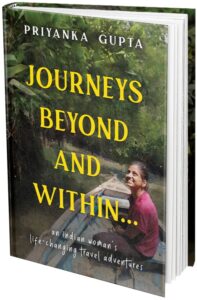
MY FIRST BOOK
Journeys Beyond and Within...
IS HERE!
In my vivid narrative style (that readers love, ahem), I have told my most incredible adventures, including a nine-month solo trip to South America. In the candid book, the scoldings I got from home for not settling down and the fears and obstacles I faced, along with my career experiments, are laid bare. Witty and introspective, the memoir will make you laugh and inspire you to travel, rediscover home, and leap over the boundaries.
Sikkim Express: "Simple, free-flowing, but immensely evocative."
The Telegraph Online: "An introspective as well as an adventurous read."
Grab your copy now!
The memoir is available globally. Search for the title on your country's Amazon.
Or, read a chapter first. Claim your completely free First Chapter here.
Want similar inspiration and ideas in your inbox? Subscribe to my free weekly newsletter, Looking Inwards.