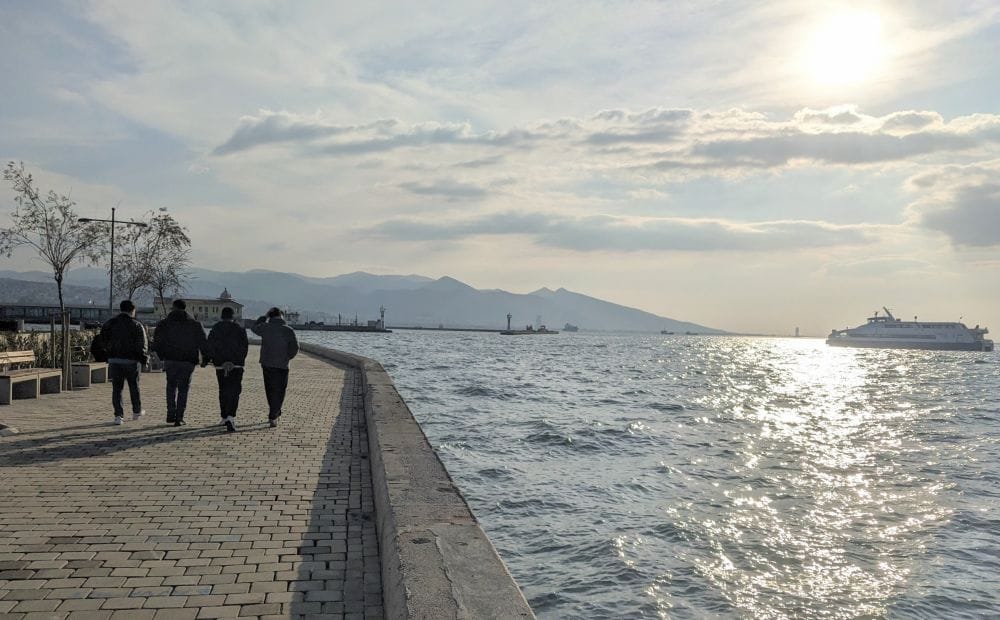
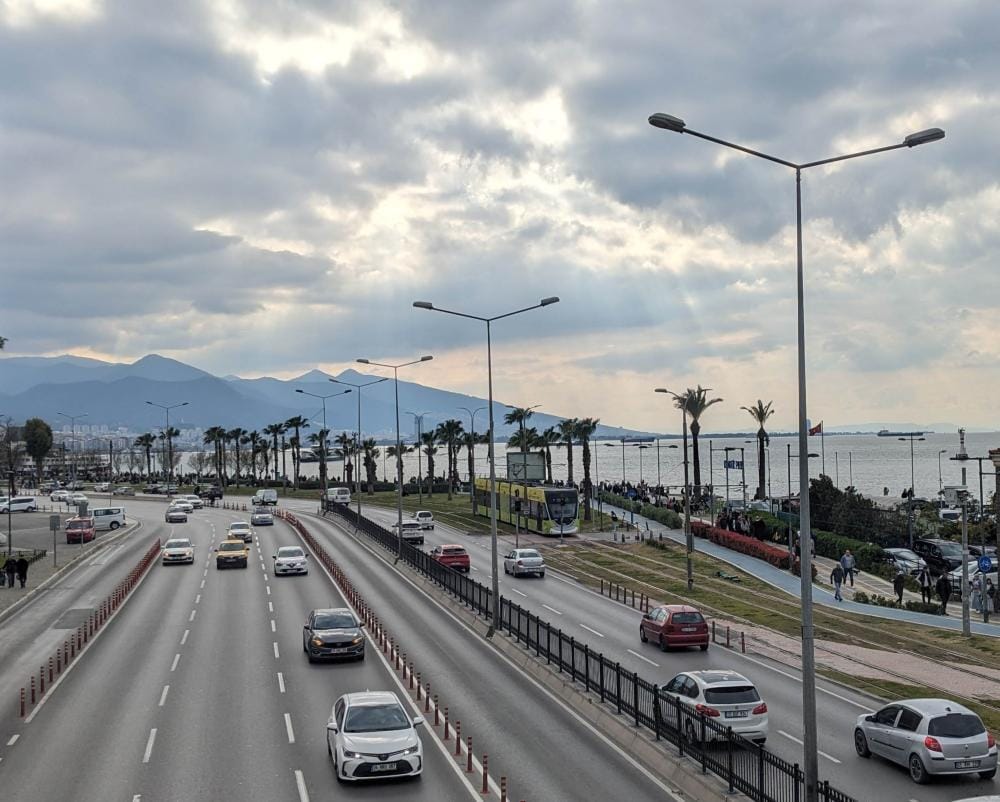
Things To Do in Izmir, Turkey (If You Could Ever Leave the Seaside)
On Sunday, my first day in Izmir, I was awake at 8:45 am. I went to the toilet quickly, showered, and got ready. I scanned the receipts from Dubai to send to my travel insurance company (you can read the story in the linked piece). Everyone in the house, which meant my host Mohammed, his cat, and his friend, whom I hadn’t met, were still asleep.
Mohammed probably woke up at 10 but stayed in bed for another hour and eventually came to ask me if I would like Turkish coffee. I was scanning documents, which I continued to do after coffee. Over that big cup of delicious Turkish coffee, we talked. He said he would go to the market to get some things for breakfast. I offered to go too, but I think he felt it would be a waste of time. Before heading out, he took out a few tomatoes, olives, mushrooms, and a cucumber from the fridge. I told him I would chop the vegetables.
Mohamed went to the supermarket, and I continued to put together the insurance things. When he returned, I chopped the tomatoes and mushrooms, and he cooked them with eggs. He had also brought halloumi cheese, which he grilled. He heated the Turkish bread bibit in a sandwich press and made two big cups of tea, too.
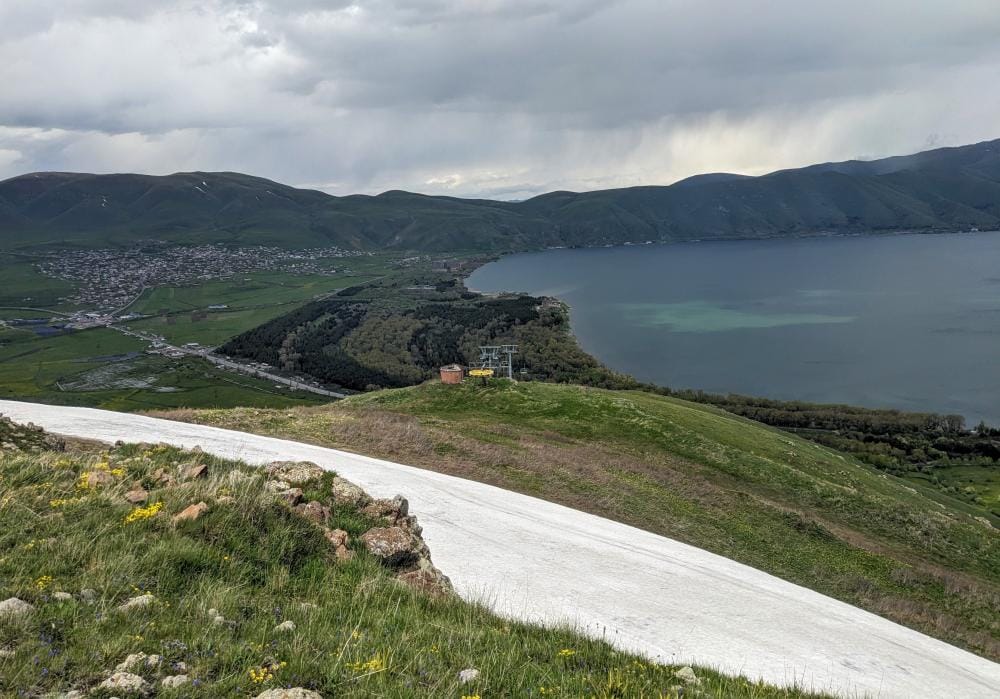
Lake Sevan in Armenia: A Hike to Nothing to See, an Icy Path, and a Headache of a Hitchhike
On my second day in Sevan, I hiked a long way to see nothing. Ekaterina, my first host and self-appointed guide in Armenia, had suggested hiking to a place called Akhtamar. I hadn’t asked what was there to see.
In the morning, I made a cup of coffee and researched flights and visas for the Balkan countries. I had only twenty days in Armenia, and given my horrible experience at the Georgia immigration, I didn’t want to go back to Georgia. I had also seen the country enough and didn’t want to explore more. Armenia is land-blocked by Turkey and Azerbaijan. Iran was at war. So the idea was to go to the Balkans. As per my research, I could visit four countries without needing an additional visa. My US visa would work. (It did work. I flew to Sarajevo from Yerevan.)
I messaged Ekaterina. “Hey! One last question. Good morning. I woke up so late. Do you remember how long it takes to Akhtamar, the place you suggested? I will start probably at 12/1 the latest. Not sure if I will have enough time then!”
“I think it’s doable. But you can always go back down too. It’s 8 km up with an elevation gain of 600, so about 2.5-3 hours, plus 3 km of descent to the Akhtamar place, so maybe 1.5 hours there. And some additional time for hitchhiking back. Or you can just walk up until you find a place where you want to stop and turn around and walk back into the town.” Ekaterina was always direct about everything.
I wrote most of this piece about taking a bus from Istanbul to Izmir City in Turkey as it all happened. Sharing it here as it is. I also added a part about the host in Izmir after I arrived in the city. Enjoy!
Leaving Istanbul, Taking a Bus From Istanbul to Izmir, and a Great Welcome Dinner in Izmir by a Couchsurfing Host
Today morning started at seven am. After the long laundry confusion (with a Couchsurfing host in Istanbul), I had gone to bed at almost 11:45 pm. A little more here and there and another toilet run, I put in my earplugs and tried to sleep. Earplugs because the dryer was still running. The host’s clothes, which he had asked me to wash in the machine, weren’t dry yet. I didn’t think they would dry at all with that pathetic dryer, which wasn’t working. The host had still not returned, so some lights were on too, but I couldn’t care too much. I covered myself with a blanket, and then you can hardly see any light. The couch was big and comfortable, and I was adamant about spending six to seven hours in bed (which was the couch). My bus in the morning was at 9:20 am. I had had a long cold and wet day out at the Basilica Cistern. Finding some vegetarian food and also the long way back had tired me out.
I looked at my clothes on the chairs. They were all wet, almost as wet as they had come out of the machine. My leggings and bag, which I had kept near the radiator, were dry. I should have put all the clothes next to the radiator. They would have looked too odd, though. All shirts, leggings, and undergarments wrapped around the radiator. No. No. We’ll see in the morning.
In the morning, I put a few more clothes on the radiator and removed the ones that had dried. Thankfully, I had clothes to wear. My leggings and jackets had dried. I went to the toilet and messaged this dryer story to my partner, Sagar. “I don’t know why he asked me to use the dryer when it doesn’t work. He knew I had to leave. Now I have to carry wet clothes. He asked me to wash his clothes, too. It was a huge pile.” Still grumpy, I boiled the kettle, started packing my clothes, and put my laptop on the charger. You need to be well planned for the day.
Time passes slowly when you have nowhere to go, but quickly when you have to be somewhere. I packed all dry clothes in one pack and made one empty for the wet ones. I signed a copy of my book for my host and sipped hot coffee, thinking that if I had to go to the toilet, I’d better go now, and not when I am on the bus. Right after eight, I went to shower, carrying all the clothes that I had to wear. My host had woken up too, and I had to get ready in the bathroom. I didn’t finish my coffee. I had to get ready.
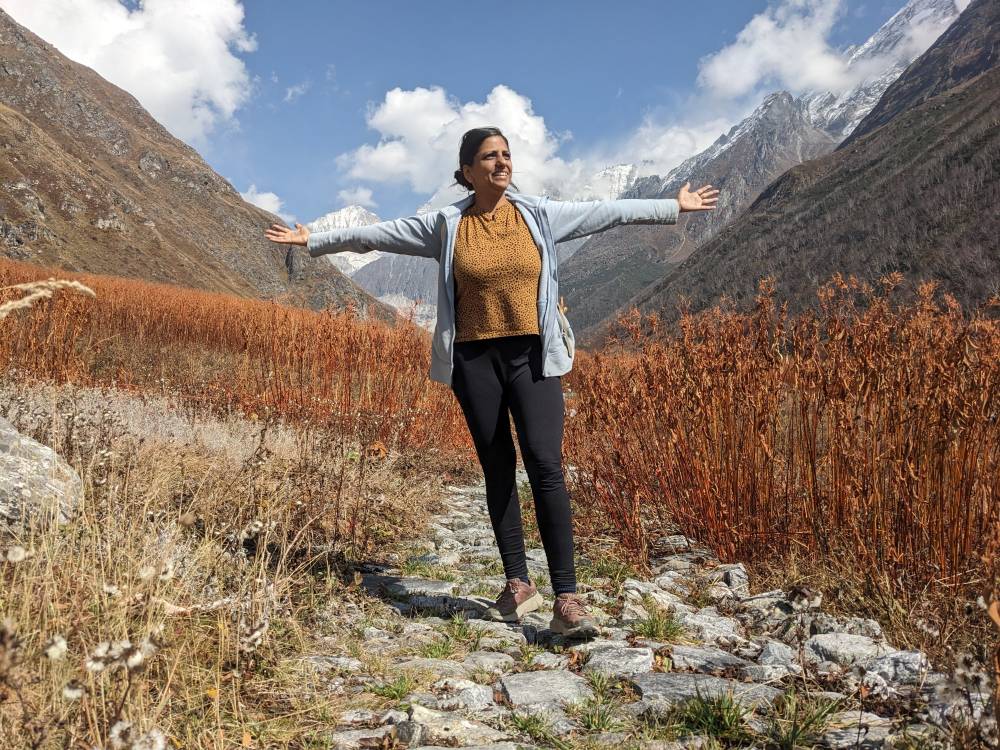
Hanging out with villagers, Wandering Around Apple Farms, Climbing Into Pine Forests, and Drinking Wine under Starry Skies in Chindi, Himachal Pradesh
The government guesthouse in Chindi, Himachal Pradesh, was located on the brow of a hill. Below the guesthouse and further ahead and behind it, the village sprawled. We checked in at two pm. Our room was Set 1.
The PWD (Public Works Department) guesthouse caretakers hadn’t received a call from their superintendent regarding our booking. They thought there was no booking. All the staff, all men, were sitting on fixed wooden chairs that seemed to have been carved out of tree trunks right at their place under a giant Chinar tree.
Okay, so let’s set it straight. Some of the below things happened in Udaipur.
A man stalked me; it doesn’t happen in all Indian cities, though I wouldn’t say this kind of thing never happens. A friendly banter is often interpreted as a desire for something more. In Udaipur, I had bought a blue and yellow georgette sari that had been hanging outside a shop. Its colorful flutter had caught my eye as I returned from an exploration of one of the best places to see in Udaipur (Rajasthan). I spoke with the shopkeeper casually, and when I left the shop, he was following me on his bike, having shut his store, calling out to me as if I was waiting for him to take me to a fort and show me a molten yellow sunset.
I also climbed, no scrambled up, a very muddy hill. It was the Karni Mata Temple hill, or the Machla Hills, on which the temple is located. Though a ropeway climbs to the temple from Udaipur city, at that time, it was closed. I took a staircase to the temple. But, I think, after following the stairs for a while, I had taken a shortcut, a mud path, as is expected of me. As it hadn’t rained in Udaipur for months, the path was dry, my feet slipping.
The staircase I had taken from Manil Lal Park to Karni Mata temple in Udaipur
the muddy path, which I eventually always find
I had arrived at Karni Mata temple’s back gate, which was closed. So I had to maneuver around. In ten minutes or so, a well-dressed straight-postured young man, who introduced himself as a royal family staff (maybe someone important, perhaps a young son’s friend) said he had come to get me. The guard who had refused to unlock the back gate for me had apparently called him. He, the son, not the guard, was courteous and concerned. “Ma’am how did you reach here?” He watched me curiously.
I felt slightly odd to be called ma’am by him, a guy who supposedly had come from the fort or the palace and who said all the royal family members were scheduled to do a puja in the temple later that day. I don’t remember all of it, but he was saying that it wasn’t safe for me to be up there alone in the evening.
For eight years, I haven’t woken up a day thinking I had nothing to do. You must have heard of, “Hey, my project is over. We are celebrating. Now onto new things!” I could never say this. I can exclaim these words after publishing every blog post, but I don’t feel like it. My project is understanding and documenting the act of being alive, and it is never over, until it is over.
I also always have more than enough to write because for almost five years my partner, Sagar, and I have been living nomadically in India. We don’t have a home, our stuff is in our car, Scooby, and we have been traveling slowly. In June 2025, we parked Scooby at Sagar’s parents’ home in North India. Now we have been traveling with our backpacks (Here are my best travel resources).
Seven Years as a Full-Time Writer, four of which I have spent on the road
On My Canvas turned seven in August. I couldn’t publish a post on its anniversary. As I’ve repeated in my newsletter Looking Inwards, a big project kept me busy. Soon that project will be out in the world and see the sun. Until then, I’m here to write about these seven years of full-time writing.
Along with the blog, I have freelanced, written poems, penned down stories, and so on. I’ve been on the road for four of those years, with all my things in the car. Yeah, my partner has been with me, too. I’m sure you have read about our itinerant journey in this massive post.
Leaving Behind a Forest to Get Into Another One: Finding Accommodationin Wayanad (Kerala)
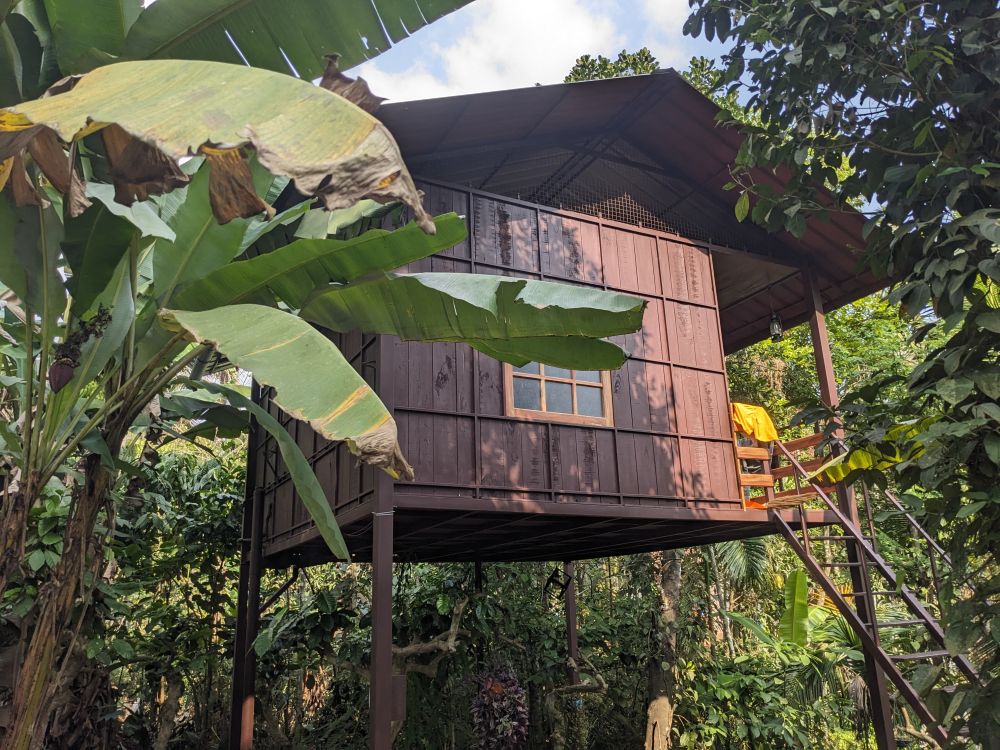
As I said in the post on the Wayanad Wildlife Sanctuary, I wasn’t happy leaving the 100-year-old sylvan cottage that was my home for three days.
The last morning in the Sanctuary’s forest stay was-let’s just say-not easy on me. The previous night, my partner, Sagar, and I finished a bottle of whiskey. In the morning, I showered, and we took a jungle safari. Mommy elephants and baby elephants crossed the road ahead of us. My joy was a little subdued. After the safari, which ended at eight, I packed the rest of the things, brushed, walked, had tea, and wrote for more than an hour.
Please note: This is the fourth episode in the Wayanad series. Here’s the First, Second, and the Third.
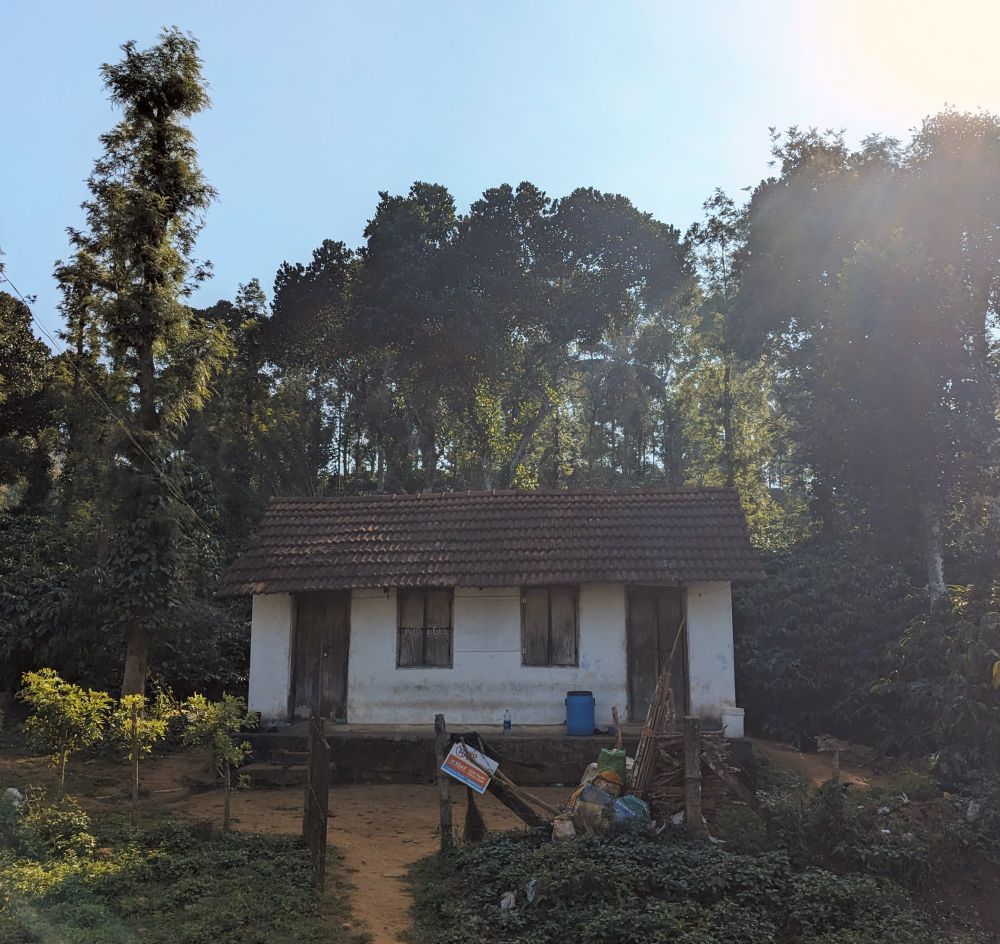
Saying Goodbye to My Home in the Coffee Village in Wayanad
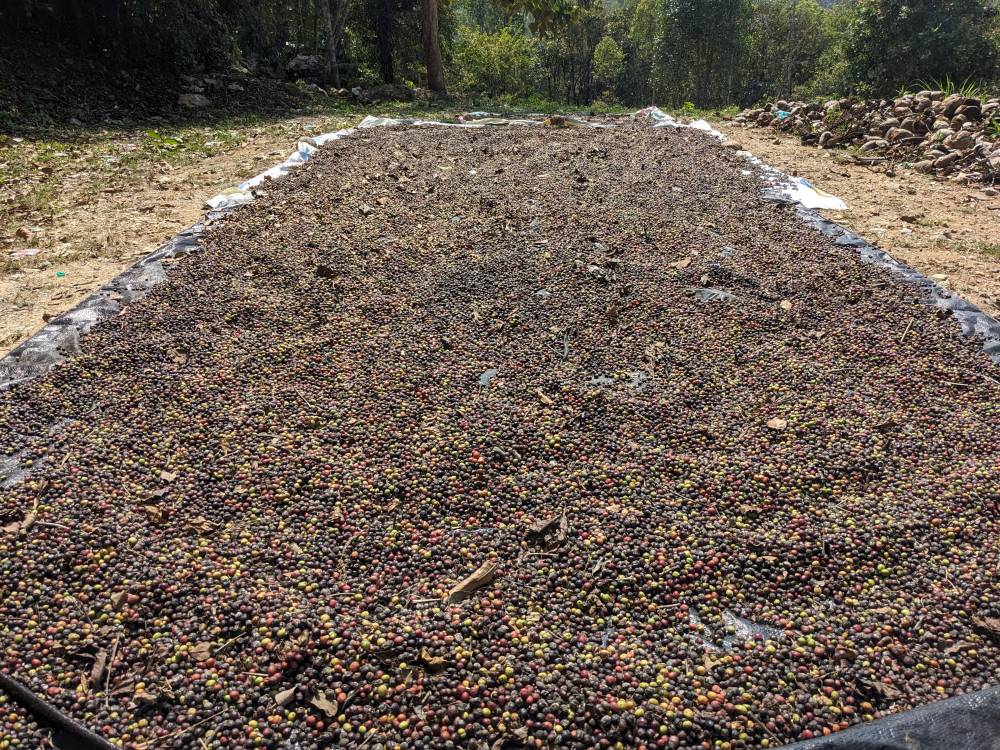
I woke up at 7:45, showered, and made breakfast: onion parathas and tea. We had to check out of the homestay. Every raw vegetable was to be made and everything to be packed. I did the dishes, cleaned the kitchen, and heated the dinner leftovers. The food was on the table all night. There was no fridge. I boiled potatoes and washed okra. My partner, Sagar, and I walked around on the porch facing the estate, finally sitting down for a bit. By 11:30, I started to work. Just an hour and a half and then I’ll finish the rest of cooking. Sagar was working, too. He would do all the packing. I would wrap up all the food things. At 1, I got up and strolled around a bit. From the porch, I called, “Shobha, Shobha,” as she had asked me to do the previous evening.
I woke up at seven and put water on the stove for my bath. Outside on the porch, I did my version of surya namaskars in front of the yellow sun that had replaced the golden moon. After washing myself, I put tea on the stove. By the time my partner, Sagar, woke up, tea was boiling. No breakfast for we had had a heavy dinner the previous night. I worked for two hours and when AB, our host, didn’t show up like the previous morning, Sagar called him.
Please note: This is the second episode in the series. If you haven’t read the first, get it here: Finding a Home in a Village in Wayanad (Kerala): Day 1, Episode 1 A Regular Day of Two Travelers in a Tea, Coffee, and Betel Nut Village in Wayanad Day 2 We slept well and woke …
My Mysore Travel Guide-Visiting the Places to See in Mysore City for a Week
After checking out of a tiny room in a peculiar highway hotel outside Mysore (also known as Mysuru), my partner, Sagar, and I took deep breaths.
“I’m so relaxed after getting out of that place. We shouldn’t have stayed there for three nights,” I said, thinking about how the sleepy hotel staff had looked at us in shock when we had returned to the hotel after lunch. Rubbing his eyes, the receptionist had asked, “You didn’t go sightseeing?” without even unlocking the main gate which he had locked from inside. Sagar and I had waited on two tiny iron chairs in the airless lobby while the housekeeping woman haphazardly cleaned our room, leaving the garbage as is, the bed unmade, and damp towels lying in a coil. Then I squeezed onto the tiny desk in the corner, and Sagar managed to work from the bed.
As if broken from a reverie, Sagar replied, “Yeah, like a weight is lifted off my head.”
When we drove to a highly-praised dosa eatery (and on top of the list of places to visit in Mysore) in downtown, the hotel room was already a thing of the past. Watching the Mysuru city go by us, we discussed our options. Either we could look for a good hotel in the city centre near the important historical places, Mysore being the the capital of the Kingdom of Mysore from 1399 to 1947, or drive further on. Our eyes were on Kerala.
I had traveled from Bangalore to Mysore with my parents thirteen years ago and visited the main places to see in Mysore city: the Mysore Palace, the city zoo, Vrindavan Gardens et cetera. Sagar also didn’t care much about exploring every nook and corner of Mysuru. We had been to Ranganathittu Bird Sanctuary (Karnataka) twice. Just a day earlier, we had strolled around an unmarked dam and lake near Mysore, spotting hundreds of migratory birds (We visited that lake from the highway hotel. Though it’s not on any list of places to visit near Mysore, it should be. Hint: Look for blue stretches around Mysuru and explore slowly.)
“Let’s see how we feel after breakfast,” we said to each other.
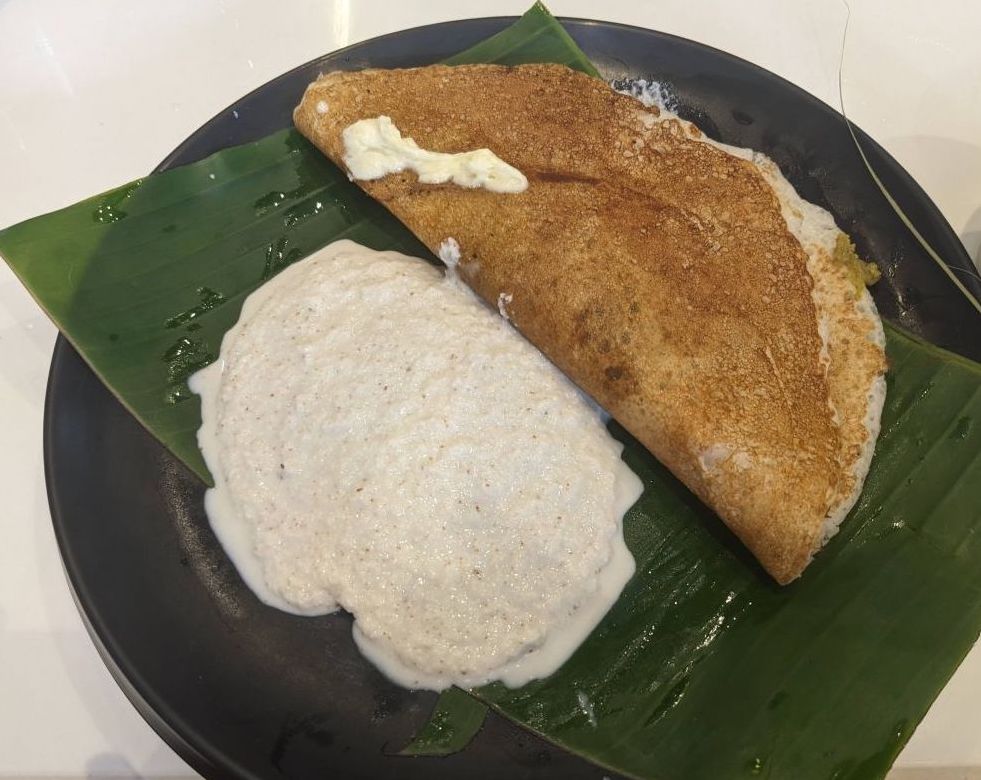
The quintessential dosa, Mysuru City, Karnataka
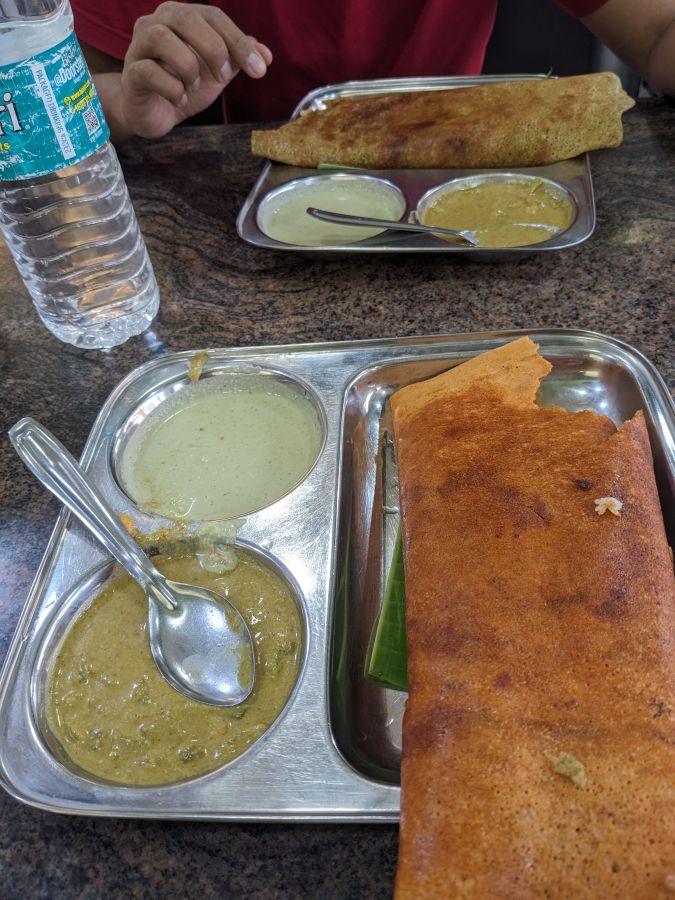
The masala dosa was a bit limp, not like the super crispy Karnataka dosa I was expecting. The place was, sadly, overhyped.
After tea, we sat under a tree on the dusty road, planning our day. Sagar had taken the day off, given how impromptu we were being.
“Do you want to drive to Bandipur or Nagarhole National Park today?” He asked, as we had been asking each other since morning.
“No. I’m so tired I don’t think I can drive today. It’s a long drive. And I don’t think even you’re up for driving for long hours.” I rubbed my eyes which had suddenly become heavy, as if wanting to close.
“No, I’m not.” He replied, his eyes tired.
“Let’s look for a hotel and stay.” After the dosa, my body had slowed down, screaming for rest and sleep. Imagining myself lying down on a bed was bringing immense relief.
We both started browsing Google Maps for good places to stay in Mysore. He was looking at hotel websites.
Finding guest homes and family stays in India for three years, we are both wary of accommodations. Some hosts don’t clean, many don’t provide drinking water, others are noisy or intruding, and so on. Somewhere staff doesn’t care, other places don’t have parking, and sometimes the toilet doesn’t flush. I can filter out well-reviewed properties only by a few red flags that I know would be unbearable in reality.
I found Mannar, a hotel with a 4-star rating (after hundreds of reviews). None of its reviews said dirty, uncaring staff, noise et cetera. One or two poor reviews where the experience might have been spoiled due to a one-off reason didn’t worry me. Parking was mentioned.
We didn’t call. Fifteen minutes later, we squeezed into a narrow, busy street and parked outside the Mannar hotel across from a dung-smeared cow munching grass from a round stone trough.
For more than eight years, I've read and written night and day to make On My Canvas—my sustenance and life's focal point—a place of inspiration, trial, adventure, and happiness. Everything here and my weekly newsletter, Looking Inwards, is free. No AI. No ads. No paywalls. No sponsors. No paycheck.
If my blog has served you in any way, please consider making a one-time or a consistent donation. Your generosity will not only support the idea that we can create a life of our choice but also sustain good-quality free writing online. I'll be thankful forever.