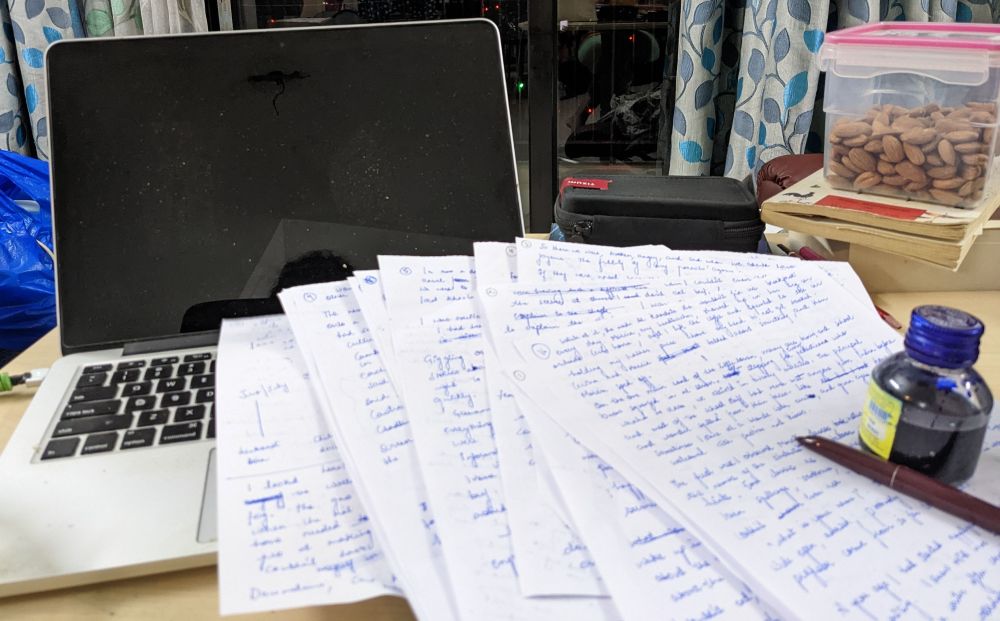
How to Edit a Memoir I am assuming you have the first draft of your memoir. I have written about writing the first draft of my travel memoir, sharing my experience. The main thing one needs to do to write the first draft is to write it. To not edit it, to not overthink it, …
In 2016, I took out my old grey and rusted brown backpack, Rusty, from the cupboard where it had been for the last three years. I was traveling to Chile to teach English as part of a volunteer program. As I was going for at least six months, I packed Rusty, a small wheeled suitcase, a laptop bag, and a black leather purse.
The four-month volunteer program was over soon. It was time to set sail for my longer backpacking trip through South America. With some push from my travel friend Alison, who also happens to be a backpacking genius, I accepted that Rusty wasn’t the best backpack after all.
Okay, so let’s set it straight. Some of the below things happened in Udaipur.
A man stalked me; it doesn’t happen in all Indian cities, though I wouldn’t say this kind of thing never happens. A friendly banter is often interpreted as a desire for something more. In Udaipur, I had bought a blue and yellow georgette sari that had been hanging outside a shop. Its colorful flutter had caught my eye as I returned from an exploration of one of the best places to see in Udaipur (Rajasthan). I spoke with the shopkeeper casually, and when I left the shop, he was following me on his bike, having shut his store, calling out to me as if I was waiting for him to take me to a fort and show me a molten yellow sunset.
I also climbed, no scrambled up, a very muddy hill. It was the Karni Mata Temple hill, or the Machla Hills, on which the temple is located. Though a ropeway climbs to the temple from Udaipur city, at that time, it was closed. I took a staircase to the temple. But, I think, after following the stairs for a while, I had taken a shortcut, a mud path, as is expected of me. As it hadn’t rained in Udaipur for months, the path was dry, my feet slipping.
The staircase I had taken from Manil Lal Park to Karni Mata temple in Udaipur
the muddy path, which I eventually always find
I had arrived at Karni Mata temple’s back gate, which was closed. So I had to maneuver around. In ten minutes or so, a well-dressed straight-postured young man, who introduced himself as a royal family staff (maybe someone important, perhaps a young son’s friend) said he had come to get me. The guard who had refused to unlock the back gate for me had apparently called him. He, the son, not the guard, was courteous and concerned. “Ma’am how did you reach here?” He watched me curiously.
I felt slightly odd to be called ma’am by him, a guy who supposedly had come from the fort or the palace and who said all the royal family members were scheduled to do a puja in the temple later that day. I don’t remember all of it, but he was saying that it wasn’t safe for me to be up there alone in the evening.
My Best Books on How to Write a Book: I Read These While Writing My 1st Travel Memoir
Not all the best books on how to write a book carry this tagline. So many titles, such as Bird by Bird or On Writing, fall directly into the list of best books about writing books. The other books for writers that I have dared to add here are those that have nurtured my growth as a human and a writer for over eight years. These titles aren’t promoted as the best books for writing, but by being so amazing and wholesome, they have slowly guided me along while I wrote my first book, one page, one day, and one breath at a time.
I had written about writers often drinking from the common wellspring of the greatest writing ever written in my favorite books from 2022. I have drunk the books listed here. While reading them, the book had become me, I was her, and everything else ceased to exist.
That afternoon when I learnt to bike and couldn’t believe what I was doing, or when I saw the Himalayas for the first time and was stunned by the pure mountains (more details in my book), and life had grown exponentially larger from what it had been in moments, these books have enlarged my life, too.
A lot of books have changed my life. The Little Prince and Zen and the Art of Motorcycle Maintenance also belong to the same category. I am not including them here. This list of the best books on writing books is limited to those that directly helped me write better, especially travel and nonfiction, my travel memoir to be precise, made me see how to edit a nonfiction book, inspired me to write and keep pursuing art no matter the outcome, allowed me to feel what I was feeling as a lone writer at work might, and some are science books that enhanced my understanding of the human organism. To write about our species, we should understand the physics of our species.
Not a list is perfect, and not a list is suited to everyone. But this is mine. These titles run with my blood. They sit in my stomach. They shape each word my fingers type and my pen inks.
Enjoy my best books for creative writers. I hope that some of these storm you and cradle you as they have me.
For eight years, I haven’t woken up a day thinking I had nothing to do. You must have heard of, “Hey, my project is over. We are celebrating. Now onto new things!” I could never say this. I can exclaim these words after publishing every blog post, but I don’t feel like it. My project is understanding and documenting the act of being alive, and it is never over, until it is over.
I also always have more than enough to write because for almost five years my partner, Sagar, and I have been living nomadically in India. We don’t have a home, our stuff is in our car, Scooby, and we have been traveling slowly. In June 2025, we parked Scooby at Sagar’s parents’ home in North India. Now we have been traveling with our backpacks (Here are my best travel resources).
The publisher needed book ideas, and when we had ideas, she needed chapter skeletons. So, all the possible chapter titles we could have in the book. This is for them to confirm if we synced over our understanding of the memoir. For two months we went back and forth, discussing what I could expect from the publisher and what they would need. Some major terms of the contract, such as no advance, 8.5% something royalty, etc., were told to me. I thought those are things we will discuss when we come to the book. For now, I have a book to write.
Seven Years as a Full-Time Writer, four of which I have spent on the road
On My Canvas turned seven in August. I couldn’t publish a post on its anniversary. As I’ve repeated in my newsletter Looking Inwards, a big project kept me busy. Soon that project will be out in the world and see the sun. Until then, I’m here to write about these seven years of full-time writing.
Along with the blog, I have freelanced, written poems, penned down stories, and so on. I’ve been on the road for four of those years, with all my things in the car. Yeah, my partner has been with me, too. I’m sure you have read about our itinerant journey in this massive post.
Leaving Behind a Forest to Get Into Another One: Finding Accommodationin Wayanad (Kerala)
As I said in the post on the Wayanad Wildlife Sanctuary, I wasn’t happy leaving the 100-year-old sylvan cottage that was my home for three days.
The last morning in the Sanctuary’s forest stay was-let’s just say-not easy on me. The previous night, my partner, Sagar, and I finished a bottle of whiskey. In the morning, I showered, and we took a jungle safari. Mommy elephants and baby elephants crossed the road ahead of us. My joy was a little subdued. After the safari, which ended at eight, I packed the rest of the things, brushed, walked, had tea, and wrote for more than an hour.
Please note: This is the fourth episode in the Wayanad series. Here’s the First, Second, and the Third.
Saying Goodbye to My Home in the Coffee Village in Wayanad
I woke up at 7:45, showered, and made breakfast: onion parathas and tea. We had to check out of the homestay. Every raw vegetable was to be made and everything to be packed. I did the dishes, cleaned the kitchen, and heated the dinner leftovers. The food was on the table all night. There was no fridge. I boiled potatoes and washed okra. My partner, Sagar, and I walked around on the porch facing the estate, finally sitting down for a bit. By 11:30, I started to work. Just an hour and a half and then I’ll finish the rest of cooking. Sagar was working, too. He would do all the packing. I would wrap up all the food things. At 1, I got up and strolled around a bit. From the porch, I called, “Shobha, Shobha,” as she had asked me to do the previous evening.
I woke up at seven and put water on the stove for my bath. Outside on the porch, I did my version of surya namaskars in front of the yellow sun that had replaced the golden moon. After washing myself, I put tea on the stove. By the time my partner, Sagar, woke up, tea was boiling. No breakfast for we had had a heavy dinner the previous night. I worked for two hours and when AB, our host, didn’t show up like the previous morning, Sagar called him.
Please note: This is the second episode in the series. If you haven’t read the first, get it here: Finding a Home in a Village in Wayanad (Kerala): Day 1, Episode 1 A Regular Day of Two Travelers in a Tea, Coffee, and Betel Nut Village in Wayanad Day 2 We slept well and woke …
For more than eight years, I've read and written night and day to make On My Canvas—my sustenance and life's focal point—a place of inspiration, trial, adventure, and happiness. Everything here and my weekly newsletter, Looking Inwards, is free. No AI. No ads. No paywalls. No sponsors. No paycheck.
If my blog has served you in any way, please consider making a one-time or a consistent donation. Your generosity will not only support the idea that we can create a life of our choice but also sustain good-quality free writing online. I'll be thankful forever.