
A Noisy Day in the Ranganathittu Bird Sanctuary, Karnataka: A Road Trip From Bangalore
We went on a one day drive to the Ranganathittu Bird Sanctuary: one of the coolest places in Karnataka and one of the best places to visit near Mysore. And I was overwhelmed by the sanctuary’s beauty.
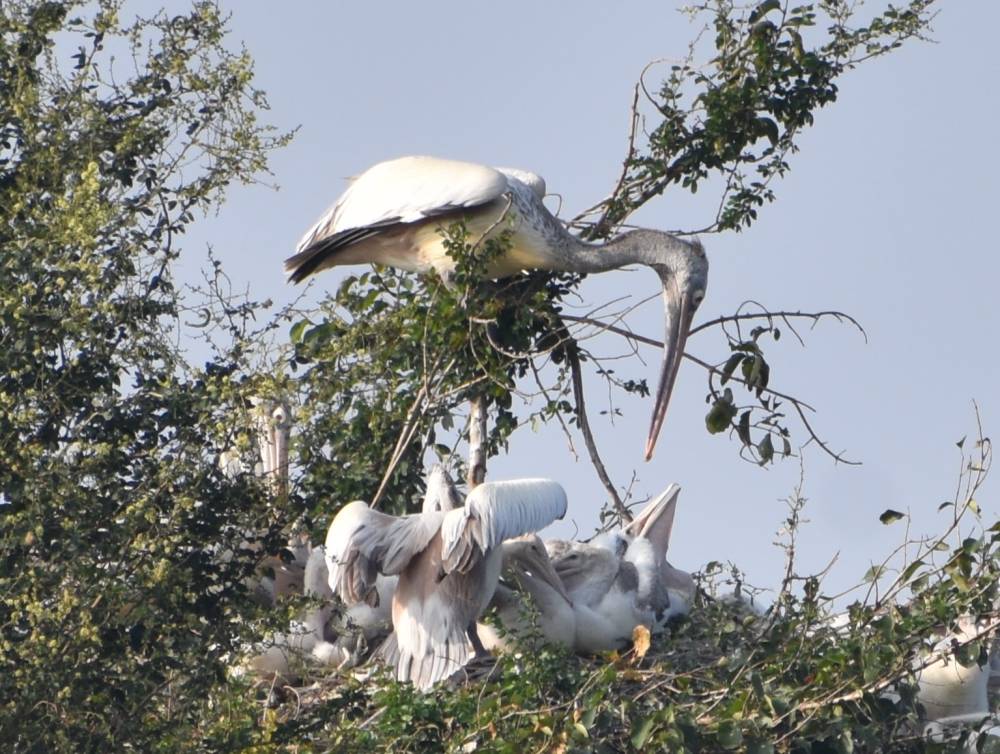
As we approached the Ranganathittu National Park, we could see big birds flying above us in groups. That part of the Mysore city felt like a forest. Soon we would see crocodiles basking on rocks and islets full of young chicks chattering incessantly for food.
Ranganathittu Bird Sanctuary is a natural reserve in the Mandya district of Karnataka. The reserve is three kilometers from the historic town of Srirangapatna (another important place in Karnataka) and sixteen kilometers (10 mi) north of Mysore. The drive to Ranganathittu bird sanctuary from Bangalore took us about four hours.
Ranganathittu islets were formed when an embankment across the Kaveri river was built between 1645 and 1648 by the then king of Mysore. These islets, originally numbering twenty five, soon started attracting birds. Once upon a time, ornithologist Salim Ali observed migrant birds nesting in huge numbers on the islands. Upon his suggestion, the King of Mysore declared the islets a protected area in 1940. Now the sanctuary is formed by six of these islets on the Kaveri river.
As soon as we arrived at Ranganathittu, we purchased a ticket and went inside. As we went inside the sanctuary, we could see the Kaveri islands below us, and above us in the sky flew painted storks, ibis, pelicans, and herons. At least those were the birds I could identify. When we took the special boat ride that takes in seven people and goes around the sanctuary for forty minutes the boatman told us that the Ranganathittu reserve hosts at least one hundred seventy bird species. Some of the common birds found are painted storks, Asian openbill storks, woolly-necked stork, pelicans, river terns, egrets, cormorants, herons, and varieties of kingfishers.
The best time to visit Ranganathittu Bird Sanctuary is from December to February, and we were well within the time frame. During these months migrant birds come to Ranganathittu from as far as Siberia, South America, and the Himalayas, and they all nest in the bird sanctuary. You can also spot crocodiles, otters, mongooses, and flying foxes there. Just keep your eyes open and binoculars in focus.
I penned down my experience in Ranganathittu National Park in a poem. After all, what is better than nature and poetry?
Writing down that poem here. Hope you enjoy it 🙂
As we entered the sanctuary, painted storks glided above us in the clouded sky,
and with our heads tilted towards the heavens,
we walked by the side of the muddy Kaveri,
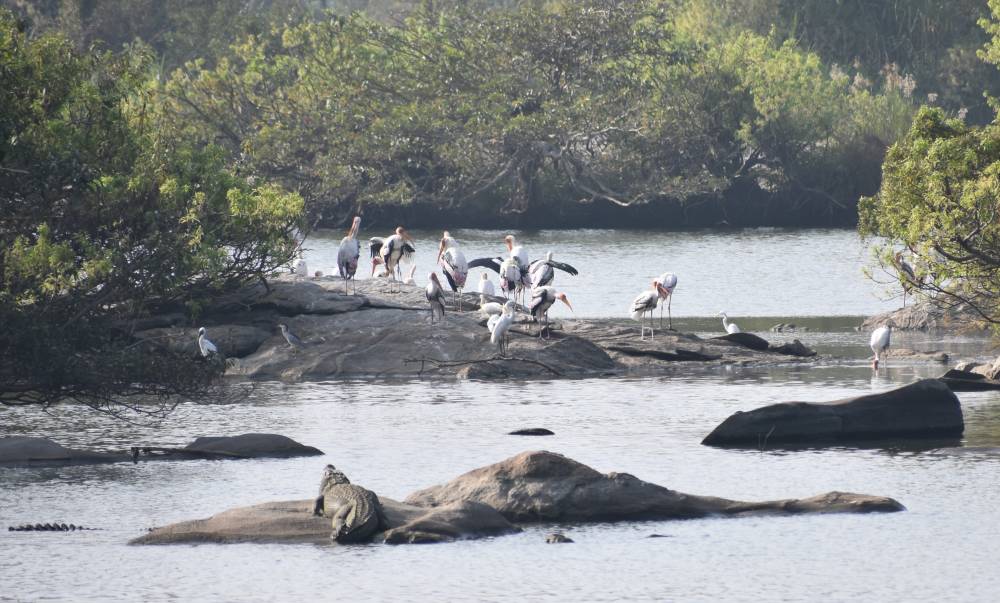
to see flocks and flocks of white and grey birds just perched onto the canopies of the Arjuna and the Acacia on the islets.
The crisp air buzzed with their songs and shrieks,
though I couldn’t identify even one of those notes.
We gazed at the distant foliage to recognize the winged-ones,
but our eyes instead discovered three crocodiles who rested on the rocks with their powerful jaws wide open,
as if they were waiting for a fish to dive into their mouth.
Their stillness made us wonder if they were real or fake,
and then we saw one of them gracefully gliding into the coolness of the water,
alluring us to go behind him.
We hopped onto a boat,
to go closer to the wilderness,
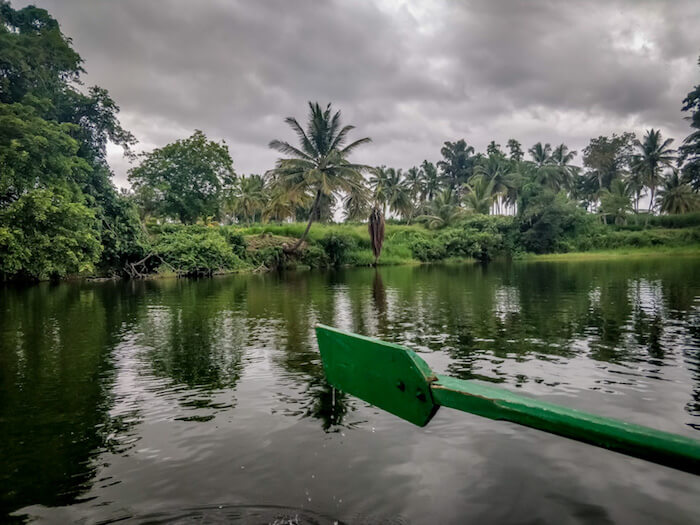
and as our boat cruised the shallow waters of the Kaveri,
the grey cormorants and the white and big egrets flew around,
while the cattle egrets sat proudly,
flaunting their breasts and their golden heads.
Openbill storks huddled together on trees
that stood like umbrellas in the peaceful water.
Luckily we saw the pelicans from far,
for their throat was big enough to hold a human,
and the grey and pond herons and white ibises watched us from above,
along with a dark-grey cloud,
who also had a tiny one at its tail,
one moment they seemed still and the other they seemed to be moving fast,
as if the papa was teaching the infant to float
and flaunt.
We rowed on and on and on,
passing by the chain of tiny islets,
sailing by hoards of trees stuffed with birds.
I wasn’t sure where to look,
as they all looked same,
peeking at us from their nests,
which had one or two or three grown-up birdies inside,
or spying from their seats on the branches.
But who said that they were all rule-abiding,
while some flew with leaves and twigs in their beaks,
others were months ahead in parenthood.
As I thought about their social rules,
we spotted a giant crocodile,
just resting on the edge of the islet,
and as our boat moved ahead in the water,
he descended into its muddiness.
Our boatman rowed,
and along swam the crocodile.
Crickets and cicadas buzzed in the foliage around,
a light breeze floated smoothly on the surface of the water
and set it into ripples,
ripples whose curves shimmered with daylight,
the wind bent the bamboos, and in return, they shrieked,
and their leaves rustled as if a man somewhere played with his lover’s glass bangles.
This bubble of nature,
the gliding painted storks,
the accompanying cormorants,
the dull-pink storks’ babies waiting on the stone islands,
the pied kingfishers winging their zebra wings,
the koels cuckooing in the distance,
the swaying coconuts,
the peaceful pelicans and the white egrets in their big groups,
all tranced me into a fathomless world,
the world I had only dreamt about,
and then the clouds danced,
and their drizzle curtained us from all around.
The cool zephyr splashed the water into our faces,
and the hypotenuse-like rain soaked us.
Along with the rain, came a slanting painted stork,
who slowed down above her children,
then she fluttered her wings,
while her feet just hung from her body,
and then she wrapped her wings around her
and landed on her feet,
to be next to her little ones.
It was all in slow motion.
In that moment,
the raindrops caressed my cheeks,
and I closed my eyes
and felt one with the world.
I also perched on a bench under a bamboo grove, next to the Kaveri,
to pen down about the day,
the bamboos cracked as if they could have hit me any moment,
and the big red ants crawled on me,
as if asking me to go away from their abode,
or maybe welcoming me with love.
I was not sure
if the sun was set or not,
but the birds knew better,
for they chattered as they do before roosting.
The only chatter that I found worth listening to.
Close by, a group of college friends made tribal noises,
and I daydreamed about Africa or maybe Amazon,
while the Kaveri thrived with life in front.
The birds settled down on the old branches,
which must have felt like home.
I wondered if they returned to the same tree or a different one every day,
or if they changed branches.
I hoped to figure out with time.
For then I had to return home,
I would go again to watch and listen,
to the baby storks who would be pink by the time,
and maybe I would be able to recognize a sound or two.
Until then, let those birds glide,
and paint the sky with their flight.


Another gorgeous road trip from Bangalore: Coorg, Karnataka – a travel guide






Also Read: Why I fall in and out of love with India, along with beautiful memories from India, in pictures.
Ranganathittu Bird Sanctuary Timings and Other Logistics
We drove down to the Ranganathittu Bird Sanctuary in Karnataka from Bangalore. The journey was about four hours long. Mysore to Ranganathittu Bird Sanctuary is even a shorter journey, and most travelers visiting Mysore stop by the sanctuary for a day.
The sanctuary had many restaurants, so food wouldn’t be a problem. Take a good camera and maybe a pair of binoculars, if you have one. The season to visit is from December to March or April. Migratory birds come in December and nesting begins. The sanctuary is around Kaveri and its islets.
Amongst the many boat ride options, we opted for the special boat ride which was forty minutes long, takes in about seven people, and goes further than the regular boat ride. We asked another family to join us so that we could share the price of the special boat (INR 1500, about USD 17 in February 2026). Also, walk around the garden in the sanctuary, and you would see beautiful flowers and fruit trees and smaller birds.
Do ask the locals and the boatman about the flooding in the sanctuary.
Mysore is well connected by road, rail, and air and from Mysore to the bird reserve is a short car or bus ride.
What about the places to stay or the resorts near Ranganathittu Bird Sanctuary?
When I went to Ranganathittu, there weren’t many nice places to stay close by. I would suggest you stay in or around Mysore and visit the sanctuary from there. I have spent about three weeks in Mysore, so sharing some of my favorite hotels and guesthouses from the city below.
Do consider Mannar Residency, the hotel I stayed in for a week. The rooms are clean, beds are good, toilet paper is provided on request, drinking water is available, and there is parking too. The location is very good for seeing the historically important places of Mysore such as the Palace. Mannar lies within walking distance from the Mysore Palace and is situated in the centuries-old Devaraja market so one is surrounded by temples, spices, and food at all time. The restaurant downstairs is affordable and serves delicious food.
Sometimes there were issues in housekeeping at Mannar, and we were provided an unclean room, but the staff tried hard to keep things good after that. Ask for a higher floor room to avoid the street noise. Go here to see Mannar’s reviews and to book.
If Mannar doesn’t work out, browse the list of hotels in Mysore on Booking.
Here is an organic farm stay that I recommend too. I had spoken to the owners once, and the property looked decent to me.
Mysuru has many more heritage and nature-focused guesthouses of interest. Here are some highly-reviewed places: Gitanjali homestay, Cornerbunker, Aashraya homestay, The Bunkers Ashram, Laika Heritage Stay, and Green Hotel India.
Enjoy your stay 🙂


Do you like watching birds? Let me know which one is your favorite bird from the Ranganathittu National Park in comments.
MY FIRST BOOK
Journeys Beyond and Within...
IS HERE!
In my vivid narrative style (that readers love, ahem), I have told my most incredible adventures, including a nine-month solo trip to South America. In the candid book, the scoldings I got from home for not settling down and the fears and obstacles I faced, along with my career experiments, are laid bare. Witty and introspective, the memoir will make you laugh and inspire you to travel, rediscover home, and leap over the boundaries.
Sikkim Express: "Simple, free-flowing, but immensely evocative."
The Telegraph Online: "An introspective as well as an adventurous read."
Grab your copy now!
The memoir is available globally. Search for the title on your country's Amazon.
Or, read a chapter first. Claim your completely free First Chapter here.
Want similar inspiration and ideas in your inbox? Subscribe to my free weekly newsletter, Looking Inwards.
Wow such a bliss this is. Reminds me of the times I spent in sahyadris last monsoon.
Thank you for reading and for the generous comment. Sahyadris are nice 🙂
What a beautiful portrait of nature!!! Enjoyed the poem very much.
Thanks Abu 🙂 Glad you liked it. Please stay connected.