

Hanging out with villagers, Wandering Around Apple Farms, Climbing Into Pine Forests, and Drinking Wine under Starry Skies in Chindi, Himachal Pradesh
The government guesthouse in Chindi, Himachal Pradesh, was located on the brow of a hill. Below the guesthouse and further ahead and behind it, the village sprawled. We checked in at two pm. Our room was Set 1.
The PWD (Public Works Department) guesthouse caretakers hadn’t received a call from their superintendent regarding our booking. They thought there was no booking. All the staff, all men, were sitting on fixed wooden chairs that seemed to have been carved out of tree trunks right at their place under a giant Chinar tree.

My partner, Sagar, and I parked our car and walked to the giant stone building. It must have belonged to another era. The men watched us from a distance, not stirring. Earlier, we had called the guesthouse twice, but our calls had gone unanswered. They said the other caretaker who managed the property wasn’t there. I requested them to ask him about our booking. They said they only found out about the guests for that day around 3:30 pm.
The stout men, with faces cold and hands behind their backs, called the other caretaker. By their nods and utterances of Set 1 and other confirmations, I knew that the room had been confirmed to the other caretaker by his superintendent and that he had not passed on the information. Within a few minutes, our friends’ car also arrived.
My college friend, Himanshu, and his wife, Mrinalini, had called us a day ago to ask where we were. They were also traveling in Himachal. That January, Sagar and I had taken to the road, leaving our home behind, and had been in Himachal Pradesh for two months, exploring small villages. We received their call in Pangna, another village in Mandi district, and they were in the Retreat hotel in Mashobra, a village in the popular Shimla district. We had made plans to meet in Chindi village, and now there we were.


They got the room No. 4 right across from ours. The rooms were simple, equipped with a bed, a table, a few chairs, and a cupboard; exactly like how you would expect them in a government accommodation. The minute the rooms were opened, Sagar sat down to work. It was Monday.
I went out of the premises’ back gate behind our rooms. The pine-needle-studded glade sloped downwards, leading me to a muddy watering hole beyond which lay a mud track. Fringed by cedar and pine trees, the trail went steeply downward. Through the trees, I could see cows and dogs below. It must be leading to the village. The browned pine needles had been swept onto tiny mountains, perhaps to be burned.
The air was, of course, fresh and clean, and I took a deep breath, taking it all in.
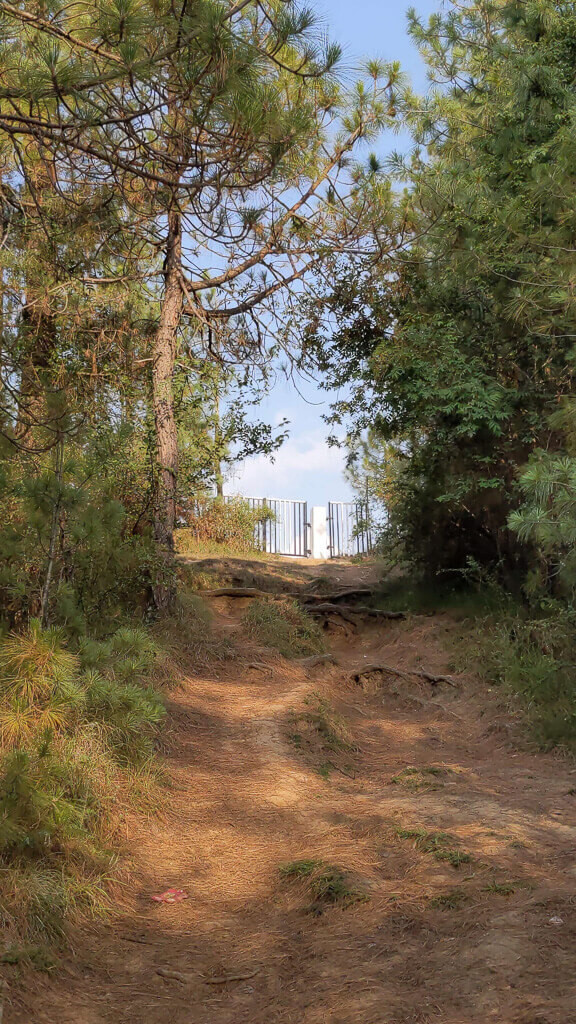
I ignored the village, for now, and went further on the path and took another shortcut to go back up.
My friends were heading out for lunch, and I joined them. Sagar stayed back. We went to the Mamleshwar hotel, a government hotel and restaurant in Chindi village, close to the PWD. These two are the only hotels in Chindi (Karsog Valley district, to which Chindi belongs, has many more, though not the best ones). A PWD can be booked in the Karsog Valley too.
“What are you having?” Mrinalini asked. My friends had ordered a big lunch of peas paneer curry and egg curry with rice and roti.
Practicing intermittent fasting, I got a bowl of rajma, the red kidney beans. It was oil-free and tomatoey, and I ate the rajma with onion, little rice, and two bites of roti. The curries looked rich and were definitely prepared with more oil, and probably color. Everything tasted delicious, and we gulped down the food.

“Let’s check out the rooms,” Himanshu suggested.
On the road, you should always have backups. The PWD guesthouses, though present in all small villages, were mostly available for a day or two, or three. They would give priority to government officials for whom the accommodations were built. Staying longer than a couple of days was frowned upon, too. And to book them, you’d have to call the booking officer again. He would definitely say that you had already stayed for a few nights. As a non-Himachal resident, we weren’t kicked out after two nights, but we also didn’t try to stay for more than three nights. The tariffs at that time, in 2021, were a thousand rupees a night (11 USD in February 2026) for two people; it was half for locals, I believe.

Mamleshwar Hotel’s rooms weren’t bad. It was in the middle of the forest, so the views were good, which was often the case in the Himalayas. All the rooms had en-suite bathrooms. On the second and third floors, you had special suites, King and Queen, which came with enclosed seating areas. They also cost more. I didn’t know then, but Sagar and I would stay in one of their best rooms for two nights.


I handed Sagar his parcel of rajma and went back to writing in the garden, just right inside the back gate. I was going through a jungle phase, of which I have spoken in other narratives from that Himachal time. Especially, Mashobra, Mehli, Fagu, and Gagal village. I wonder was there any location where I didn’t work in the wild? Probably no.
I would pick up my notebook, pen, a water bottle, and my laptop (only when necessary). I equipped myself with some tissue in case I had to pee. Either I would stay close to the guesthouse, within its boundaries or on nearby trails, or I hiked deeper into the forest or towards another village. If the plan was to go long, Sagar would come too.
We discussed and went out together generally, but so much wilderness was so near to the Chindi guesthouse that I didn’t have to ask Sagar to come along. Otherwise, it was better to go into the unfamiliar jungle as two and not one. The leopards didn’t come out during the day, but one had to be careful. And what if you were lost?
We wouldn’t sit on the main track but would fork out of it onto a smaller path, a glade, or venture into the forest to remain hidden, as we wrote and worked. The delicious quiet amongst the trees cleared my mind as a slate is wiped clean.
Once I had worked in the jungle, there was no going back.

Chindi’s woods were magnificent, too. The chirping of magpies and parrots, the constant cool breeze rustling my hair and whispering in my ear, and beautiful lush trees and fresh pine air to breathe glued me to the forest floor. Writing in the wilderness, my hands couldn’t match my brain, and I was spilling it all out in incorrect grammar and spelling. We would also carry a bedsheet if needed, some bananas, and chargers. When our laptops discharged, we got into our car, if we had taken it, and plugged into our portable car power invertor.
For dinner, which we were having as early as five pm, we walked to a dhaba that locals recommended. Dhabas are small and simple roadside food joints in India that serve set menus, though they also cook on order (from the menu). Mainly focused on locals, workers, and truckers, they serve fast. You sit on cots or plastic chairs, the food is sometimes cooked over a wood fire or coal, and the atmosphere is extremely casual.
“There are two dhabas close by,” the young server at the Mamleshwar restaurant had told us. “Go there for local food. What we serve here is restaurant style.” He had spoken my thoughts. One dhaba was near the petrol pump and offered a thali of vegetables, dal, and other things, including a pumpkin sweet dish. And another one was before the petrol pump. The waiter recommended the one at the petrol pump, the Thakur Dhaba.
Looking for Thakur dhaba, we had walked beyond the temple in Chindi village, crossing the small shops and food joints. A tea stall owner reiterated the words of the server. Further ahead, a puja was going on a hill by the roadside. A big, decorated wooden palki, a portable coach carried on poles by several people, was kept on the ground, and a giant drum was being beaten. Through the crowd surrounding the procession, I got a glimpse of a goddess idol covered in jewelry and red shining silk clothes.
The road curled ahead, promising a long journey. We had already walked a couple of kilometers, and going further seemed pointless. Now, on the opposite side of the road, there was a dhaba, filled with people. But there was no petrol pump. It wasn’t the one we were looking for. We would have gone inside but for its patrons whose eyes were fixed on us. We turned around, crossing the eatery and then a junk shop and an old house.
Our stomachs gurgling, we enquired about the dhaba and food, in general, at many small places. An aunty told us that the procession was of the devta, the local god, and that every year they had a small fair for two days. That year, the fair was canceled due to covid.
Locals were walking to the puja place, carrying small bottles of a glistening liquid that we could tell was ghee. At another place, a middle-aged woman told us that the work and the shop didn’t leave them any time or energy to make food. Then we asked a young guy at a tea shop. He didn’t make food but told us about the many places to visit in and around Chindi.
“You know you can reach Karsog from here in fifteen minutes on foot.”
I made a mental note to follow the path he had suggested. Sagar and I would have a long adventure in the village of Karsog, the area’s fertile rice valley.
“Also, definitely go to Shikari Mata Temple. It is a long walk; the temple is revered. We all go every year. Whatever you ask, the Shikari Devi gives. Even when it snows, it doesn’t snow inside the temple. The temple stays dry. Go there.”
Inspired by the many locals suggesting that we visit Shikari Devi, we would later hike to the temple from Chindi. That story, as you might know, is penned down in detail.
He also repeated what others had told us about the dhaba. But he said the petrol pump was six kilometers away.
Everyone was giving us random numbers, and nothing made sense. We were starving now.
We hurried to Mamleshwar.
“One mushroom peas curry and dal makhni. Three chapatis. Please use less oil in the curries,” We told the kind server who would become our confidant. He would help us plan our trip to Shikari Temple, located deep inside the Shikari Wildlife Sanctuary.
The rotis were crisp. For sure, the flour was from a local mill. It had a different flavor and a nuttier texture. The meal was delicious.

Sagar and I walked back to our room in the dark. Millions of stars shone above us like little promises. Stars appeared much earlier in Chindi, sometimes as early as seven or eight pm, than they did in the Gagal village near Mashobra, where we had stayed for three weeks. That was Shimla district, one loved by tourists, and this was Mandi district, unknown to travelers and the one that we have explored in abundance. We walked hand in hand, talking about how the villagers must feel to have that precious village as their home, growing apples, rearing cows and sheep, and raising pink-cheeked children.
Back at the guesthouse, we chatted with our friends in their room. Our Hawk Eye Cherry wine bottle that we had bought in Pangna village came in handy. Sipping the fruity wine, we walked out into the garden and stood under the stars. The entire village was sleeping, and you could hear your own breathing, on top of the songs of the crickets. The air was colder but not cold enough to need a jacket. We smiled and talked, the occasional wild sounds mixing with our soft voices.
Himanshu said to Mrinalini, “Do you see the moon, dear?”
The next morning began with an early walk, which I have described in the other post on Chindi, the one where the younger girls of the village shared with us about patriarchy and rules. Sagar and I wanted breakfast. We took out our car to find that elusive dhaba. The distance was a bit much to walk, and we weren’t sure of the location.

First, we couldn’t find any dhaba nearby. As per Google Maps, the nearest petrol pump was twelve kilometers away. But as many places are not marked on the Maps, especially in rural areas, we kept going. Nothing. After fifteen minutes, we turned around. Finally, we crossed a food joint on our left. Yes, it was the Thakur dhaba we had been looking for. We hadn’t noticed it on our way onwards, probably because a couple of cars were always parked outside it, hiding it from view.
The dhaba folks said they were only making lunch and not parathas. Ouch!

We drove on, crossing the Mamleshwar.
Near a bridge over a stream, there was a local joint, its board displaying the name, Apna Dhaba. Cars were being washed outside the shop. A man washed his car with a pipe, and another one filled mugs from a plastic drum. We ordered two paneer parathas and sat down on a dusty wooden bench. On the road, that we were told went up to China, cars and trucks jostled with each other to get ahead. A loud JCB was at work nearby, halting the traffic intermittently. When the machine moved out of the traffic’s way, the vehicles rushed like swarms disbursed from a hive.

The paneer paratha was different. It had carrom seeds in it and was generously stuffed, unlike how you would find it in most restaurants. The parathas were also crispy, and we were thankful for the meal.
We drove back, and I wrote in the garden again, under the pine trees, which looked like peacocks with their colorful tails turned upwards toward the sky. Sitting on the grass, its juices crushed against my skirt, the fresh grass smell overpowering every other fragrance, I wrote in my notebook with the sun on my face.

Mrinalini joined me, too. After a while, Sagar and I went to the pine forest opposite our guest house. There, behind a lee of trees, on a cushiony floor of pine needles, I wrote about Karnataka, the state that had housed me intermittently since 2010 and that I had left forever that year. The wind was cool, and it sang amongst the trees.
When we returned to our guesthouse, I again went out the back door and worked near the watering hole. We skipped lunch. The parathas were enough to keep us going.
In the evening, all four of us drove in our two cars to Thakur dhaba. They were closed for dinner. Hah! Our luck!

To be clear, we never look so much for any place.
We stayed in the state for months at a time, and I’d say it wasn’t always easy to find food in Himachal. While some villages had many dhabas, others didn’t. Locals made food at home, and at most, you could expect a tea shop, which might also sell pakoras or samosas.
In Gagal village, which I mentioned earlier, there was no dhaba. Either you cooked or climbed the hill to eat at a resort kind of place, no dhaba even in that market, or drove further to find a shop on the main highway.
In Nalagalli village, our homestay made food else we would have to drive to Thakur Dhaba, the one whose tales I have been singing in this article. Yes, soon after the Chindi adventure, we would find ourselves in a homestay nearby, closer to the Thakur Dhaba. That homestay would become our second home in Himachal. But not yet.
Food was simple in Himachal. Locals didn’t eat fancy preparations nor cared for much variation. Their fanciest meal was either a Mandi Dham, a big meal made on special occasions, puri sabji or chana bhatura, or a festival meal which included sweets such as kheer or halwa. Their food options were simple, which I preferred anyway, but also limited. Not many eating joints in a residential village, and to find one on the road, you might have to walk a long way.
The food at the eateries was simple, so it was always of great quality. They would often use flour ground from their own wheat, or if they had to buy it, they bought it from a local mill. Vegetables were local and sometimes even homegrown. Though nothing was organic, the Himalayan soil worked like magic. Everything tasted better in the mountains. Another big contribution to the quality of the food was that many places still cooked on coal or wood fire, giving everything an exotic smoky and earthy flavor. I loved it.
We drove on, and our friends followed. We stopped at another small local joint. The guy, who looked a little surprised, said he would make kadhi and chana. “Would that be okay?”
We said, “Of course. Sounds great.” Sagar and I love the yoghurt-based chickpea flour curry, that is kadhi, and the black chickpeas, the chana, too.
By the time Himanshu and Mrinalini parked and joined us at our outdoor table, we were being devoured by mosquitoes. Himanshu got so paranoid that he took out the anti-mosquito spray he had been carrying in his car and sprayed it all over us, including the plates of food that had just arrived. How scared he must have been!
We picked up our plates and skittered here and there, onto our own tables. The food was not so great. We ate quickly and left.
While driving back from dinner, the lights of the Karsog Valley shone below us and the cosmic stars above. Sagar said he felt we were flying. Maybe we were. At the guesthouse, we hit the bed.
The next morning, Sagar and I walked down to the village, but not into it, and sat in the jungle and chatted for a while. When we returned to our room, Sagar lied down on the bed, and I joined him, the sun beam coming in through the window warming us up. I didn’t want to get up. Half an hour later, we showered, and I went back to the forest behind the guest house.
The locals who passed by me always invited me home. I would visit the house of the girls whom I mentioned earlier.
The girls, clad in salwar kameez, were angry about the privileges given to boys and men and complained of the restrictions on women. After chatting with them for an hour and accepting their invitation to visit their house in the evening, I left. Our conversation is written down in this narrative.
When I arrived at the guest house, Mrinalini had messaged to ask if we needed some food. I requested her to get us kadhi and makhni dal, the only two things available. I ate the food with Sagar on the bench outside, finishing our meal with tea.


Dinner was at Thakur Dhaba again. The old movie, Ajooba, was playing on the small black and white television, and I didn’t know when I started watching it.
Sagar and I started our next day in the jungle too. We drove to a point, parked our car, and climbed up an obscure trail into the forest. The uphill path was covered with pine needles. The trail had long ago disappeared, and we were clutching onto rocks and spiky bushes to get up. We arrived at a ridge. Sagar sat down there.
I was worried about making our way down later. I knew that further up the forest would be flatter, and a trail was bound to exist. It always did.
I decided to find it. Climbing up on that slope with a laptop bag on my back and period cramps in my stomach wasn’t easy. My feet slipped a lot, and every time I was about to slide, I would grab a pine tree trunk. Sometimes the bark came off in my hands.
When I arrived at the top, Sagar was barely visible under a tree. I could see our car parked on the road below.
I took a tiny path on my left and arrived at the flatter part of the forest. A wide trail ran free in both directions. I walked up and down it a bit but couldn’t find any side trail that would take us down. Then I worked on a poem about Karnataka (still unpublished).
I was still worried about how we would get down. None of the tracks looked promising. Meanwhile a shepherd passed by with tonnes of sheep and goats. I missed asking him.
I tried a few more paths. Meanwhile Sagar’s laptop stopped working so we decided to go down. We took the way we had climbed up, and that was basically making our way down the grassy pine-needle-studded steep slope, clutching whatever our hands could grab. There were no grooves for our feet. When Sagar really had a pine slip—the oyeee moment—we decided to retrace our steps and try another way.
We got onto the one big main trail and continued walking. A few cows, seeing us walk towards them, started to run. But now I had recognized the track; it was the one we had taken the previous day.
So much worrying about for nothing. But this is how Sagar and I live in the mountains, and I wanted to share the story with you. To share that we don’t always have to work on our sofas and ergonomic chairs. Sometimes the grassy ground is the right place to be. Though you may not know the way, be skeptical about the forest, and stand out alone in the jungle amongst locals, the discomfort is taken over by the pleasure the nature brings. You will be more mindful, focused on the work, rather than browsing the internet or losing yourself to reels. Hopefully you try our way sometime.

We got down onto the road a bit further away from our car but that wasn’t a problem. Sagar and I can walk infinitely. Back at Mamleshwar, I went upstairs to have something to drink, and Sagar took a call in the car. After two hours, he came upstairs, and we ordered dinner.

After dinner we worked some more. When we turned around, Himanshu and Mrinalini were sitting behind us on another table. Our polite friends had decided to not disturb us.
We asked our server for a room for the next day. It was our last night at PWD. The server also told us that Raja Veerbhadra, the six-time chief minister of Himachal Pradesh had passed away that morning from a heart attack (he had also had covid twice). Raja was a king of Sirmaur district (if I am not wrong). He said the Raja Sahib (that’s how locals referred to the Raja respectfully) had stayed at the Mamleshwar guesthouse many times.
“People considered Raja Sahib God.” The waiter had been affected by the minister’s death. “He did a lot for the people. All his people and employees and workers received free food and education. And people don’t know how the son of the raja would be. They definitely don’t hope as much from him. Congress would be finished now.”
We went onto to talk about Shikari Devi temple.
“Even when the entire mountains would be covered in snow, it doesn’t snow inside the temple. This is real stuff.”
Himachal locals are believers. They are simple, grounded, and, mostly, helpful. And our young lean waiter was a perfect mountain man. Hardworking, focused, honest, and transparent about how things worked in his state.
With his help, we booked a room for the next night. Back at the PWD, we invited our friends over for apricot and cherry wine. The silent night, inevitably, took us out under the stars. At around one am, they went to sleep, and Sagar and I worked some more. The next morning began early, and we checked out and checked into Mamleshwar at 11 am. Our friends were going back to their home in Delhi.

Breakfast felt like a must for we hadn’t eaten for fourteen hours.
I think I had some more notes penned down in my sweet green diary that I had bought in Myanmar. But as of now, I don’t have the diary with me. So let’s call it a day. I hope you have enjoyed reading about my adventures in the quaint village of Chindi and that you get to visit it soon.


What was your favorite part of my trip to Chindi (Karsog Valley)? Did something surprise you?
MY FIRST BOOK
Journeys Beyond and Within...
IS HERE!
In my vivid narrative style (that readers love, ahem), I have told my most incredible adventures, including a nine-month solo trip to South America. In the candid book, the scoldings I got from home for not settling down and the fears and obstacles I faced, along with my career experiments, are laid bare. Witty and introspective, the memoir will make you laugh and inspire you to travel, rediscover home, and leap over the boundaries.
Sikkim Express: "Simple, free-flowing, but immensely evocative."
The Telegraph Online: "An introspective as well as an adventurous read."
Grab your copy now!
The memoir is available globally. Search for the title on your country's Amazon.
Or, read a chapter first. Claim your completely free First Chapter here.
Want similar inspiration and ideas in your inbox? Subscribe to my free weekly newsletter, Looking Inwards.
Your storytelling perfectly captures the charm of slow travel and the joy of discovering peaceful places away from the usual tourist crowds. I especially enjoyed reading about the walks through the pine forests, the apple orchards, and your stay at the government guesthouse
What a beautifully immersive piece—your storytelling truly makes Chindi come alive. I could almost feel the quiet of the forests and see those starry skies. The little details about food, locals, and everyday moments add so much authenticity.
I’m curious—if someone were to plan a short 2–3 day trip to Chindi, which experiences would you say are absolutely unmissable? And would you still recommend the PWD guesthouse over Mamleshwar for the overall experience?
Hey. Thanks for stopping by. I think so many things I wrote about are unmissable. Hiking randomly in the forest was precious to me. I was happy in both guesthouses so you can choose as per your budget and availability 🙂