Covid-Related Travel Update, January 2025/2026: Chile is open to international tourists. Visit the Chilean government’s official website for travel-related information and regulations. Don’t forget to read the government’s rules to be followed in public spaces here. My guide to Chile visa would be helpful for Indian citizens.
Covid-Related Travel Update, Jan 2024: Chile is open to international tourists. Visit the Chilean government’s official website for travel-related information and regulations. Don’t forget to read the government’s rules to be followed in public spaces here. My guide to Chile visa would be helpful for Indian citizens.
A month before my solo trip to Chile, I ran into Valentina. We were riding the same train from Bangkok to Siem Reap. As we got off the train, Valentina told me she was from Chile.
What a coincidence! I was just heading to Chile. Cozying into the same hostel in Siem Reap, we soon became travel friends. “Call me Val,” she said.
While strolling together in the magnificent Angkor Wat temple, Val asked me if I knew how Chileans greeted each other. I shook my head. I knew nothing about the Chilean culture. We were in June, and my flight ticket to Santiago was booked for the end of July. The classic me hadn’t yet applied for a Chile visa. But I wasn’t worried. I was going as a volunteer of the English Open Doors program [EODP] to teach English in Chile; I knew the program would help me arrange a visa quickly.
Val took it upon her to educate me about the traditions in Chile (and also gave me a lot of travel tips for Chile). And Val’s guidance made my six-month solo adventure through Chile a little easier. To return the kindness, I am aggregating all the unique things about the culture of Chile travelers should know.
Covid Update Jan 2024/2025/2026: Indonesia is now open for all travelers.
Nyangnyang Beach Bali – One of the Best Beaches on the Island
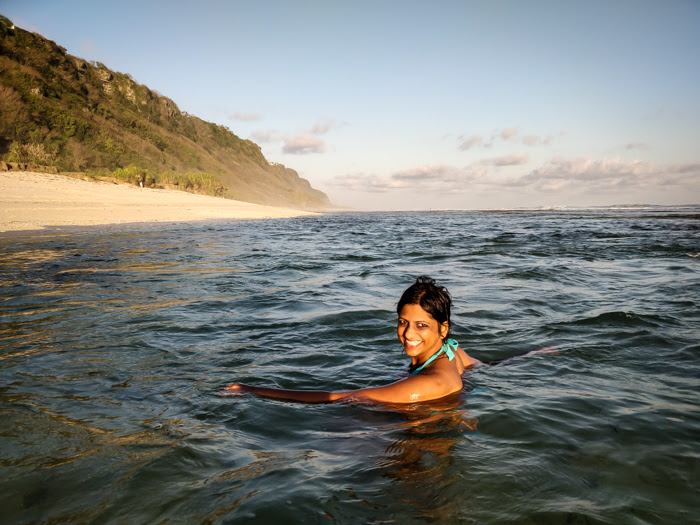
We descended the stairs on the hill shadowing the Nyang Nyang beach. And all we could see was the turquoise Nyang Nyang rolling ahead of us into infinity.
Bali has been a relief from the chaos of the overcrowded and the ever-rushing world. Though I had heard really touristy things about Bali, I love the place.
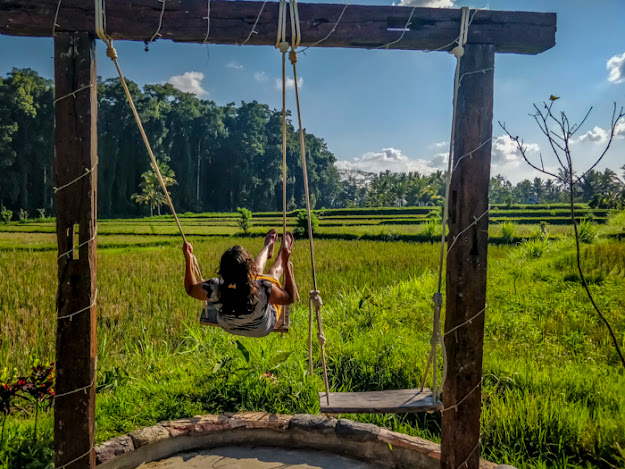
I have spent most of my twenty days in Ubud, old Bali with a modern twist, a village called Laplapan, which is close to Ubud, and also biking my way to far away floating temples, hidden beaches, and rice fields whose pictures were able to enchant me enough.
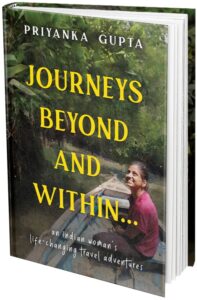
In my vivid narrative style (that readers love, ahem), I have told my most incredible adventures, including a nine-month solo trip to South America. In the candid book, the scoldings I got from home for not settling down and the fears and obstacles I faced, along with my career experiments, are laid bare. Witty and introspective, the memoir will make you laugh and inspire you to travel, rediscover home, and leap over the boundaries.
Sikkim Express: "Simple, free-flowing, but immensely evocative."
The Telegraph Online: "An introspective as well as an adventurous read."
The memoir is available globally. Search for the title on your country's Amazon.
Or, read a chapter first. Claim your completely free First Chapter here.
Before I came here, I thought Bali would be a tourist jungle packed with hotels, restaurants, tour shops, yoga centers, and bike rental shops, along with some greenery. But Ubud and Bali are places that have all these things and also have artistic temples the Balinese people visit daily, lush paddy fields in the heart of the island, cute ducks wobbling around in open pastures, deserted turquoise beaches (such as Nyangnyang beach), hidden jungles, a cool river cutting through the middle of Ubud, splashing waterfalls, a colorful underwater world, and all with the backdrop of a gaping volcano. I have captured my first glimpses of Bali and some travel tips for the island in the linked post.
Covid Update January 2024: Indonesia is now open for all travelers.
Travel Tips for Bali: Collected From My One-Month Journey
I write this piece while sitting on the balcony of a beautiful Balinese home, with a lush green garden, with the blooming frangipani canopying over the sunlit courtyard and its tiny temple, and with towering palm and coconut trees swaying in the distance. And as I listen to the water falling over an artistic fountain while drinking tea, I know that there is nowhere else I would want to be in this moment.
Having been in Bali for ten days, my wanderlust soul and ever-wandering eyes have experienced and seen a lot.
I have given up my apartment, packed my bags, said my goodbyes, and off I go with my backpack, a pen and a notebook, and a one-way ticket to the world.
I have been in namma Bengaluru for a year now. Before that, I was in South America (SA), teaching, living, and traveling. After having been nagged by my family to return, I came back last year.
As I move onto a new journey that takes me outside India for a couple of months, I couldn’t help but reminisce about the places I have lived in and visited in the last one year in India.
India-a country with distinct religions from the ancient Hindu to the declining Zoroastrianism, with a myriad of languages and dialects from Konkani to Jarawa, with a plethora of geographies from fathomless deserts to treacherous glaciers, with a vast network from modern sea links to old hanging bridges, with a wide assortment of food from homely dal roti to mouth-watering, overnight-cooked chicken biryanis, with a range of commutes from rusted Hero bicycles, serene camels, and obedient bullock carts to fancy Rolls Royces, from peaceful Tamil marriages held for two hours during daylight to exciting Punjabi wedding functions sprawled over many days in luxurious hotels spread across India; we have it all.
This large and miscellaneous congregation of people-that India is-sometimes makes me proud, but sometimes the restrictions of this collectivist society suffocate me.
Getting stuck on borders multiple times and having paid a lot of extra money for the last moment flights because I could not cross into the neighboring country without a visa, I realized that an Indian passport is not the strongest one. Though there are ways to make it stronger. A valid US tourist visa (or a US business visa) not only allows you to visit the US, but with a valid US visa you can also travel to many more countries which let you in with a “visa on arrival” or an e-visa (if a US visa is stamped on your passport). For example Peru, Colombia, Guatemala, Costa Rica, Georgia, Mexico, Philippines, Turkey, and more.
To make my dream of traveling to the US and these countries come true, I applied for a 10-year B2 US tourist visa, and, it was approved.
Please read through the detailed process of getting a tourist visa for the USA from India. I also pledge to clear all the myths that envelope the US tourist visa process.
White roses, pink bougainvilleas, golden marigolds, and red hibiscuses bloom throughout the day in my parent’s garden, but then comes night, and the queen of the night takes over. These memories from SA waft through my being as the scent of the queen of the night drifts through my parent’s garden and settles in our wistful dreams.
Hope you enjoy these amazing memories from the time I was traveling in South America.
Covid-Related Travel Update Jan 2024 – Peru is now open to international travelers. And as per Supreme Decree 130-2022-PCM in Peru’s official gazette El Peruano, Covid entry requirements and all other regulations and restrictions were lifted. You can also look at the official website of the Peru government for more information. My guide to Peru Travel Visa would be helpful.
Peru: Poems and Pictures
Oh dear friend, would you convey my message if you travel to the mystical land of the Incas.
Could you find that old lady who guided me to the bus and tell her that I dream of her hair as I dream about the Himalayan snow.
Could you find that little mystery-eyed girl who would be bigger by now and whisper to her that I would come again to play the game of “donde estas” with her in her home on Lago Titicaca.
Covid-Related Travel Update Jan 2024/2025/2026 – Peru is now open to international travelers. And as per Supreme Decree 130-2022-PCM in Peru’s official gazette El Peruano, Covid entry requirements and all other regulations and restrictions were lifted from November 2022. You can also look at the official website of the Peru government for more information. My guide to Peru visa for Indians would be helpful.
Peru is an easy country to enter. People from the US, most countries in the Americas, and Western Europe do not need tourist visas for Peru. But it is different for the Indian citizens.
Peru Visa for Indians
The process of the visa to Peru was worth the effort to see the gorgeous country (here’s my extensive travel guide to Peru). But the process simplified soon after I visited Peru.
Since March 2017, Indian nationals holding a minimum six-month valid visa or who are permanent residents of either the US, Canada, United Kingdom of Great Britain and Northern Ireland, Australia, or any Schengen member country can enter Peru for one-eighty-days (180) per year without a Peru visa (for tourism and business visits).
The maximum period of stay will be up to one hundred and eighty (180) calendar days, either as a continuous visit or several consecutive visits, during the term of one year.
As we approached the Ranganathittu National Park, we could see big birds flying above us in groups. That part of the Mysore city felt like a forest. Soon we would see crocodiles basking on rocks and islets full of young chicks chattering incessantly for food.
Ranganathittu Bird Sanctuary is a natural reserve in the Mandya district of Karnataka. The reserve is three kilometers from the historic town of Srirangapatna (another important place in Karnataka) and sixteen kilometers (10 mi) north of Mysore. The drive to Ranganathittu bird sanctuary from Bangalore took us about four hours.
Ranganathittu islets were formed when an embankment across the Kaveri river was built between 1645 and 1648 by the then king of Mysore. These islets, originally numbering twenty five, soon started attracting birds. Once upon a time, ornithologistSalim Ali observed migrant birds nesting in huge numbers on the islands. Upon his suggestion, the King of Mysore declared the islets a protected area in 1940. Now the sanctuary is formed by six of these islets on the Kaveri river.
As soon as we arrived at Ranganathittu, we purchased a ticket and went inside. As we went inside the sanctuary, we could see the Kaveri islands below us, and above us in the sky flew painted storks, ibis, pelicans, and herons. At least those were the birds I could identify. When we took the special boat ride that takes in seven people and goes around the sanctuary for forty minutes the boatman told us that the Ranganathittu reserve hosts at least one hundred seventy bird species. Some of the common birds found are painted storks, Asian openbill storks, woolly-necked stork, pelicans, river terns, egrets, cormorants, herons, and varieties of kingfishers.
The best time to visit Ranganathittu Bird Sanctuary is from December to February, and we were well within the time frame. During these months migrant birds come to Ranganathittu from as far as Siberia, South America, and the Himalayas, and they all nest in the bird sanctuary. You can also spot crocodiles, otters, mongooses, and flying foxes there. Just keep your eyes open and binoculars in focus.
I penned down my experience in Ranganathittu National Park in a poem. After all, what is better than nature and poetry?
Writing down that poem here. Hope you enjoy it 🙂
Painted storks in Ranganathittu
As we entered the sanctuary, painted storks glided above us in the clouded sky,
and with our heads tilted towards the heavens,
we walked by the side of the muddy Kaveri,
to see flocks and flocks of white and grey birds just perched onto the canopies of the Arjuna and the Acacia on the islets.
The crisp air buzzed with their songs and shrieks,
though I couldn’t identify even one of those notes.
We gazed at the distant foliage to recognize the winged-ones,
but our eyes instead discovered three crocodiles who rested on the rocks with their powerful jaws wide open,
as if they were waiting for a fish to dive into their mouth.
Their stillness made us wonder if they were real or fake,
and then we saw one of them gracefully gliding into the coolness of the water,
For more than eight years, I've read and written night and day to make On My Canvas—my sustenance and life's focal point—a place of inspiration, trial, adventure, and happiness. Everything here and my weekly newsletter, Looking Inwards, is free. No AI. No ads. No paywalls. No sponsors. No paycheck.
If my blog has served you in any way, please consider making a one-time or a consistent donation. Your generosity will not only support the idea that we can create a life of our choice but also sustain good-quality free writing online. I'll be thankful forever.