
5 Years As a Digital Nomad in India: Behind The Scenes
Table of Content [TOC]
- Introduction to My Digital Nomad Lifestyle
- How Do We Find Homes Around India—5 Years Without an Address
- In Such Transience, How Do We Make Ourselves At Home? Or, How To Not Feel Homeless As a Nomad?
- Working While Living a Nomad Life
- How Did We Manage On The Road While Being Buried Under Work? Was The Digital Nomadism Worth It?
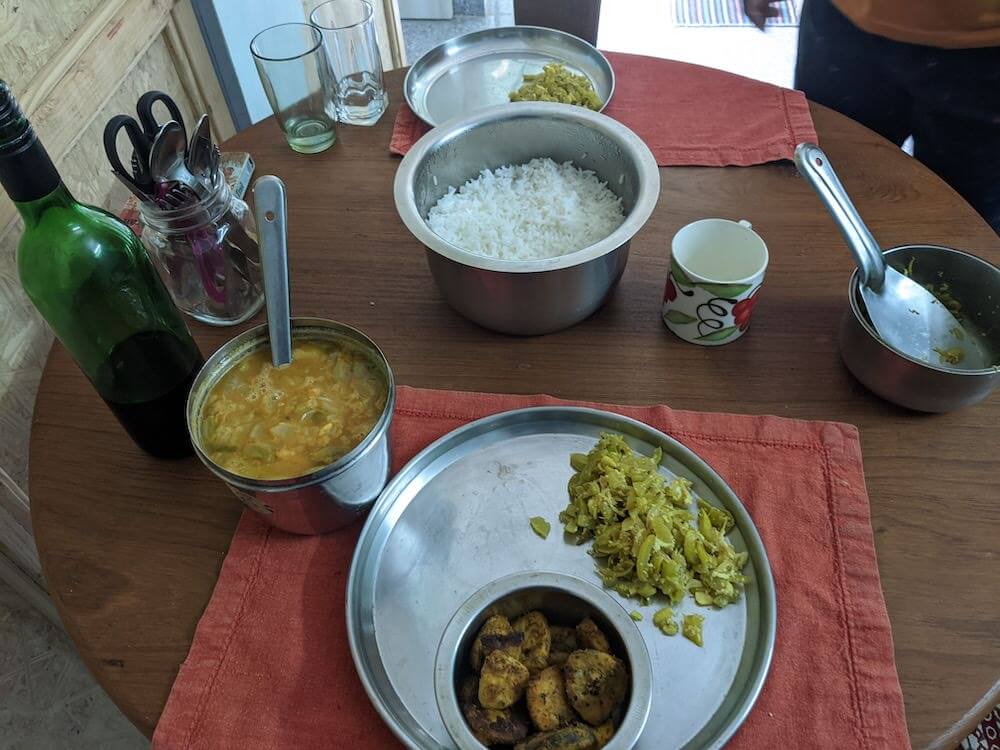
- What About Food? Does Life As a Nomad Make You Compromise On Food and Health?
- How Do We Pack For Long-Term Travel?
- How Do We Manage Money Since Becoming Digital Nomads? What Are Our Nomad Living Expenses Per Month?
- How Do I Make Money While Living As a Nomad?
- Traveling Constantly, How Do We Ensure Low Footprints?
- Reflecting on My Journey and Life as a Digital Nomad
- A Fairy Tale
- After 60 months of Hotels, Hostels, and Guesthouses, Do I Miss Home?
- Why Did I Become a Digital Nomad? Why Did We Leave Home?
- How Did Our Families React to Our Nomadic Lives?
- Scooby Dooby Doo, Where Are You?
- Homeless For 5 Years, Or, With a Home Everywhere?
- What Have I Learned?
- What Is My One Takeaway From The Journey?
- What Is The One Thing That Has Helped Us The Most?
- What Is The One Thing We Never Take For Granted?
- What Is The One Thing I Could Have Done Without?
- What’s Next?
- Would I Ever Want a Home Of My Own?
Introduction to My Digital Nomad Lifestyle
January 5′ 2024 Bangalore
Here I am in a hotel in Bangalore, writing about my nomad living and wondering why do I feel so cold and why am I so uninterested and unenthusiastic about everything. I have stayed in hotel rooms before for weeks. Not often do I feel this gloomy, directionless, and filled with the notion that nothing is going anywhere.
Is my sadness associated with the fact that all my friends in the city are busy with their kids and office? Either they are planning a vacation two to three months down the line, wondering how they would manage with their children, or they have returned from a holiday, coping with the consequences. Their kids aren’t well, office work feels worse than before, and the paraphernalia of city life has been at their throats since they arrived.
Or am I so dejected because—as my friend Jitaditya from the offbeat travel blog, Travelling Slacker, says—Bengaluru, this busy city of software giants and startups, makes a person lethargic and uninterested? Maybe, the gloomy and grey weather has dampened my enthusiasm as well. The sun came out for a few minutes. I was hot immediately, and now it is cold and windy again. The climate is dreary, at best. The constant traffic outside my hotel window could have also caused my despondence. Infantry Road, home to foot soldiers of the colonial British power in the 19th century, has an incessant movement of vehicles from early morning to, well, next early morning. Despite the window glass, you constantly hear the honks and vrooms.
My hopelessness may have something to do with the pending work on the blog as well. For the past two years, I was occupied with a creative writing project that didn’t let me look up from it. Concomitantly, the blog has suffered.
Update 2025: And here is the BIG writing project that was keeping me away from On My Canvas.
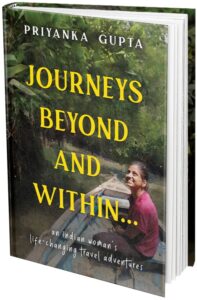
MY FIRST BOOK
Journeys Beyond and Within...
IS HERE!
In my vivid narrative style (that readers love, ahem), I have told my most incredible adventures, including a nine-month solo trip to South America. In the candid book, the scoldings I got from home for not settling down and the fears and obstacles I faced, along with my career experiments, are laid bare. Witty and introspective, the memoir will make you laugh and inspire you to travel, rediscover home, and leap over the boundaries.
Sikkim Express: "Simple, free-flowing, but immensely evocative."
The Telegraph Online: "An introspective as well as an adventurous read."
Grab your copy now!
The memoir is available globally. Search for the title on your country's Amazon.
Or, read a chapter first. Claim your completely free First Chapter here.
Perhaps, the feeling of transience and non-belonging that fills me when I see families, including every friend, doing the usual things everyone of my age does is irking me. Children, jobs, house, school, parents, workers, apartment events, et cetera.
I don’t have any of it. I mean I do have a family, a partner, parents, a car, and my never-ending work. But while my friends and acquaintances are comfortably, let’s just say, settled in flats and houses with multiple workers to help them, I live from guesthouse to guesthouse, sometimes, just because they will have me. I don’t have many employees, but an ever-changing staff around India keeps my room clean, cooks for me at times, and runs the online portals that ensure a roof above my head.
Is the lack of a sense of belonging, my fleeting presence in every place, the wandering life—tomorrow I have to leave again—bothering me?
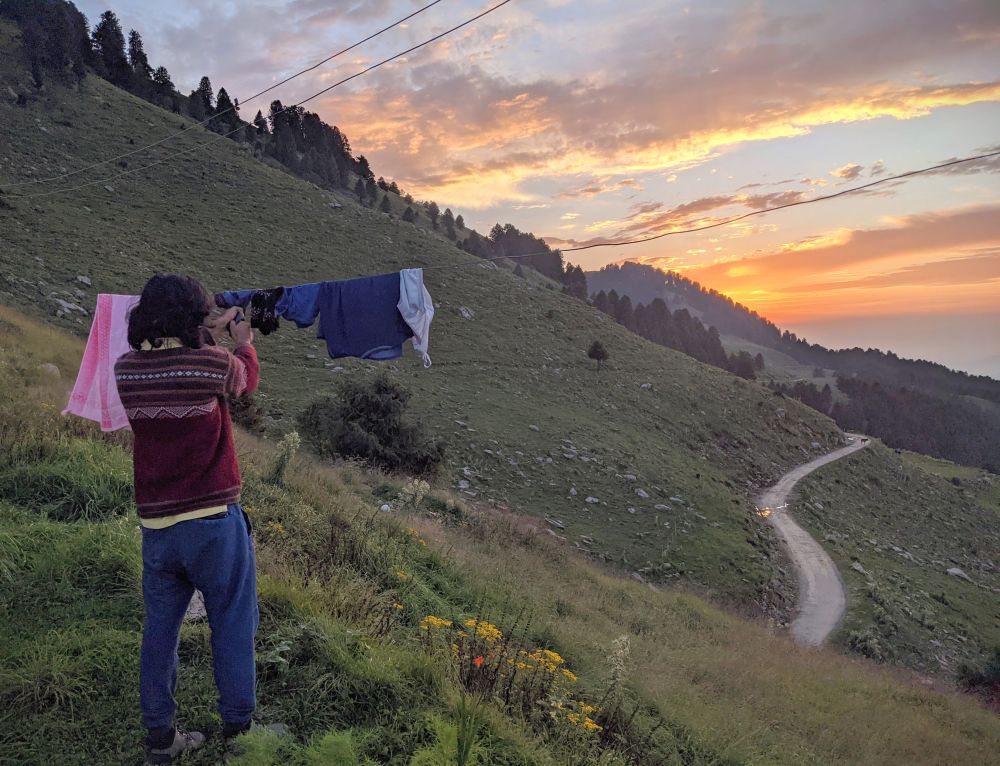
My partner, Sagar, and I left our tiny rooftop abode in Bangalore (Karnataka) on 31st January 2021, packed our things in our car, and got onto the road. This blog post details the beginning of our digital nomad life and how and why we made our way through India during the second wave of COVID-19.
Now after five years in short-term accommodations, how do I feel about living day by day, what are my most favorite adventures, and what have I learned?
As a reader recently told me on Twitter, “It’s really hard to pull off this lifestyle.” I agree with him.
Some mornings when I wake up, I can’t tell where I am.
But it is easy, and it is hard, and I will have to go into details to explain what I mean.
How Do We Find Homes Around India—5 Years Without an Address
How do you find these places? How do you find accommodations?
That is the first question everyone who hears about our digital nomadism asks. No, they don’t ask what we have seen or what was our most scary day. Where do we stay is on everyone’s mind.
Camper vans, motorhomes, or RVs that are so loved around the world aren’t common in India.
Motorhomes are complicated in our country. Endless rules and regulations, licenses and permissions, and rare camper van parks make the camper vans sound like a horrible experience to begin with. But the most discouraging is the unawareness of moving homes in India. You would be questioned at every traffic post, stopped at inter-state border crossings, and examined at places unexpected. People would forever poke their noses around your vehicle and ask questions, and the worse, you wouldn’t be safe. I can think of so many places we have crossed during our five years, so many forests, deserts, highways, and waterfalls where I have had an urge to camp. But I know how unsafe they can be. No one in the night to call, out in the wild, a man and a woman. I am sorry, but that can’t be done.
Camper vans won’t be safe in India, not yet.
If a motorhome was an option, I would have surely bought one, or converted a good old van into a camper van, driven it around the country, and taken it abroad too. Well, we make do with what we have with the hope that when I travel out of India, I will get a motorhome, put Sagar in it, and show him the world. Only to return to a cabin in the forest, stars above us in the sky.
Finding hotels and homestays—or sometimes a tree hut, a stilt house, a wooden cabin, a jungle mud cottage, a beach home, a tent, a ship, a 3400-m high government guesthouse in the wilderness, an apartment, a mountain home, a room, a friend’s house—a decent roof above our head—has been the hardest part of our journey.
Some nights I worried we will not find a place (like on February 10′ 2024, in Thrissur, Kerala): everything was sold out, accommodations didn’t look good, and prices were out of our budget.
Despite the tariffs, the quality of the accommodation and services promised can’t be guaranteed ever. The simplest things, regular cleaning, hot water from the geyser, and the internet, have been recurring issues. Requests such as not having cockroaches in corners or rats invading at night, a refill of the gas cylinder as promised, and linen change can be considered outrageous.
I have spoken a lot about Indian hotels/accommodations and Indian homestays in the linked articles. To add, I can say that our hospitality industry is unstructured. Even people who have not traveled can put up a home on rent or Airbnb. Amongst so many different cultures, the living style and rules of homes change from village to village. We are expected to follow them all. As most of us do, some hosts overvalue their property, and tariffs are high. Things have worsened after COVID-19. But whether the place and the service justify the cost is debatable. Hotel staff is underpaid, there are no regularized standards, and again, most people working in the tourism industry are untrained, haven’t traveled as much, and don’t personally care about the guest experience.
Our hospitality staff is often overworked, so leave friendliness and personal care, professionalism is a commodity you rarely find.
The elephant in the room here is that travel in India—traditionally—is associated with short vacations on which people relax, drink, eat, and have fun.
How many of us take an overnight bus to an unknown town, pay a dusty hotel, and eat strange food to learn about that place?
I didn’t.
Before I traveled to Southeast Asia and South America in 2016, I looked at traveling as a vacation. But having quit my job, I headed off to Southeast Asia without a return ticket or a plan on my mind. I wanted to impress my friends and ex-colleagues. “I will travel solo for an indefinite period,” I said. At that time, the idea of purposeful, slow travel was as thinly spread as “Not eating a big, carb-heavy dinner is a healthy habit.”
Though some of my reasons for traveling were wrong, my method was (sort of) right from the beginning. My heart was in the right place, too. In Thailand, I followed the advice of a couple of popular travel blogs. Soon I was trusting my instinct. By mistake, I overstayed my visa in Thailand, paid a fine, and arrived in Cambodia by a cross-border train at night. Luckily, the train had three other international travelers too. We got a taxi to the nearest town. I didn’t have anything booked, so I tagged along with a traveler from Chile to a cheap hostel she had reserved. In Vietnam, I arrived in most places without a reservation. Things worked out in the end, and I never slept on the road.
The magical thing that happens when you travel slowly—without an end date in mind—is that you take your time. You don’t have to rush anywhere after breakfast, so you sit and watch the chicken rice hawker play with her child. You connect with crazy people from around the world who had the same crazy idea as you—we will pack our bags, book a ticket, and go to this unheard-of place. The harder it is to get there, the more you want to go. You stare at the tri-rickshaws, eat in malls, and befriend people you end up hating. You climb waterfalls, wander around historical places (as sad as human torture centers and killing grounds), and jump in the water because everyone is doing so.
I did all of it. At some juncture, I started seeing the point in slow, observant travel in which one is not rushing from one destination to another or isn’t lying down in the hammock all the time, sipping coconut shakes. I have nothing against coconut shakes. But in Southeast Asia and on my nine-month travel in South America, I came across tourists who immersed in the culture, had adventures slowly, and for whom travel was a method of discovery. I became friends with Canadians, Chileans, Chinese, French, Dutch, British, North Americans, and Germans who traveled with their life savings to explore, learn, and undo. They were on indefinite trips, they said.
I wanted to see the world, too.
South America changed me is a huge understatement.
Everyone, at least once, should leave their home for a year, go to a distant culture whose language they do not know, and live in it. If by the end of the stay, you aren’t transformed, maybe you didn’t let go.
This guide on South America has everything you need to know.
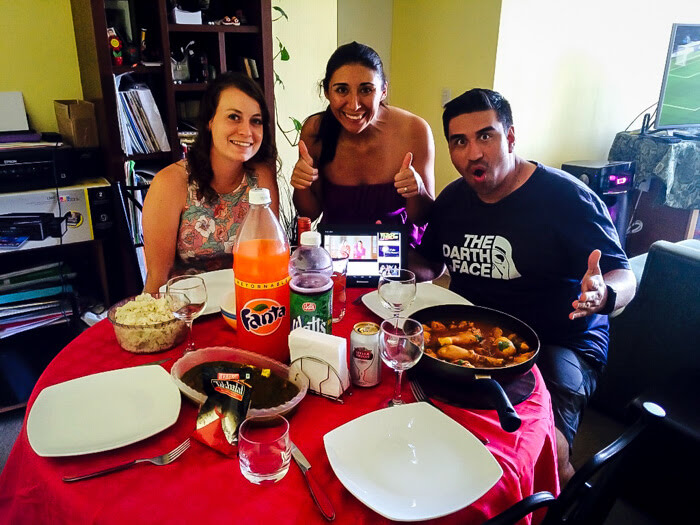
Now, travel has become a form of living for me. I travel, I live, I write. I can turn these phrases around in any order, but they all mean the same to me.
They say I am a digital nomad. I don’t care. If you define digital nomad as someone working and living from place to place, then yes, I am a digital nomad. But I choose villages over cities and mud sheds in jungles over apartments, and I never search “best places for digital nomads.” I never hunt down all the coffee shops in any location I go. Mostly there are no coffee shops around me.
Given that long-term travel—ours would be called indefinite travel, as we don’t have an end date—isn’t common in India, most hosts, staff, and owners do not understand why we are staying for more than a couple of days or beyond the weekend. They don’t understand why we would need the mundane day-to-day things on a trip. After all, travel is looked at as a respite from the daily living.
Our request for a work set up in a room, a simple straight chair and table, has confused many hosts and managers, especially in rural or popular areas. When we don’t order the heavy breakfast, aloo poori or parathas, we are considered a bit weird; while we are only trying to begin the day on a light stomach to stay active and productive. The staff doesn’t appreciate our need for a kettle, a larger space, regular cleaning, and a quiet atmosphere. I wouldn’t even go as far as expecting two workstations, laundry service, and a few plates and spoons in the room for one to have fruits.
You are supposed to put down your bags, go out, and only return at night.
In a hotel on the outskirts of Mysore (Karnataka), we left our room for lunch and handed the key to the staff, requesting them to clean. When we returned, the hotel was locked from inside. For the past few days, we had been wandering around the migratory bird colonies on the Kaveri River tributaries (the link bird sanctuary and also some unmarked, unknown places). Now, it was time to work. The Kannada-speaking caretaker woke up from his afternoon sleep, opened the door, rubbing his eyes, and asked: “You’re not going to the site?” He meant we were not going sightseeing.
Our room hadn’t been cleaned. And housekeeping was essential as the dustbin had overflown, the bathroom was wet and there was no mop, and in the absence of a space to dry towels, they had to be changed. We waited in the corridor while a begrudging staff did a rough job.
That afternoon, I was sure the staff didn’t appreciate our presence in the hotel at that time of the day.
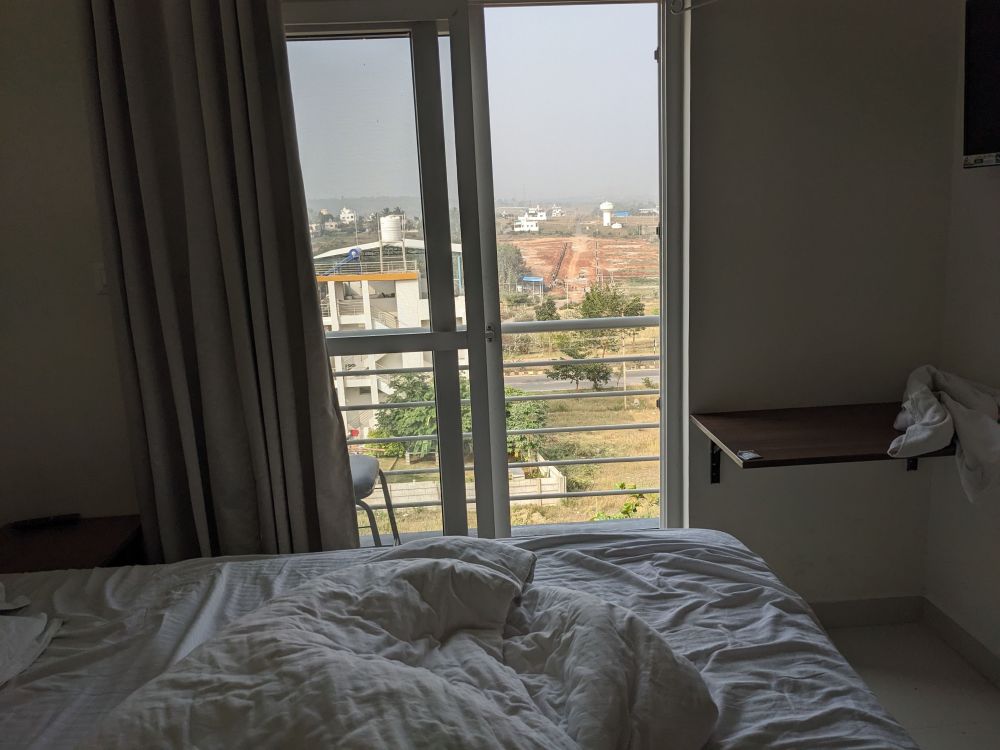
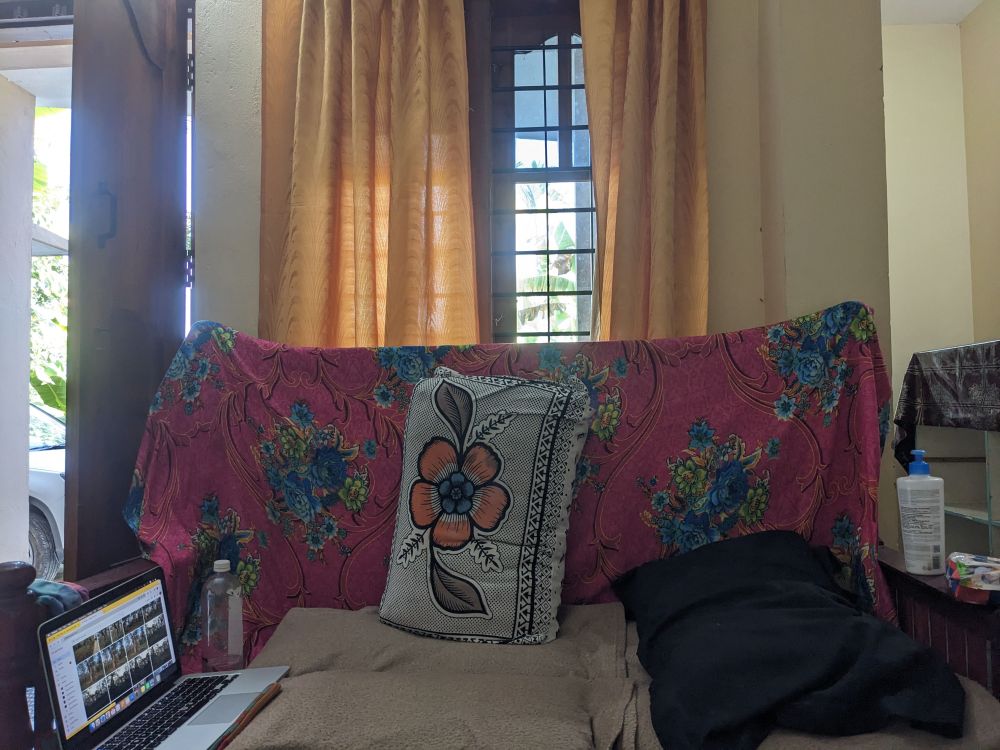
It is how it is. We get what we get. Then we make do.
Apart from what I have written on my Travel Resources page, this accommodation guidebook, and the homestay manual, I can say that we do not find places, they find us. Most often, things work out the way we wouldn’t have imagined them.
We book online sometimes (not Airbnb: read My Travel Resources Guide to know why), zoom into Google Maps and make calls (many, many calls), leave a question on a contactless property, look through accommodation portals of communities, follow friends’ recommendations, check out nearby properties of a present stay, extend our reservation and negotiate for a long-term price, and—one of our best methods—drive through the place, look at guesthouses from outside to notice any red alerts, request to show, and unpack.
The best way to go is to tell the intended duration of stay, ask about drinking water, wifi connection, and cleaning schedules, mention that you would like a quiet stay, and choose a room or floor that isn’t crowded by one or two days guests (if possible).
After doing this for five years, I don’t take even the basics for granted.
Negotiations aren’t easy, they aren’t hard. Slowly, we are getting to know how much one should pay, where to stop bargaining, and what to expect. From rooms and homes for three hundred rupees per night to ten thousand per night, we have stayed in them all.
We have learned that more money doesn’t mean better cleaning, cordial staff, bigger space, or quick resolution of system failures (Unless you are in The Taj, but, well, even in Taj, our shower drain was blocked and the hammering and drilling woke us up one early morning). In fact, we have gotten better care in smaller and more affordable spaces. A Pondicherry homestay that cost us less than a thousand rupees per night and provided breakfast and a washing machine is a family I can return to anytime.
Set expectations at the beginning. When we are shy about asking something or book the place though the host has already screamed at us (true story), things don’t turn out so well. Try to get a system established since day one. Never pay the whole amount immediately.
Mostly, the system fails. Be okay with that.
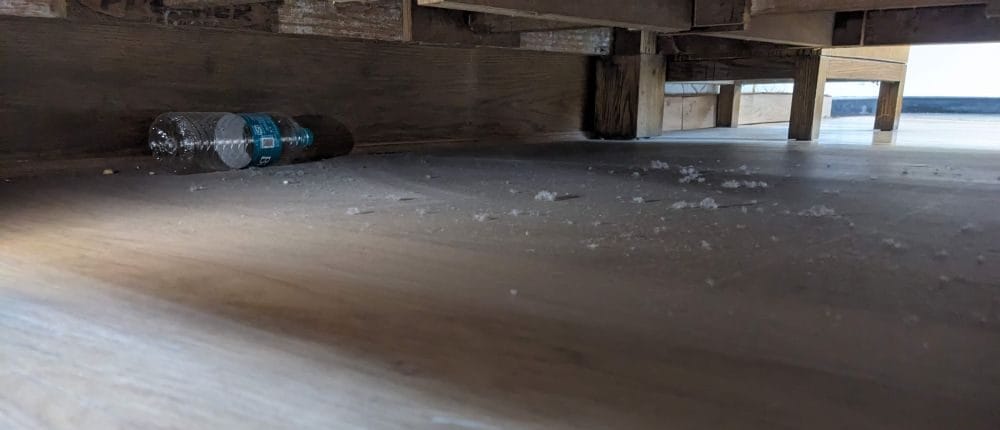
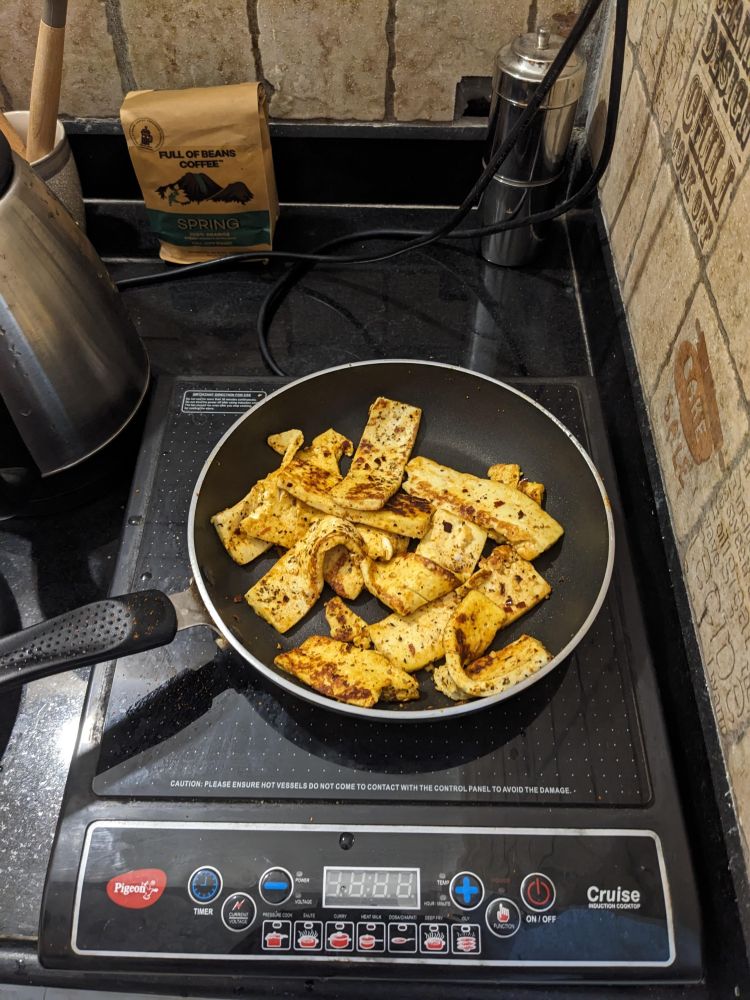
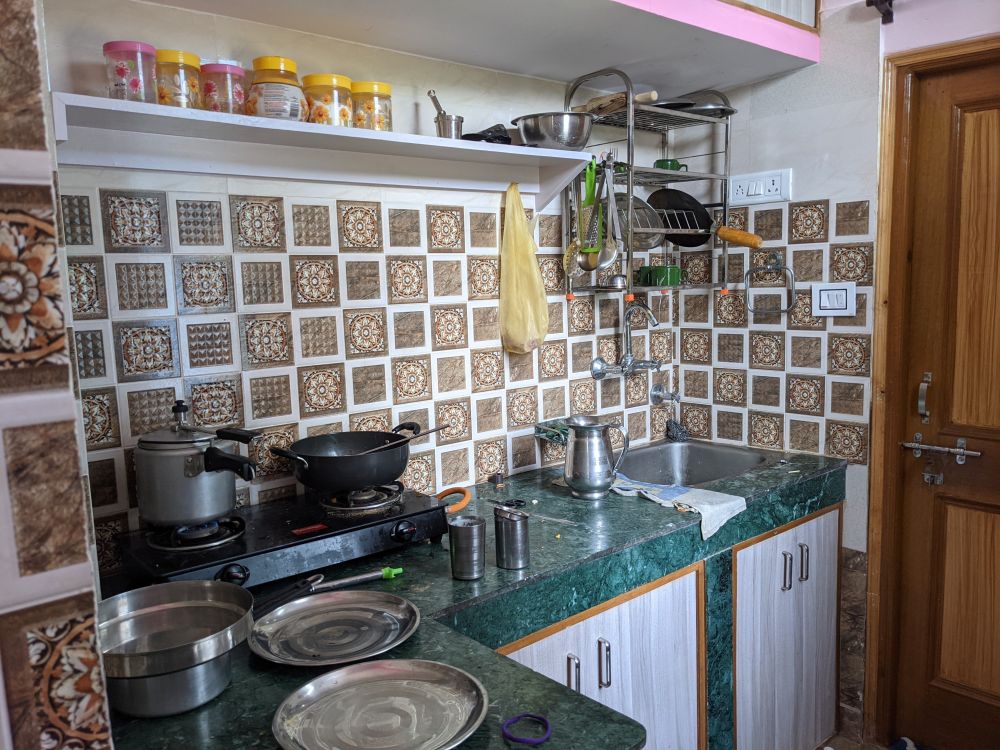
Upon check-in, usually an hour goes in coordinating with the staff to clean and getting the towels, toilet paper, water, and a usable kettle, and so on. In majority of our stays, even at family-run homes or in expensive resorts, we have, unfortunately, found the place dirty, unchanged bedsheets that still stank of smoke from the previous guest (happened in Mysore), giant cockroaches in bed (in the eastern Himalayas in Sikkim), filth or alcohol bottles under the bed and around the living area (recently in a Bangalore hotel), unusable bathroom (twice not even flushed), dysfunctional geysers from which water fell off the wall, hair-wrapped soaps, and so on. The utensils and induction were in the pictures but not at the property.
Having the house maintained regularly over a long stay is hard. Sometimes, the staff is persistent on daily tips: even when they have not done a good job, and we stayed for six months (happened in this stay in Auroville).
On some days, you are bound to be miserable. You have been requesting for housekeeping because you wanted the chore done. When the staff shows up hours later after multiple reminders, you can’t care anymore. But you still see the footmarks and the dead lizard and the foot-mat that is black now. Well, they are not changing it.
You request them. You feel powerless. One of the sullen housekeeping looks at you with hostility in her eyes. You are sure she hates you. She hates her job though, not you. When you direct them, trying to make the room your home, you face resistance. They talk to you or amongst each other in a language you don’t understand.
In a hotel in Palakkad city of Kerala, I requested a wet mop over footprints, and the housekeeping lady moped. Then she looked at me and gave out a contemptuous cry—though we had just been laughing together.
I was judged. I felt horrible. I might have cried a little bit too.
This is the back-and-forth I dread, the thing that can make me feel hopeless on a sunny afternoon. Going into the details, please provide fresh glasses and please put some cleaner in the toilet, renders me guilty.
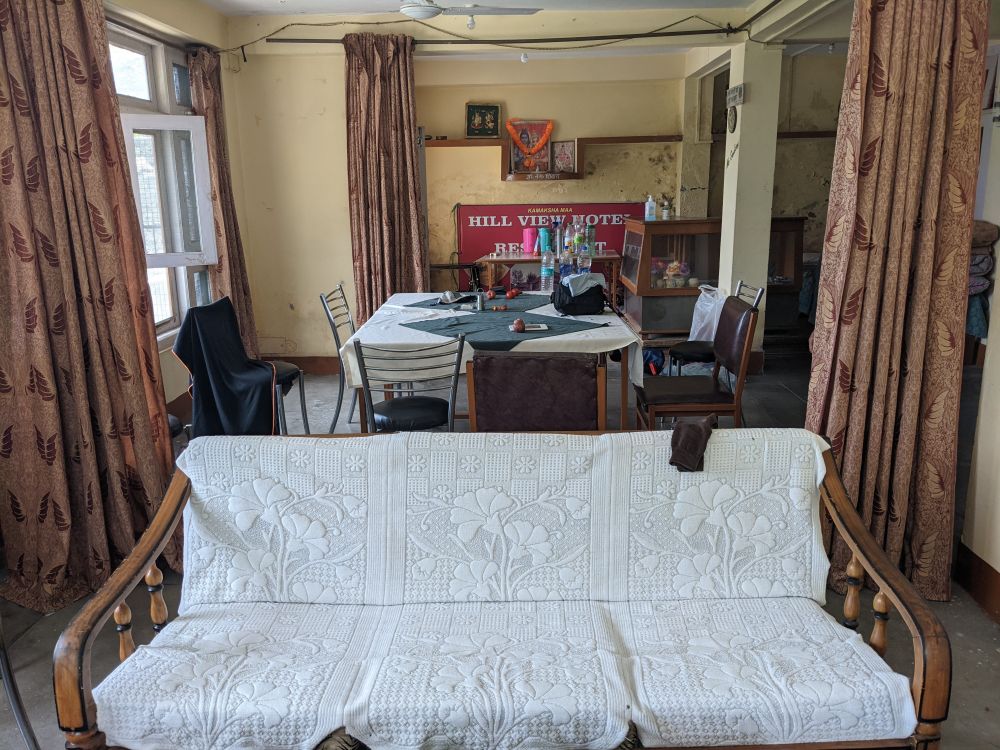
All because our hospitality industry isn’t structured, and we don’t have a system in place.
Over time, instead of depending on external friendliness, I have started to believe nothing I am asking is so outrageous that another human wouldn’t have asked for it. That people are complex. Each day is different, and the love, cordiality, and efficiency of the staff and hosts would change from day to day.
If a place gives you too much headache, get out. Nothing is worth a headache. You will find another home, but the most important is to be at peace.
Sometimes, we prefer not to utilize the services. For a month in Dehradun, we requested the host to not send the housekeeper. She had been aggressive and had slammed the door in our faces, while doing a bad job. During the entire stay, we cleaned ourselves though our rent per day included the cleaning charges.
At some homes or hotels where we stayed longer than a normal traveler, we felt uninvited, or as my partner says, “We overstayed our welcome.” That we should have left a bit earlier. What makes us think that? A certain comment, dour looks from the family or the workers, or a sudden retraction of services.
We, the so called digital nomads, might be a trouble to the workers who are used to guests leaving every morning and returning at night after seeing the attractions of the destination. Sagar and I stay and request replenishment for water, toilet paper, and tea bags and call if the power or the internet goes off. Sometimes, the forbidding look of the boy who brings us supplies gives him away.
In India, the service employees are paid peanuts. We tip frequently: from a hundred rupees to even five hundred. That still doesn’t make it. The hardships of the job raise the frowns again, and we are left to wonder if we have been nice enough, or if we are pettifogging.
I try to ignore everything and tell myself, as Sagar says, that we can never know what a person is going through, can never assess their inner turmoils by their faces, and it is not as much about us as we think.
Things are neither black nor white.
Many days, we just miss friendly smiles.
Even at our homes, no one welcomes us back every day. But it is home, after all. We cook, sleep, and invite guests over whenever we like. We have friends around. In a new area, you feel out of place, and a little bit of friendliness and simple gestures put you at home right away.
At times, we have resided in accommodations for months without feeling that homeliness outside the boundaries of our room, apartment, or hut. We stay put. That was the need of the hour. Either we had to be in that locality, and there was no other better place, or we had already paid, or we were too tired to notice the indifference and so made do. The home was, in itself, sufficient enough for that time even with its imperfections and particularities. When in one Pondicherry home we couldn’t take the host’s inappropriate and unjustified demands, we involved the police and left immediately.
All around India, there are a couple of hotels and a few families to which we can return anytime. When we go back to a place where we have stayed before, its people recognize us, welcome us, and we are at home immediately.
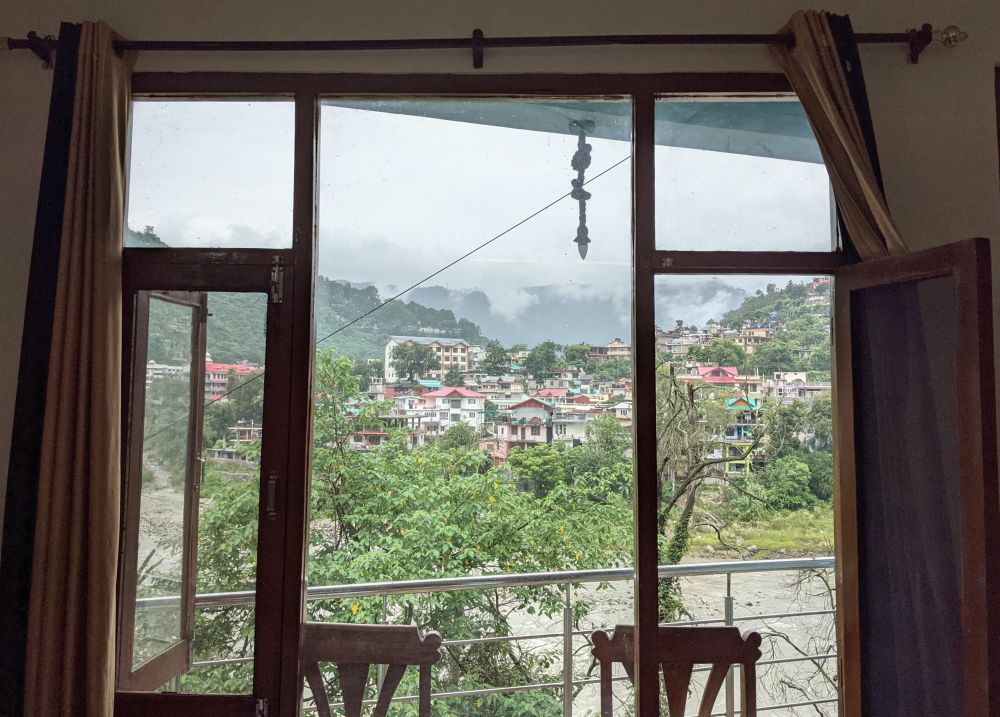
In Such Transience, How Do We Make Ourselves At Home? Or, How To Not Feel Homeless While Living a Nomad Life?
We humans are screwing up the planet, but we know how to keep ourselves safe and secure.
Now after getting into a new place hundreds of time in the past five years, we make every home quickly ours.
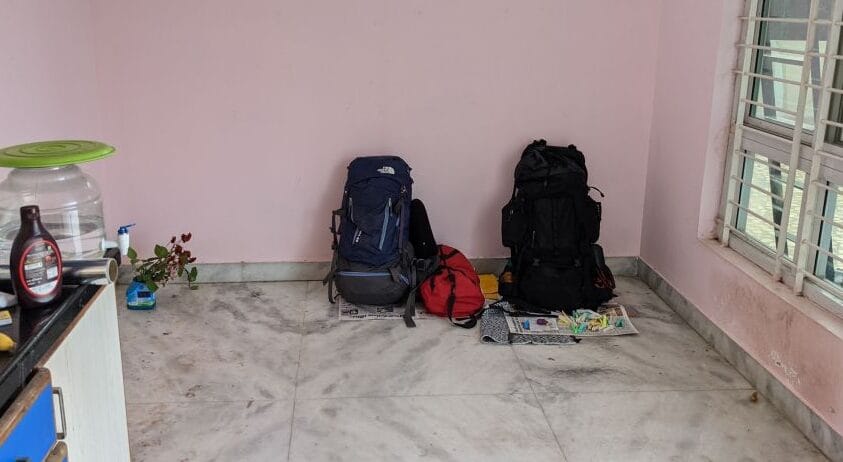
As soon as we get in, we put down our backpacks. In the later section on how we have packed for the road, I have explained our packing. I also have a complete article on how to choose a good backpack for yourself. We bring both backpacks and laptop bags from the car. After carrying two separate laptop bags for five years, recently, I put my laptop into Sagar’s shoulder bag—because that’s what we were doing every time we got down at a park or climbed up a mountain to work in the green. Now, we have to bring up only one work bag. If I need my notebooks and diaries, I bring mine too.
Sometimes, we realize the simplest of things in months, even years, and I find that amazing. Even after five years, we are constantly updating, modifying, and recalibrating the arrangement of our things, their positions in the car, and what we take when we check in. There’s always scope for improvement, and we can never say, ‘This is perfect now.’
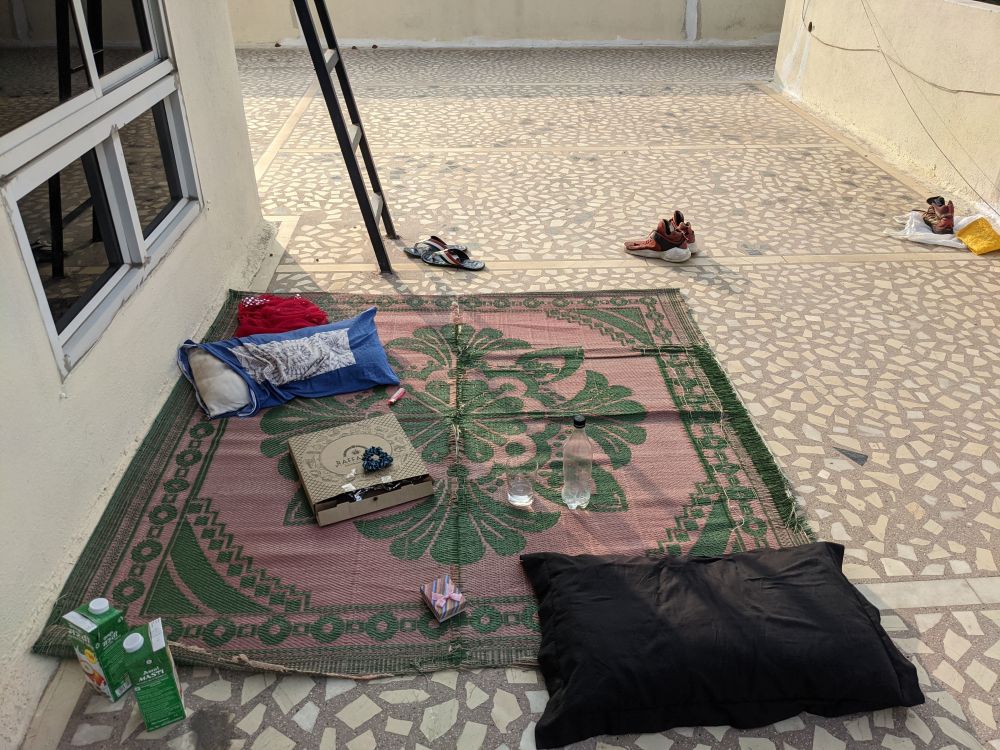
I take out my body cream (this is an ultra nourishing cream from France I use regularly for I get dry rashes frequently), toothbrushes (my go-to extra-soft dentist-recommended toothbrush for my sensitive gums), and water bottles and arrange them in the room. For a longer stay, or when we get one-foot high or stone-hard pillows in our room, we get out our pillows from the car, too. They are our back cushions on long drives. Beddings around India have broken our trust. So when we are doubtful, or lizard droppings shine on the bed (the caretaker, of course, denies), we take out our bedding bag.
Update January’ 2026: For the past seven months, we have been traveling without our car. It is parked at Sagar’s parents’ place, and we both are carrying our backpacks and laptop bags. Not having a car hasn’t bothered us at all. In fact, I feel liberated. No need to look for a proper parking space, clean and maintain the car, or to repack and load up the stuff that we would invariably take out just because we had it. We are making do with what we have in our bags and using public transport between destinations.
Anyways, we always used to walk around or take taxis or public transport within a place, so this is perfect for us.
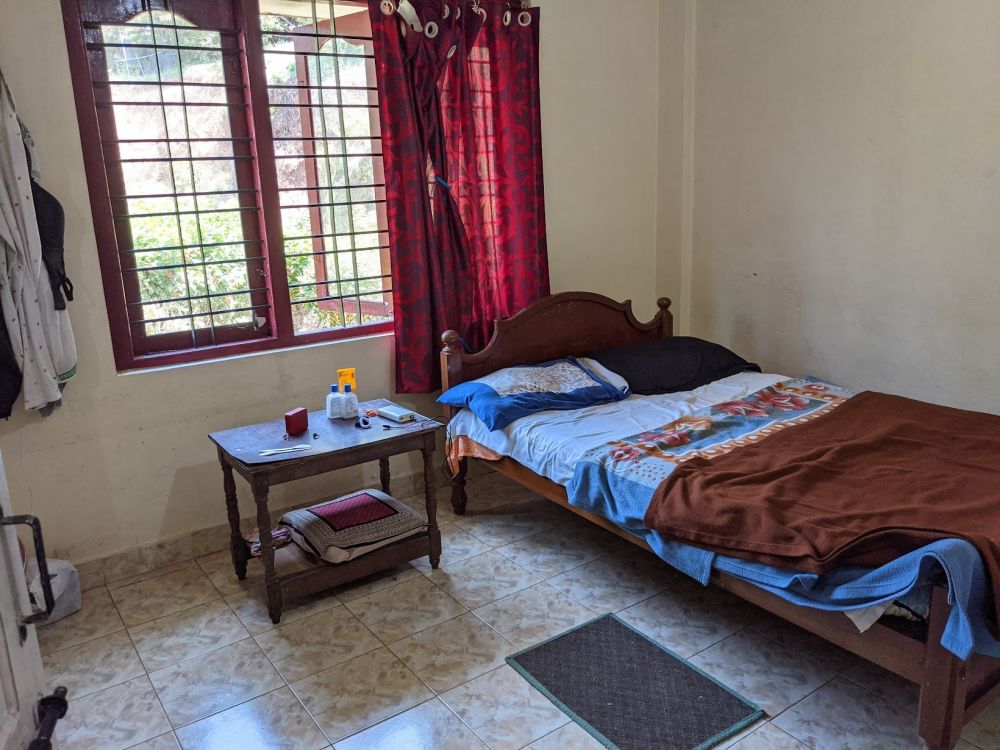
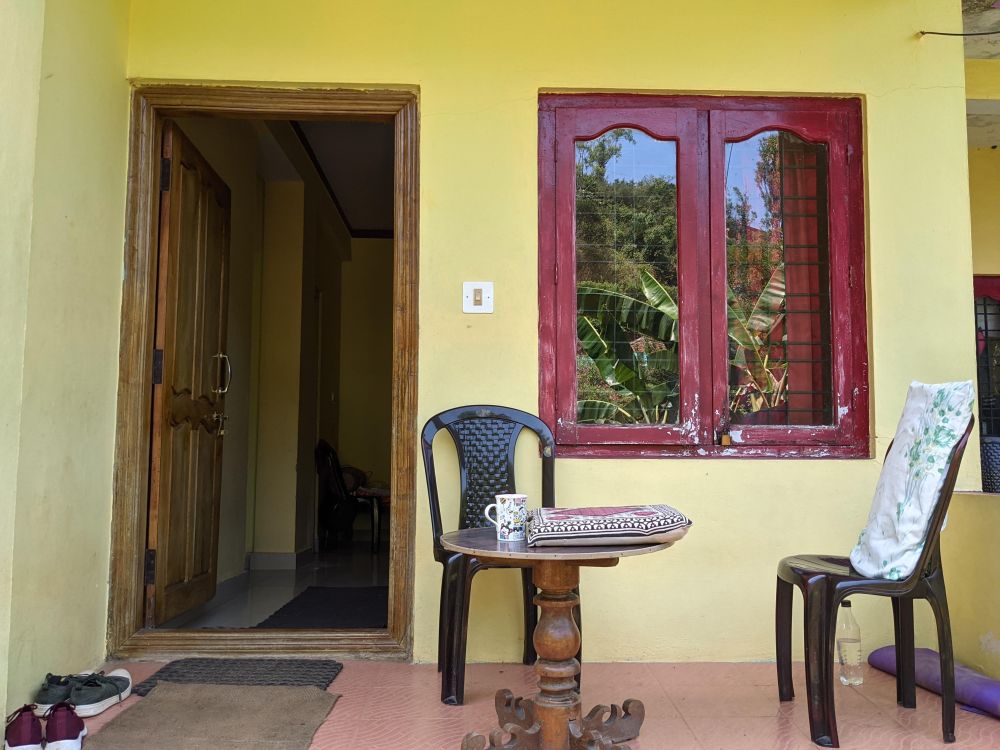
I can make perfect sit-outs of uncomfortable sofas in hours. We get water bottles filled at night, so early morning, we don’t have to call or knock at anyone’s door for water (I gulp litres as soon as I wake up). Somehow, I mostly find a bed facing the east. Recently, in a house with multiple beds, their mattresses still in their plastics (I guess to keep them clean), the only bed with a mattress out of its plastic became our bed for three days. It was also the one on which the first sun rays fell.
When almost everything changes around us frequently, nature is our constant friend.
Everything is psychological if we look at it. For sure, the presence of our things in the room makes it our home immediately. I even hang our night clothes, and the moment we are in, we take out our indoor slippers. A cup of chamomile tea before bed snugs us right in. How do we heat water? In the absence of a stove or a hotel-provided kettle, we bring out our own.
Our friends lovingly gave us a kettle they weren’t using. Now, it stays in the kettle bag and comes out on cold nights or sleepy afternoons. In a wooden hut, the geyser switch worked as a plug point. We weren’t sure if the other charging points would take the higher wattage so didn’t take a chance. (Here is the stay, perfectly lovely by the way if only a too hot, and you can also read about our adventures in that lovely hut nestled amidst small ponds in a small Wayanad village.)
Talk about finding a solution!
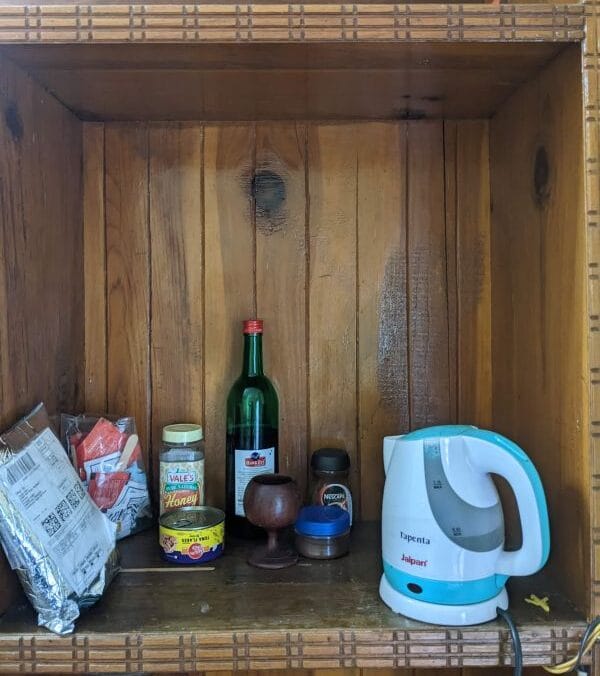
Since then, that kettle has died, and now we have this one. It is small and like a flask, fits easily in our laptop bag, and comes in our budget. Now we don’t have to depend on anyone to provide us a kettle or hot water, and neither do we have to go out just for coffee or tea, especially as soon as we wake up.
In every new place, we soon get into a sort of a rhythm, a rhythm that has been developed with habit, by traveling often, and by doing this enough times. The rhythm takes over, and we merely dance to it.
What we are still wrong about is the time we would need in each place. Often, we are extending our stay or leaving half-hearted. If we could just stay for one more day!
After five years of nomad living, still wanting to stick around to places and be able to feel at home anywhere is a good thing.
Now we are ever slower, exploring a destination at our pace, writing and working and walking around, cooking our meals, and finding our own adventures. So we might scramble into hilly caverns or dance along with a religious procession, but a must-visit cafe or a Victorian building might never make it to our list. For sure, we squeeze into vegetable markets, climb up lighthouses, and sit at local restaurants, drinking beer and crunching friend prawns, much to the surprise of local servers and men. The longer and wilder the paths the better (no matter if one is not allowed on them) and gobbling a thali by the roadside is preferred over a fine-dining.
We are growing ever so unapologetic. I, especially, do not like to move every day, and choose a kitchen-stay over a simple room whenever I can (for the love of cooking, buying green ingredients, and healthy food). Sagar loves everything but cannot take pettifogging hosts or intrusions of privacy. In Calcutta, on the east coast of India, we were frustated with the guesthouse hopping we had to do in the absence of a desirable place but then soon settled into the house of a friend of a friend and made it our own as if we had always had it.
One day you are homeless, and the next morning, you are kings.
Working While Living The Nomad Life
Beyond finding good stays, the most challenging has been to work on the go.
My partner has a full-time remote job. His calls and meetings can be so incessant he won’t even get up for lunch. This doesn’t have to be the nature of the work, but it has been so.
Checking out of a place to get to a new one, going on a hike, and even buying groceries (we were on the road during the second COVID-19 wave) becomes hard. At the beginning of our journey, we fought in Mashobra village in Himachal over, “You can’t take out one hour to buy groceries and lunch” as I have written in the linked narrative. When we do go out during his busy work day, we have to be extra patient with each other, or a disaster is imminent. Suddenly, a storm might make it difficult to climb, networks might disappear, or there is always the back and forth at the new accommodation.
Initially, Sagar was driving us to all the places, and I was finding guest homes, negotiating, talking, settling us in, getting the place clean, cooking, and so on.
“Do you think you are the only one who has work? You don’t care about my work at all.” This was my usual criticism.
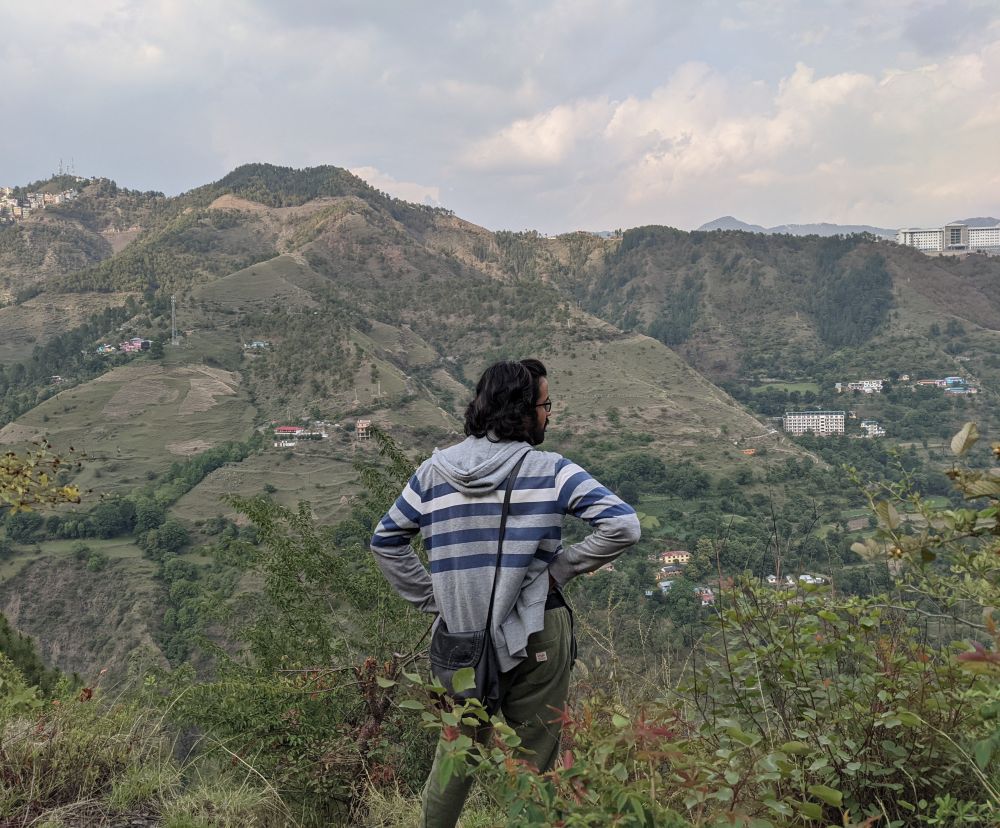
My partner—who couldn’t change the schedule of his work—repented his behavior. I repented my harsh words. On our four-month trip through the Himalayas in 2021— we were traveling faster, moving often, and hiking a lot. We stayed in most locations for a couple of weeks at best. Climbing apple trees, admiring blood moons, and daring wild trails were our day-to-day.
My Himachal Pradesh articles can be found here.
Amidst so much, we used to be stuck in long, miserable discourses of blaming each other and apologizing to each other.
“You don’t care and you take me for granted,” and “I didn’t mean it and I didn’t know” were our favorite phrases.
Not anymore.
Sagar cares for my work and progress more than I do. His inability to pause his work had nothing to do with me. Now, instead of being stubborn—if you won’t adjust, I won’t—I depend on the flexibility of my work: I can write earlier or later in the day to keep us going. He takes over the weekends.
The idea is to keep our lives running peacefully. And every so often, I can say, “You have a meeting? I’ll just go get some mangoes.”
I accept the host’s request to join the family for dinner around a bonfire. On Sagar’s behalf, I give the excuse of his meetings. An afternoon walk around the cottage’s coffee estate or picking corn with the village women is my solitary time, and I don’t even ask him to come.
Sometimes, we still argue over managing the day, but these conversations aren’t as long drawn-out as before.
Changing homes or locations on weekdays and exploring the local places is unavoidable, even desirable.
“I want to walk this way and see what’s here,” I often say, pointing to a path or street around a new guest house. Or if we leave tomorrow, today is the only day to see that temple down the mountain. The local events and festivals don’t follow our work schedule either.
At every destination, Sagar and I patter nonstop about what we want to see, do, try, and figure out. We are still learning to flow between leisure, work, and exploration together.
From that hotel on the outskirts of Mysore where the staff was surprised that we didn’t go sightseeing, we checked out on a weekday. Extending a day in that guest house would have been a blasphemy. On such mornings—most checkouts are by noon—we get ready, work, pack, leave, and drive to a new hotel we have shortlisted or stay out. If something works out soon, good enough. Mostly, we find ourselves in a park or a garden, in the car parked on the roadside, or perched on a bench under a tree. We work some more, shortlist a few more places, even explore the destination, and see one or two guesthouses and finalize. Sometimes, we check in by seven or eight pm, and on those days, we have to be each other’s and our own best friend.
Now without our car, we book a place before we check out. Or, if we have to leave in a rush, sometimes due to unaccommodating hosts, we take a cab to a cafe, preferably with large sofas, and decide sipping hot cups of coffee.
That day in Mysore, we checked in much earlier though and took a long afternoon nap. But I will never forget that Friday when we left our friend’s home at ten am, drove to another city (Chandigarh), saw its places, tried on different hiking shoes in stores, worked from a cafe in a mall, ate at a well-known food joint, and, when we didn’t like any accommodation, drove to Himachal, checking into an amazing hotel by eleven pm.
We were exhausted by the end of the day. But getting into a good home is more important than a rushed check-in.
Finally, in bed, we said, “I can’t believe we have done so much today!”
From mid 2022 to the end of 2023 and for six months in 2024, a big creative writing project my book made it difficult for us to move around so freely. I started it in Pondicherry in March 2022 and wrapped up the first acceptable draft to be send to the publisher in mid-October 2023. During this time, we stayed put at locations and homes for longer than intended. I hadn’t planned to write a book while living the life of a nomad. Now when the publisher asked me to write one, I had to do it.
How Did We Manage On The Road While Being Buried Under Work? Was The Digital Nomadism Worth It?
Taking you through our stay in Pondicherry, Calcutta, Vietnam, Siliguri, Sikkim, and Himachal
Pondicherry
Our slowing down for the book began in Pondicherry in March’ 2022. Overall, we stayed in the area for ten months.
Were we still exploring and traveling or just living?
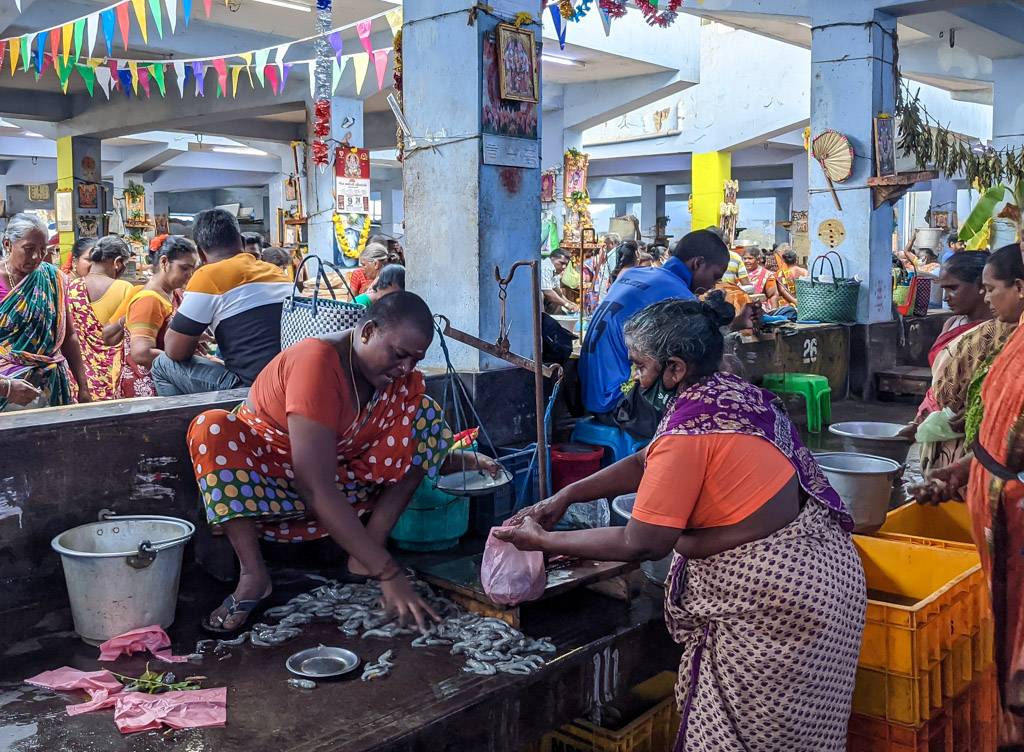
During January and February, we lived at a beach in fishermen’s colony, right next to the most popular neighborhoods amongst tourists. Though we didn’t tick mark the list of things to see, we lived with locals, visited the ancient grocery market frequently, bought greens I had never seen before, walked regularly in those neighborhoods that travelers visited especially, and went to the beach every day. At four am, we were woken up by the calls of the fishermen calling each other, already taking out their boats into the sea.
Maybe you won’t consider all this as exploring the place. I do. When you buy fish from the street fish market, try to get it scaled and cleaned by a woman who is already scolding you in Tamil, and elbow your way through that busy hotchpotch, you get the real experience of the destination.
To travel is to see, feel, and hear, and not just have a good time.
In Pondicherry, I also picked up the car again after my driving course that I took in February 2021. In between, I didn’t drive due to COVID restrictions, mountainous paths, and just the inertia of not having driven for long. Though I started taking the car out at five or six am, mostly, we returned by nine. During those morning hours, we caught the city of Pondicherry in action.
Auroville, Tamil Nadu
From the beach, we moved to Auroville, a community on the outskirts of Pondicherry. Established by Mirra Alfassa in 1968, a follower of Sri Aurobindo, now people from about fifty-nine countries live in Auroville. Many of them came as early as the 1960s, following the founder. Though the idea was to make a space where all humans will live in peace as equals, now the community represents a disillusioned diaspora from the world who wants a different life but doesn’t want to work for it. Trouble in Utopia: an article about Auroville on Slate.com by Maddy Crowell ends on the perfect note,
“That place (Auroville),” he (a bar owner in Pondicherry) waved his hand at the ground. “They’re all looking to be cured. The ones who are cured, they leave. The rest, they’re stuck.”
“Cured of what?” I (Maddy Crowell) asked.
“That,” he responded, “is the question.”
In Auroville, a hut in the middle of a dry forest—with no running water connection, an outdoor cold shower, and an outdoor little stone basin on the earth to wash utensils—became our home for two months. It had a simple cement floor, a mattress for bed in the ventilated attic, and long meshed openings in the walls covered with thin georgette clothes. There was no wifi connection, our phone caught network rarely, and we were in the middle of a forest with frequent power cuts. Not that we had more than one plug point, two faint lights, and a standing fan we never turned on.
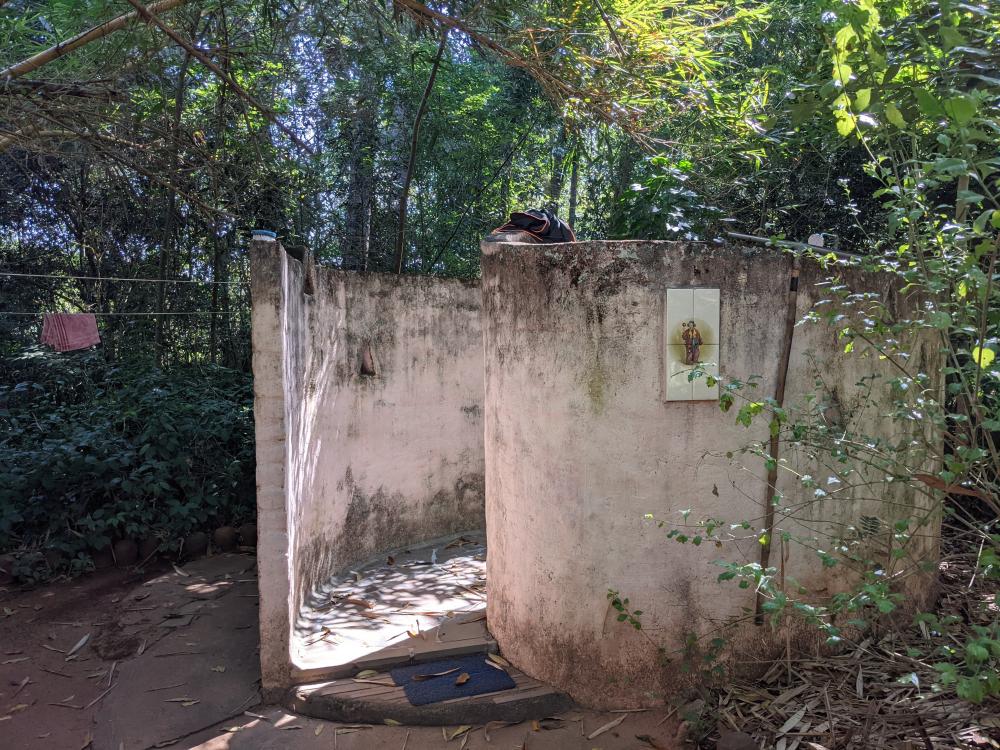
Sagar wasn’t excited by such raw, rustic living. But I had gone to Auroville—a place known for unique housing solutions—for the down-to-earth homes.
“I know you’ll never stay at this place. I always adjust for you, but you’ll never compromise for me.” I wiped my tears in our temporary accommodation right outside Auroville. We had just visited the hut, and its squat toilet with no hand shower had broken my hopes.
“Let’s take it,” Sagar said, consoling me.
“No. You’ll complain forever.” I shrugged his hand away and curled up on the bed, my laptop waiting for me to resume the draft of What is Good Writing and a Christmas bonfire leaping high in the sky beyond the window. The past few days in the Pondicherry house where we had to call the police had been tough (the host wanted to charge us for the dilapidated crap she called a washing machine, and we had put our foot down.)
Sagar insisted he would adjust. We took the jungle hut for a week and kept extending it.
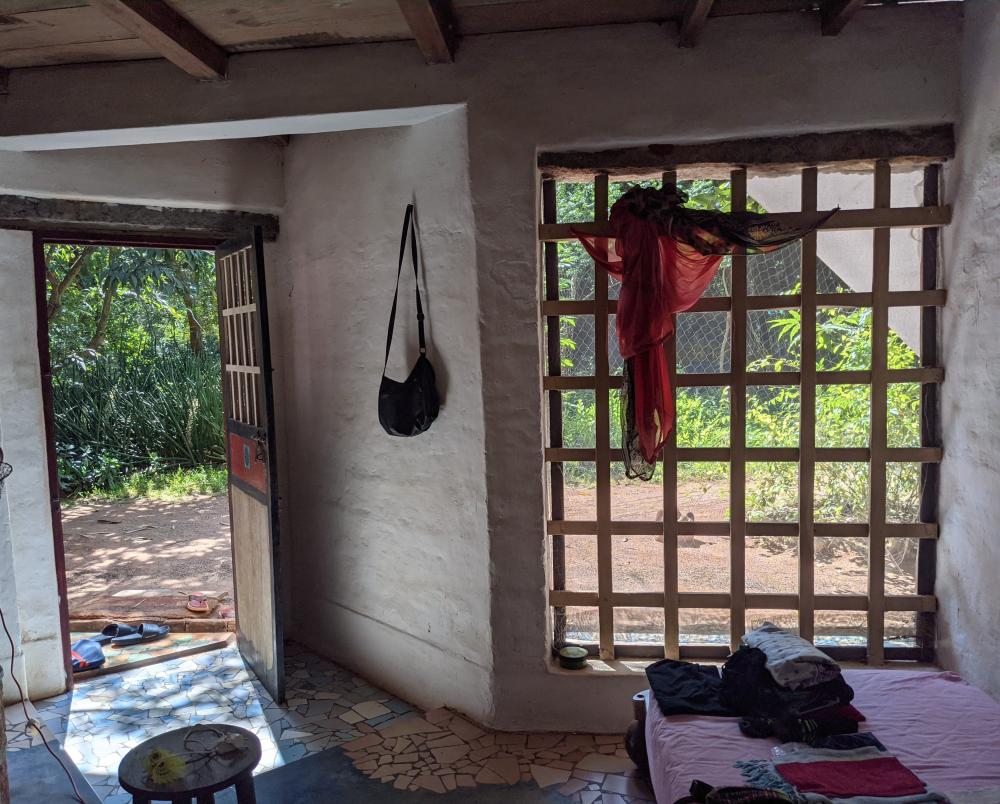
That jungle cottage needed us to work hard and be patient every day. Our host was an old French woman, and trying to coordinate, raising the problems, and convincing her that yes a big fat rat did sneak in every night through the wall mesh deserved a post of its own. I have to write it soon.
When I looked beyond the living issues, the natural life breathing around me absorbed me completely. Through my daily walks and explorations that began at dawn and went into the night, I studied how a forest breathes, which animals are shy and which are friendly, and how the light filters through the leaves throughout the afternoon. Mushrooms, moss, and moths all intrigued me.
When we were not busy staring at snakes outside our cottage or watching the stars from our bed, we attended local festivals and art activities and finally explored parts of Pondicherry we had not seen while living in the city. One fine day, when the host shouted at me that I was spoiling her Sunday—the shower didn’t have water, and it was pending to be fixed for weeks—I finally put my foot down (again). A noisy new neighbor in the other hut who thought only old people liked to be quiet didn’t encourage me to stay either.
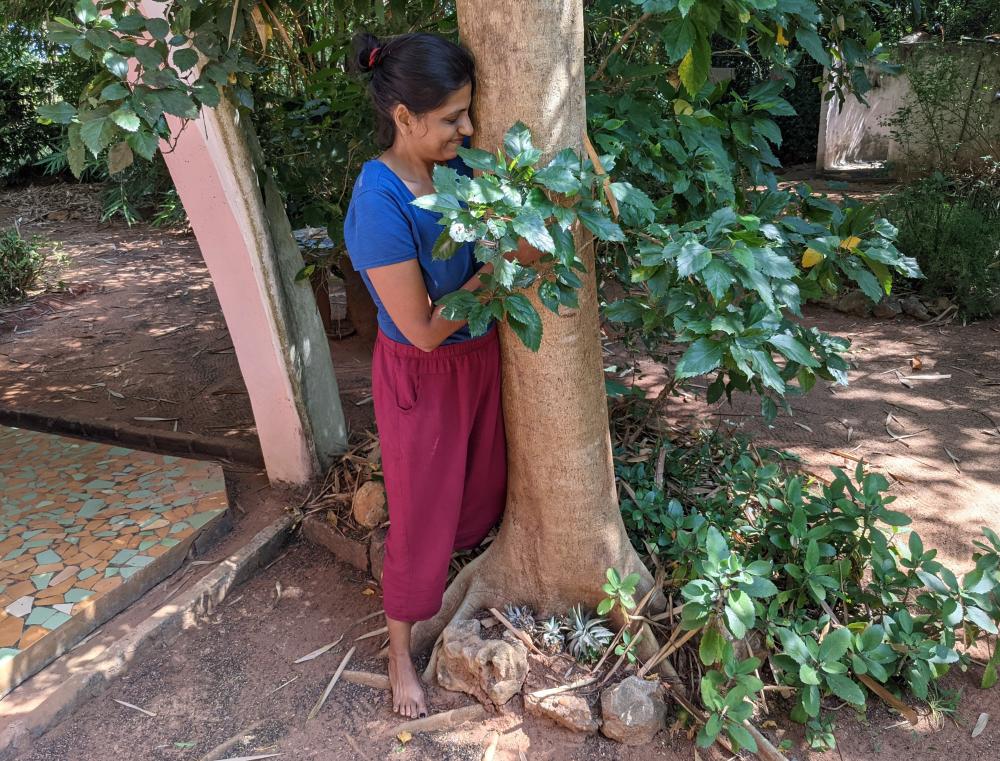
From the forest, we went to another guesthouse, which was at the edge of the jungle. Now, we didn’t have to bring our own water cans, weren’t told we were using too much gas, and didn’t have to do gymnastics with phone in hand, looking for internet. Wifi and electricity mostly worked well, and the staff looked after the rest of the things with a little cajoling. Of course, we weren’t in a hut in the forest anymore but it couldn’t be helped.
That guesthouse was our longest stay during the five years. We stayed in the same room for six months, and my big writing project travel memoir, Journeys Beyond and Within…, took wings from that room. I woke up at dawn, walked around the lake, and admired the snakes and turtles that showed themselves to me. After a shower, I wrote with a cup of black coffee on the table.
That was my schedule for most of the six months. In between, I attended Tamil festivals, classical music events, and plays in a nearby theatre. I walked and biked through the mud lanes curling through the forest, letting myself get lost and discovering a new path daily. No one stared at me, even if I wore short skirts or shorts. I was free, at least wardrobe-wise.
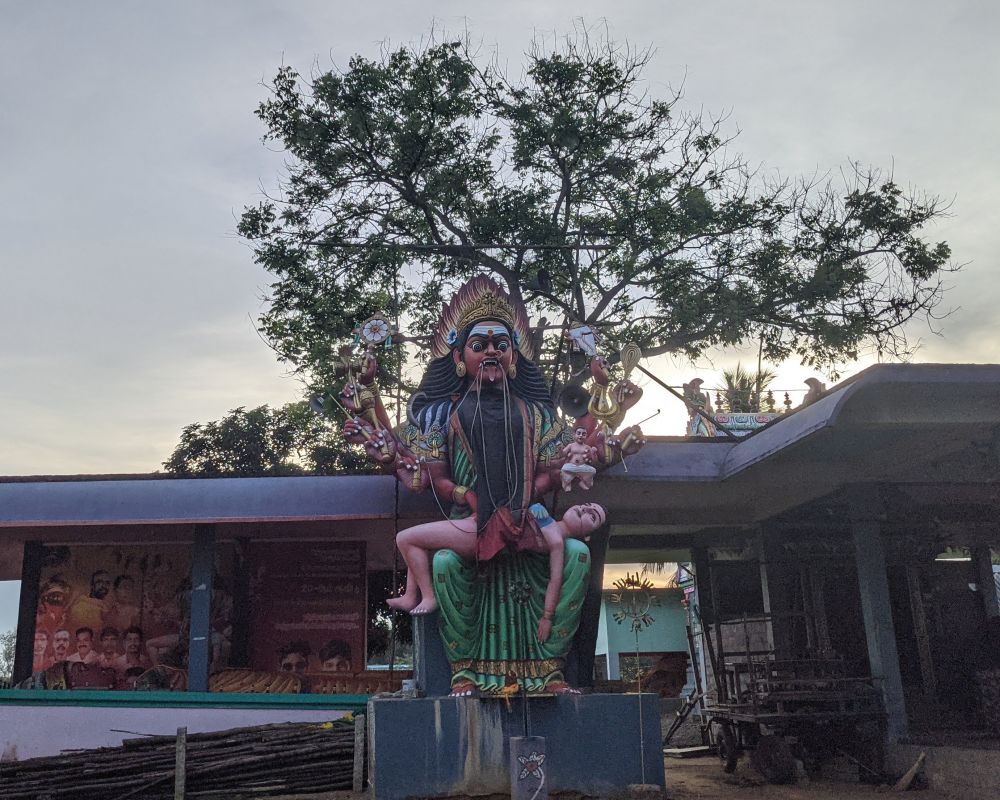
Every Friday, Sagar and I gave the keys for the weekly cleaning and biked to the community’s grocery store. Pulling ten to twelve kilos of fruits, vegetables, and cheese on an uphill slope in the sun, we broke into sweats. We drove to the city to buy mangoes from a wholesale truck. Every time some ten kilo was picked up. Sadly, I don’t have a photo of me on my blue bicycle beauty.
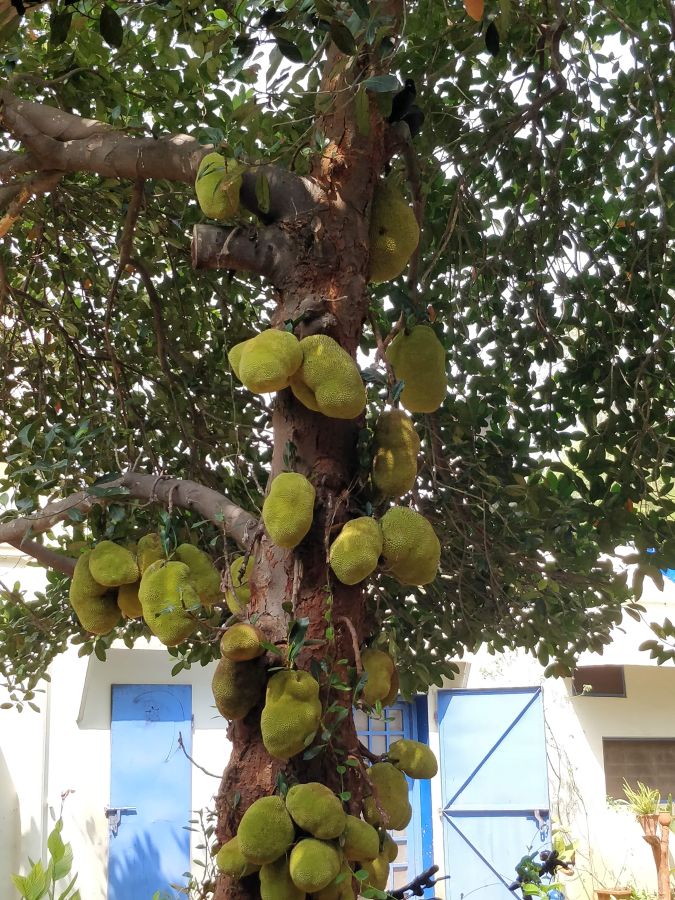
With a friend from Columbia, I walked amongst the trees at night without any flashlight. In the darkness, the silence of the forest was even more profound. With another friend who was old and in a wheelchair, I watched the guesthouse lake, both of us quiet. I stole drumsticks, lemons, and papayas from the trees outside our room and cooked to my heart’s content. In the jackfruit season, Sagar and I carried empty bags and a knife and biked to the forest jackfruit trees we had marked on our mental map.
“Be quick,” Sagar said to me as I tried cutting a large jackfruit, its spikes poking my palm. I got a big jackfruit free, but the white sap oozing out of its stem made everything sticky. I pulled another smaller one, too. We quickly put them in plastic bags, shoved them in the side bags of his bike, and pedaled hard to our guesthouse singing, laughing, and hailing ourselves as the heroes we are. I prepared the jackfruit fry with onions the way my mother does.
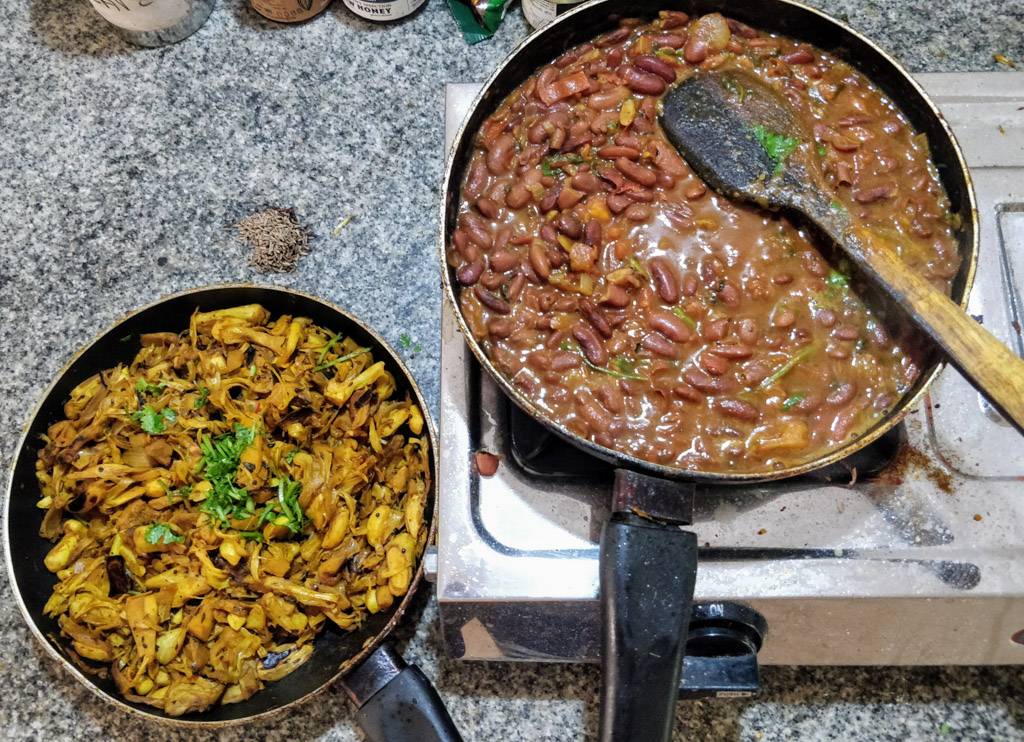
I didn’t leave home to become a jackfruit thief, but I don’t mind the title.
Though we were too shy to be seen taking the wild jackfruits, now I know anyone could have taken them, and no one would have minded. If I say life is a bit like that too—treasures are waiting everywhere to be found—you might not believe me.
The journey sounds like a dream. It mostly was, if not for the people of Auroville. Though I have a couple of posts on Auroville in drafts, this article is a good place to mention that when you stay in cultures different from your own, or when you don’t follow the popular culture practices, you stand out and that may not be the good thing always.
For example, Sagar and I don’t fit into the culture of my parental home in Uttar Pradesh. Instead of a sari and bindi—the conservative markers of married women in North India—I wear pants and don’t even put on earrings. I have quit my job to write, we live out of a car, and we cannot be found visiting temples or praying. Our unconventional choices put us right out of the circle of people in any community. No matter whether we are in the East, the West, the North, or the South, language, religion, physical appearance, lifestyle, work choices, and eating habits segregate us from others.
In most places, the differences are obvious as we are outsiders. But even in experimental places such as Auroville—which claims to be a universal town where men and women of all countries can live in peace and progressive harmony above all creeds, politics and nationalities—we didn’t fit in, to our surprise. Irrespective of what the community said, the fact that they are a group, made them particular and exclusive. As the residents value less work and more leisure and depend on external donations, we were judged for working online and working hard—the linked post has more details.
We still resided in the place for eight months. You may call us hypocrites but we were taking what we needed from the system. Auroville is a big place with about three thousand people (as of June 2023). The idea behind the township was to have a space for all beings from around the universe and the capacity imagined was 50,000. However, due to in-community conflicts and slow growth, houses are fewer and green space is much larger. Think of the township as several buildings scattered around a large forest. I could walk for an hour without being seen by another human. Most mornings, I cycled to the internal grocery center and bought fresh cow milk and Malabar spinach. The cultural activities provided enough entertainment. The whole place was my playground, and all its turtles, owls, and tortoises were my friends.
Even by the end of six months in the guesthouse, I hardly had one human friend.
Did I get a sense of belonging? Within our large room equipped with a stove, yes. I put on classical music and took long hot showers, the bathroom’s light off. As the rain poured outside, I burnt candles, sipped red wine, and read on our porch, sometimes only disturbed by the lost owl looking for a shady branch. The library was my favorite place where not only I played with the in-house cat but discovered forgotten writers from the past (linked are my favorite books from that year, mostly picked from the library). I cooked for as long as I liked when I liked.
Outside our space, the natural world adopted me.
That guesthouse that we could extend month by month rooted us for a bit. Being a nomad, someone with no home to go back to, I truly appreciated the stability, and the library.
Auroville to Calcutta (West Bengal), By Road
Only at the end of August, did we leave Auroville to drive to Calcutta. We were to park our car in Kolkata at a friend’s house from where we were flying to Vietnam for our birthday month.
That one-month trip delayed me from finishing the project book sooner, but then I always question myself: what will I get by completing a project as soon as possible? The idea of meeting all deadlines sounds great. That I could do it in the least possible time, faster than everyone else makes me a hero. But when I know I would need a break, relaxation, or recharge to enjoy the process, I pause.
The journey to Vietnam wasn’t the most relaxing option. We planned to figure out things on the go. But I had been in Pondicherry for months. Though still considered outsiders in the community, we had to make ourselves at home every day. Still, my routines were set. Neither did I have to look for a home or food every day. The idea of traveling to a new place thrilled me (I had been to Vietnam in 2016 but only for ten days.).
I have come to understand that mostly we travel to be elsewhere.
From Pondicherry to Calcutta, we followed the east coast, drove through the rural West Bengal, and stopped at ancient places of Andhra and Orissa.
I didn’t know that caves and monasteries as old as the 6th century CE exist just on the roadside—right on the highway—for a common man’s view and perspective.
At my college friend’s home on the outskirts of Kolkata, we were truly home, though for a night. We unpacked and packed, prepared our car for storage, and took our last B12 dosage injection (we had to take five due to the deficiency as per the latest medical report). We booked a one-way ticket to Saigon and a family-run hotel for three nights and flew.
Vietnam
Vietnam was much more crowded than how I remembered it from six years ago but unexpected adventures came our way.
Our journey began with some fishy adventures in the city of Saigon. On Sagar’s birthday, we cycled in rain through the little island we were staying on, stopping occasionally to play pool with the locals. Back at the riverine guest house, my partner slept off drunk on rice liquor while I drank into the night with the hosts and guests and finished the home-grown prawns cooked in coconut caramel sauce in a clay pot. On my birthday, we biked, again in the rain, on the muddy trails of Cat Tien National Park. We were returning from a natural water pool, drunk on beer given to us by a family. Balancing the cycle through the sludge, I sang loudly in Hindi about the glory of Sagar and of the fresh and lush forest that swayed as if rejoicing with us. My phone got soaked.
For the next three weeks of the trip, we had one phone only.
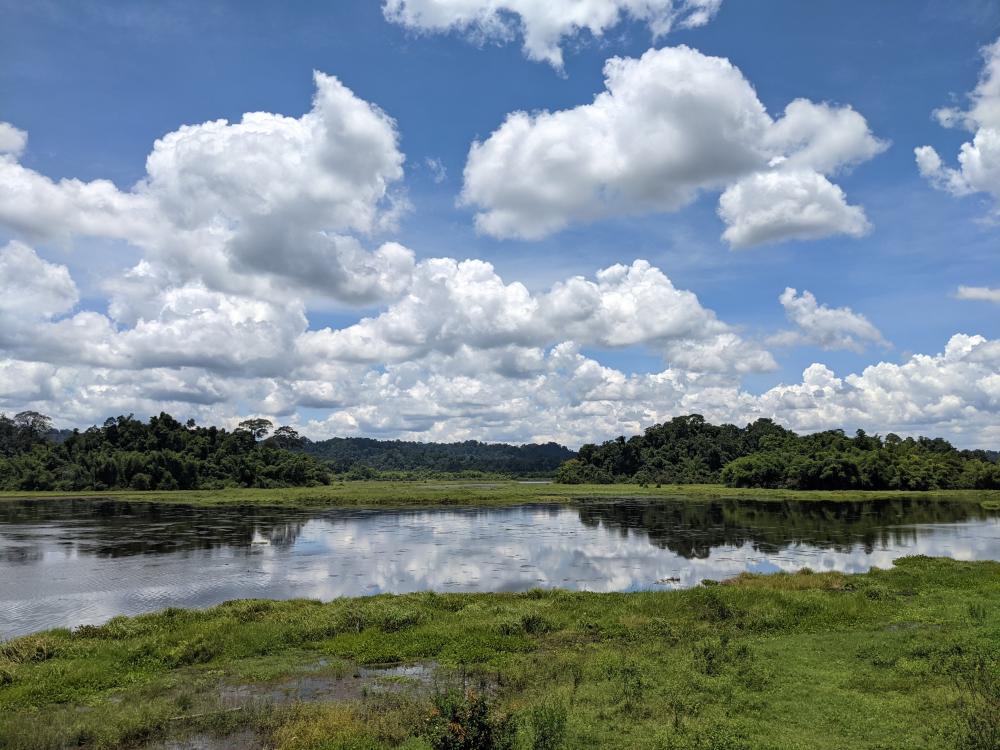
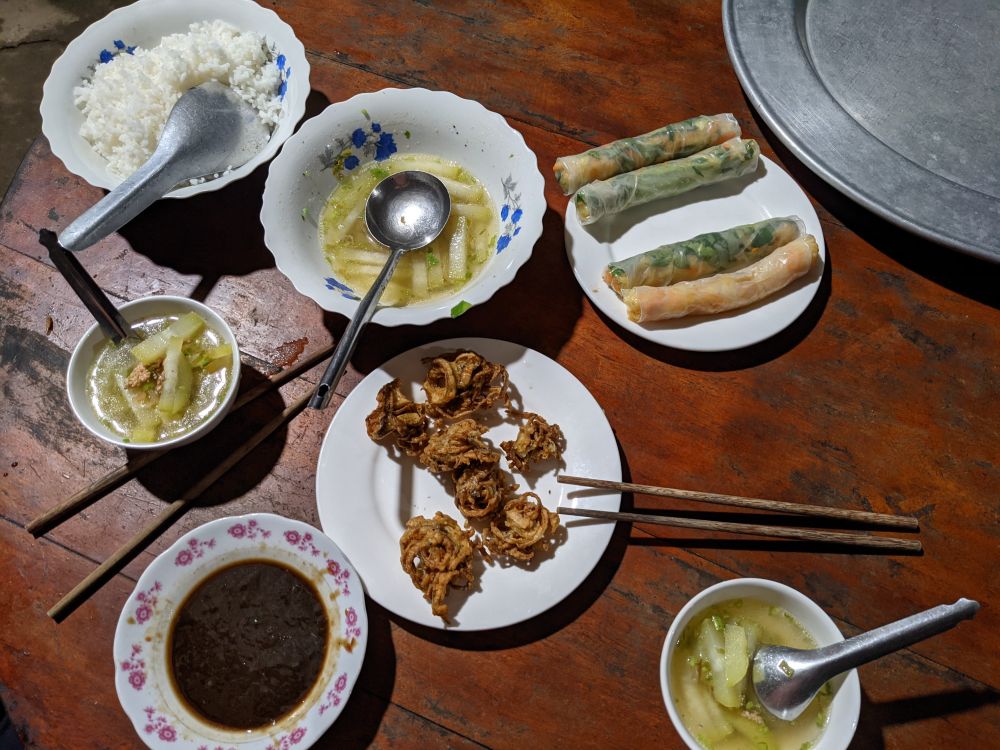
Please note: I stayed at the Green Hope Lodge in Cat Tien National Park, and I think it is one of my best stays ever. Friendly staff, the loveliest kindest family, big and clean rooms, great view of the river, and proximity to the forest and many eateries make Green Hope Lodge a wonderful accommodation. The rooms are like big cottages facing the river, and they are quite affordable, even in 2025. I stayed in Cat Tien in 2022. Amazing! You can browse through the photos and see availability here.
I didn’t repent pausing working on my project book, as you can read in the newsletter Traveling in Vietnam: Chopsticks, Fish Noodle Soup, and Coffee I published after returning from the country.
Calcutta (West Bengal), Again
Back in Calcutta at the beginning of October, right at the start of Durga Puja celebrations, the biggest festival of West Bengal which we were fortunate to attend, we continued staying with our friends. Thankfully, they didn’t kick us out. They encouraged us to stay.
“Why are you leaving? Go when you have figured out a good place,” My kind friend told me as the pressure cooker in her kitchen whistled.
I accepted her generous offer, gratefulness filling my heart. Sagar was embarrassed. “Maybe we shouldn’t stay for so long,” he said, scrolling a hotel booking app.
“These are my college friends. We can be here until we find something. After the vacation, some stability will help me,” I replied.
Now we didn’t have to get up and think, where should we go today? All I had to do was make a cup of tea and write. By the time, the house help arrived, I was at my desk in our room.
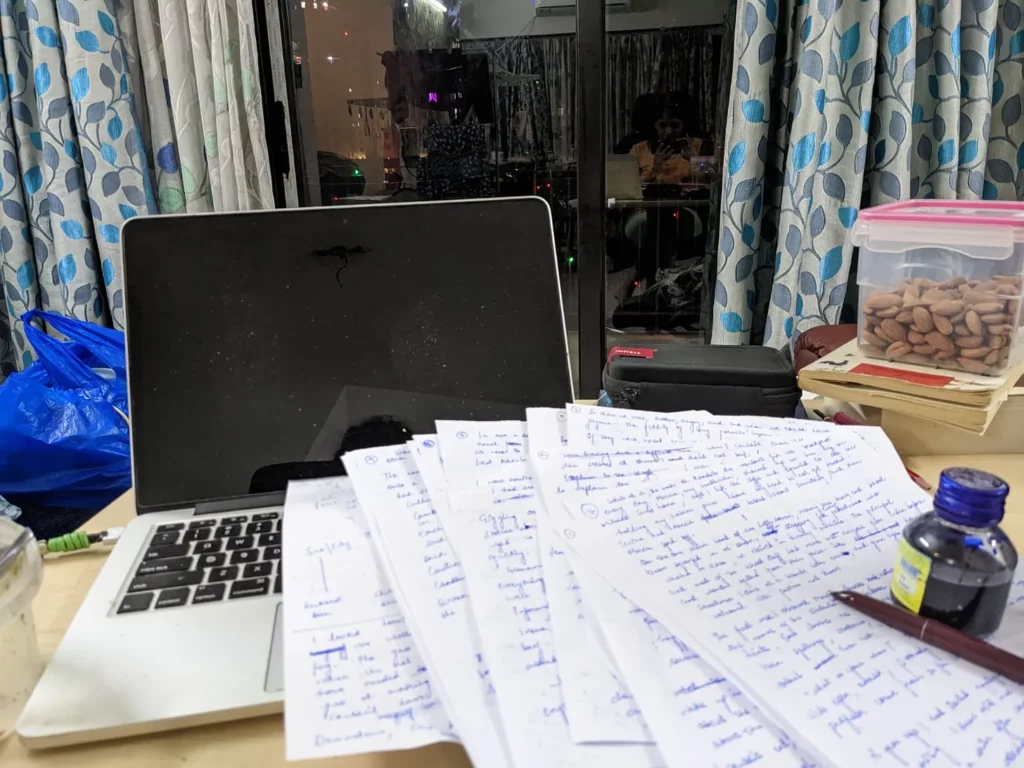
I wrote in longhand all days of the week from early morning until I slept, except when I had to instruct the cook regarding meals or when I walked around the lily-studded lake channeled directly from the Ganga river flowing a hundred meters from home. In the evening, I copied the stories to my old Mac word by word. Even the helpers of the house were surprised if I was not at my desk. Sagar worked outside on the dining.
A month passed by. That month-long vacation in Vietnam was now a hazy memory.
My friends went to Delhi for two weeks to celebrate Diwali with their parents. I started searching for guest homes. I would have to leave, too. But they said, “No, you stay. The house is open.” Again, I took their offer. We had been looking at accommodations in Bengal and further eastwards but had liked nothing. Maybe we hadn’t looked that hard. We weren’t going to be homeless even if we didn’t book anything. Now that was something.
On Diwali, Sagar and I drove to the main Calcutta city. We lived on the outskirts.
“Let’s have some Diwali fun,” we said to each other.
As we stood by the shore of the Ganga absorbing the smell of the river, dolphins swam along the coast. We were overjoyed. “Look, look,” we cried and held each other’s sweaty hands.
Such moments—when the universe exposes its true face to us—aren’t rare. One doesn’t need to travel to be amazed by this world either. But travel has made me recognize such ethereal instants faster, and I embrace them with open arms.
On Diwali eve, my friends’ home and our hearts were lit with the lights from the lamp and the homemade festival food.
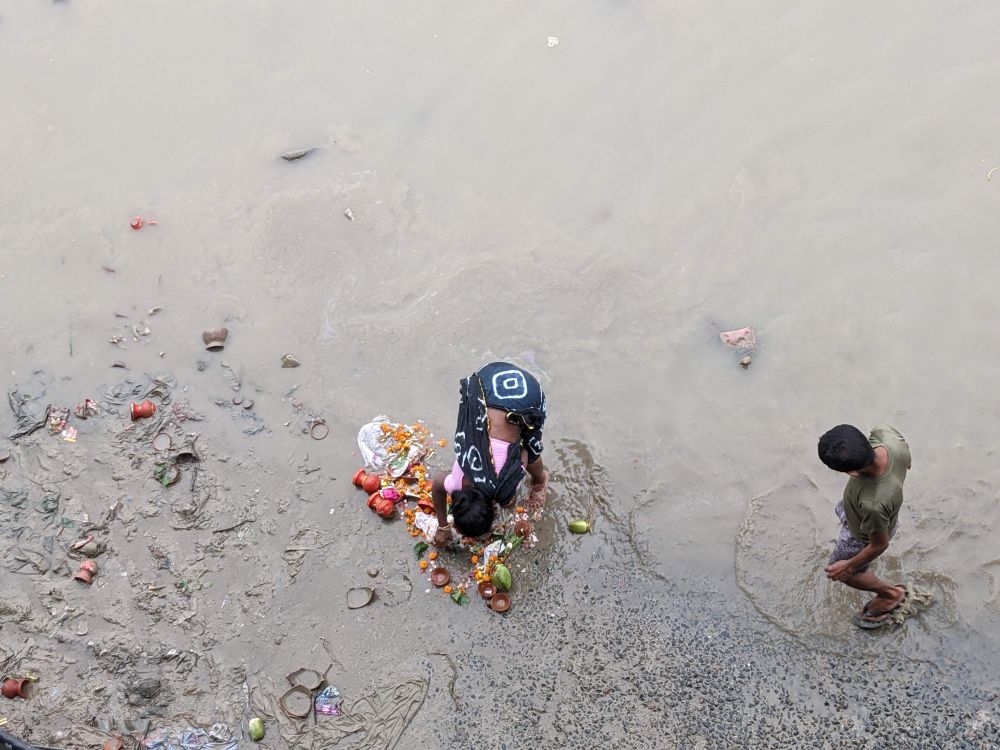
Gestures of kindness go a long way, and we are nothing and nobody on our own are only two of the lessons the road has taught me. Patience from everyone was needed every day, and where is that not true?
All during the months in Kolkata, my mother would ask me: So you’re still there? She hadn’t heard or seen anyone putting up with their friends for months. Now when I tell her I am at a friend’s home, she isn’t surprised. I think, somewhere in her heart, my mother knows, like me, that we have friends everywhere and perhaps a home, too. But I didn’t know this while becoming a digital nomad; this is pure luck.
Siliguri, West Bengal
In mid-November, Sagar and I, finally, left Kolkata. Though we had booked a homestay in Guwahati—we both wanted to explore the Northeast—we got doubtful on the way.
“Why are we going as far as Guwahati when so many others places fall on our way? Would we just pass by them?” I asked Sagar as he drove.
“Not sure. Because we found a place there? What do you have on mind?” His eyes squinted on the open highway ahead.
“There is a nice apartment in Siliguri. Want to try it out?” I asked, my eyes glued to the Airbnb app on the phone screen. If I had logged onto Airbnb, I must have been desperate.
We didn’t know anything about Siliguri, the city that connects the rest of India to the eight Northeastern states. A couple of hours later, we were there.
First, we stayed for two days and then ended up living in the apartment for two and a half months.
The lovely little two-room place had its issues, some of which were hard to ignore. Disruptive neighbors, an outdoor toilet, no hot water even in winter, no good work chair, Indian Air Force’s helicopters vrooming above our locality five to six times a day, garbage strewed around the building, and the worst: a host who rang our loud doorbell even if his cat sneezed and who tried to replace every item: from as small as foot mat to refrigerator and even electrical wiring while we were in the house.
I could count the number of days the host didn’t show up at our house. Every time he decided he was having an emergency, I needed a couple of hours to be able to breathe again. Meditating didn’t help. He knocked exactly the second I sat down on my yoga mat.
If we had a home, we would have gone back to it. We were living a nomad life, though, and that means no home to your name, no keys to turn into the lock at night.
We could have traveled further towards the East. But some friends from Assam had told us that traveling impromptu in the Northeast isn’t the easiest. They said the internet might be unreliable, and you can’t always find a place to stay in remote areas or convey what you are looking for because of language gaps. Unsure if we would be able to figure out that unknown part of India without advance planning, we continued in Siliguri.
Other accommodations in Siliguri didn’t seem good either.
We tried to work within our limitations, took deep breaths, and stayed put. That was the need of the hour.
Did we feel restricted and hopeless about not having our own comfortable home? Yes. But most of the time, we were also trying to make the best of it too.
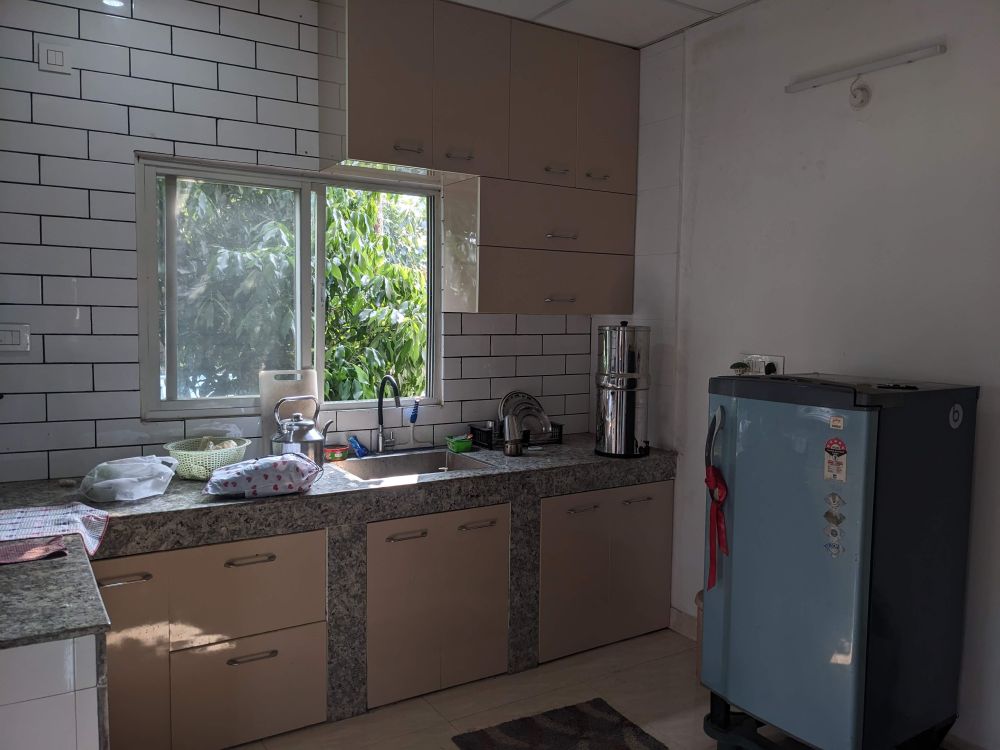
In hindsight, I can’t believe I endured that Siliguri home. It sounds impossible. But I have learned that at the moment you are just trying to survive, as I write in this letter on the vicissitude of seasons. Rather than spending energy on ‘How it could have been,’ you think, “What can I do now?”
Not having a home has been a choice. The host was interruptive, but he wasn’t a bad person. I lived in that house in the hope that one day he would appreciate my hand-folded pleas to let us be. Despite everything, we couldn’t give up on him. That’s how hope works: as long as you have it, you keep going.
You can’t have all good all the time. Some sacrifices have to be made.
Also, the circumscribing open grounds that were littered but had turned copper in the winter, and the stream curling through them mesmerized me. The road to the house ran through the Mahananda Wildlife Sanctuary, and I drew my energy from the wilderness. I often went for long walks. Whenever I lost focus, I sat down again. Doing our job is decency. Also the local vegetable and fruit markets kept me going.
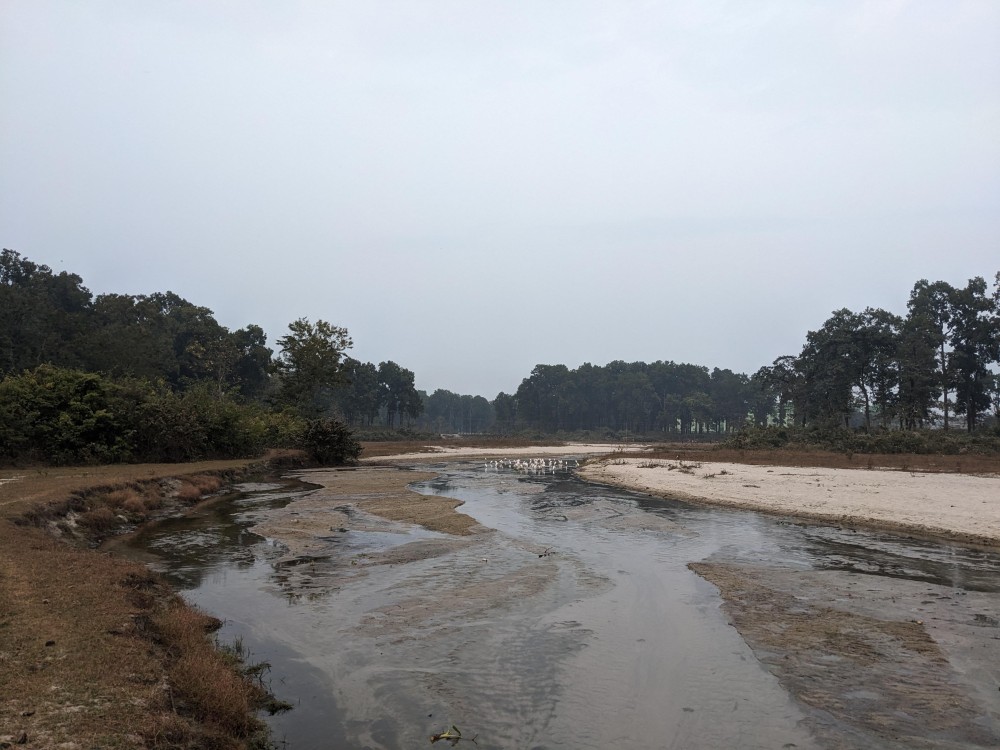
Our time in the apartment was over. We still hadn’t figured out the next destination or home.
Anyone can see that neither Sagar nor I are big planners. We do as we go. In our defense, the one or two plans we make always fail. We had planned the start of our trip in 2021, but then the delivery of our car took its own time, and the pandemic took its turns. At times, we book a stay for a week, but somehow we can’t leave before three. On the rare occasions when I book in advance, I repent leaving the current place.
We have mostly learned to leave it all up in the air.
The unpredictability is hard to take on sometimes. But both of us like the freedom that any morning we can decide to stay or pick up the car and go wherever we like. We bear the cost of the freedom, the freedom of being nomadic.
After the apartment, we stayed for two days in another home in Siliguri. Its kitchen had so much dust and cobwebs that we decided to sleep hungry. As leaving the city on a busy work day without knowing where we would go made us anxious, I booked a large room overlooking a humungous tea estate for two days.
“I know it’s expensive,” I told Sagar as we sat on the dusty dining table, making sure not to touch more surfaces than necessary.
He said something along the lines of No Shit Sherlock and started recommending other accommodations. All of them sucked.
“Let’s just loosen up our pocket a little. We can always tighten our budget later. Assume we are spending on our anniversary. This is a special occasion. Let’s make things easier for us,” I convinced him and joked, “And you call me penny-pinching?”
Our anniversary was a couple of weeks later. We don’t necessarily go to a new place for celebrations. But we needed the break.
Tea Estates Outside of Siliguri, West Bengal
In the lush tea estate, I found the treasure of nature. Sagar took a day off, we plunged into the large bathtub for hours, drinking wine, and we went on long walks through the tea plants. Booking the Mayfair Tea Estate had been the best decision, and I thoroughly recommend the place to anyone looking for a green escape near Siliguri. It is an expensive stay, but Siliguri doesn’t have many nice stays, the tea estate is free to be explored, and I have another word for you: peacocks.
Enjoy!
Kalimpong, West Bengal
From Siliguri, we went to Kalimpong, a mountain town in the Himalayas of West Bengal. We finally drove on a weekday and argued on the way (we do much better now). But this time, we had a room in a home booked for two nights. Our host called us every half an hour throughout the day.
Every home in that vacation town was high-priced. Locals from Kolkata and other nearby cities thronged to Kalimpong in holidays.
“Four thousand per night? Nothing is less than three thousand.” We said to each other as we browsed for more guest houses in Kalimpong after dinner in the host’s kitchen. At that time we didn’t know our light dinner would cost us six hundred rupees.
“Bonfire, meals, villa stay. This place isn’t for us. People here would expect us to chill, eat, and spend.” Our kind and enthusiastic Nepali host had already told us he was unhappy with us. “You guys are workaholics,” he had said.
I tried explaining to him that we stayed at one place for a few days so that we could see as well as work. After all, we hadn’t paused our life to resume it post-vacation. We were living while we were going, the infamous digital nomads.
The man wasn’t convinced.
Early morning, I turned on the little heater, plonked on the sofa, and wrote. We checked out after breakfast around a bonfire and memories of a homemade tofu scramble I haven’t found again. A bit later at a cafe, I zoomed into the map and searched ‘hotels nearby.’ In an area close to us, red markers mushroomed in a blink. The hotel-studded space was the city of Gangtok.
Sagar and I looked at each other and said, “Something might work out.”
I shortlisted a couple of hotels that looked quiet, had workstations, and promised great views. A room with a window is a writer’s best friend. You may not go out for hours or days, but you can still see the world.
We had never been to Gangtok. It was perfect.
Gangtok, Sikkim
None of the shortlisted hotels worked out. But when you wish for something so hard, the universe makes it happen. We landed at a hotel at night and were welcomed with the traditional silky Sikkimese scarf, khata.
We didn’t know that room 405 would be our home for three months.
By that time, I had stopped expecting much from accommodations in India. I checked everything and asked for what I needed.
“Does this feel fresh to you?” I checked with Sagar while sniffing the bed sheet.
He bent down, shoved his nose into the bed, and said, “Feels fresh to me. Look at these creases, they aren’t there in old bedding.”
He was wrong. As he caressed the bed cover like one touches an old friend, I didn’t correct him. That sniffing was our first litmus test.
Suddenly, the phone rang.
“Ma’am, what would you like to have for dinner?”
I don’t tell people not to call me ma’am anymore.
“I’m still trying to figure out if this bed sheet is fresh.” I laughed. A chuckle rang from the other side.
“Let me call you back.”
Staff came with in-house reusable water bottles filled with warm water, a gesture exclusive to that hotel and that we appreciated much in the cold weather. I breathed. Thankfully none of that mineral water bottle nonsense. The guy said the bedding was changed after every checkout.
“Are you sure this is changed?” I asked him, adhering to my promise that I wouldn’t take even the obvious for granted.
“Yes. Do you want to change it?” He stood at the door.
“If you say it’s fresh, then no.” I smiled, and he smiled, too.
The staff had a sense of humor. When we asked for a heater, it was sent to us immediately. We were told it was included in the tariff. The room was fourteen hundred per night, about USD 16 as of October 2025. The bed was comfortable, the bathroom was spotless, and the kettle and tea bags comforted us. In the morning, the unlimited hot water in the strong shower shook me out of slumber.
We extended our stay. And then again, and again, and again.
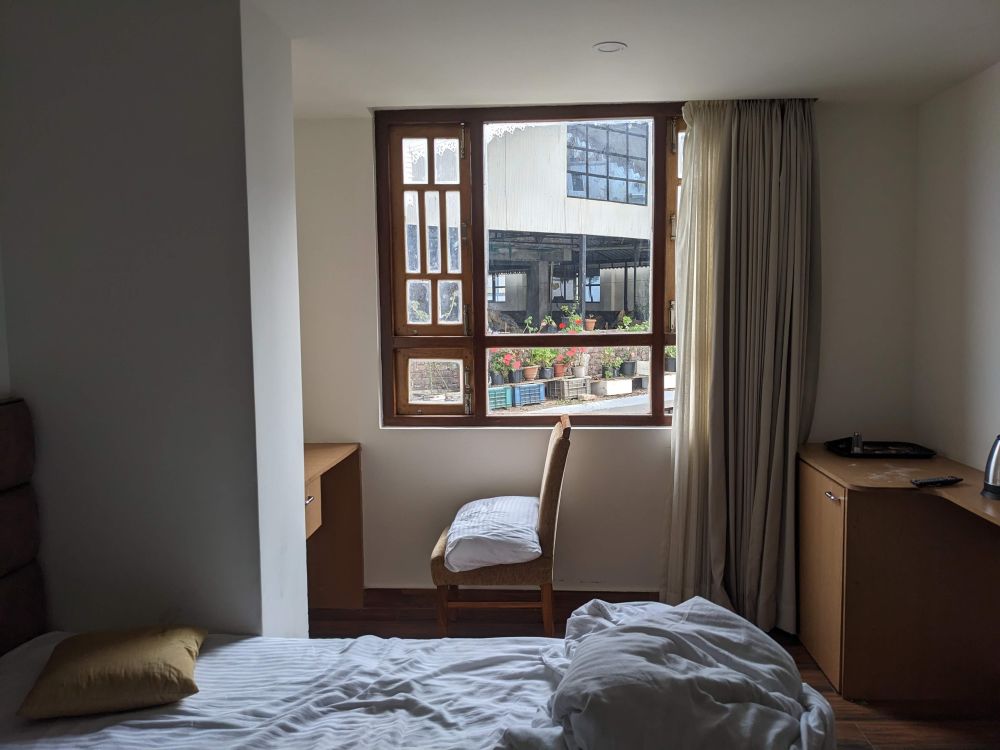
After a week, we left because we were ashamed of what would the staff think of us staying for so long. “Don’t they have a home to go to!” Someone might say.
After shuttling between three to four different hotels—none of whom could compare to the first one—on Sunday we went back. We were welcomed with love and smiles, and we didn’t waste any more time and got into our room, which was now priced at 1300 for us (about USD 15 as of October 2025). Its workstation was behind a wall, separated from the rest of the room, and the sofa chair and the desk were on two ends, distancing the two of us substantially. None of the other rooms matched up to it.
I picked up my work routine again. Our one-meal-a-day schedule saved our lives—I write about our food habits in the What about food section. The nearest food eateries were in the main market square a twenty-minute downhill walk away. Our hotel’s restaurant wasn’t that great beyond the basic parathas and was expensive too. On a cup of instant coffee and apples, we worked until we could and walked to lunch.
Our experiments around the food joints brought us down to a few places we frequented. Mostly we devoured Nepali, Bengali, or a Rajasthani thali meal. Though we are not big rice eaters, for weeks we had a Nepali meal that a loving waiter served us. It had rice, dal, pickled radish, onion, a vegetable preparation, and churpi chutney: local cheese churpi sautéed with tomato, onion, and green chilli. We could take refills.
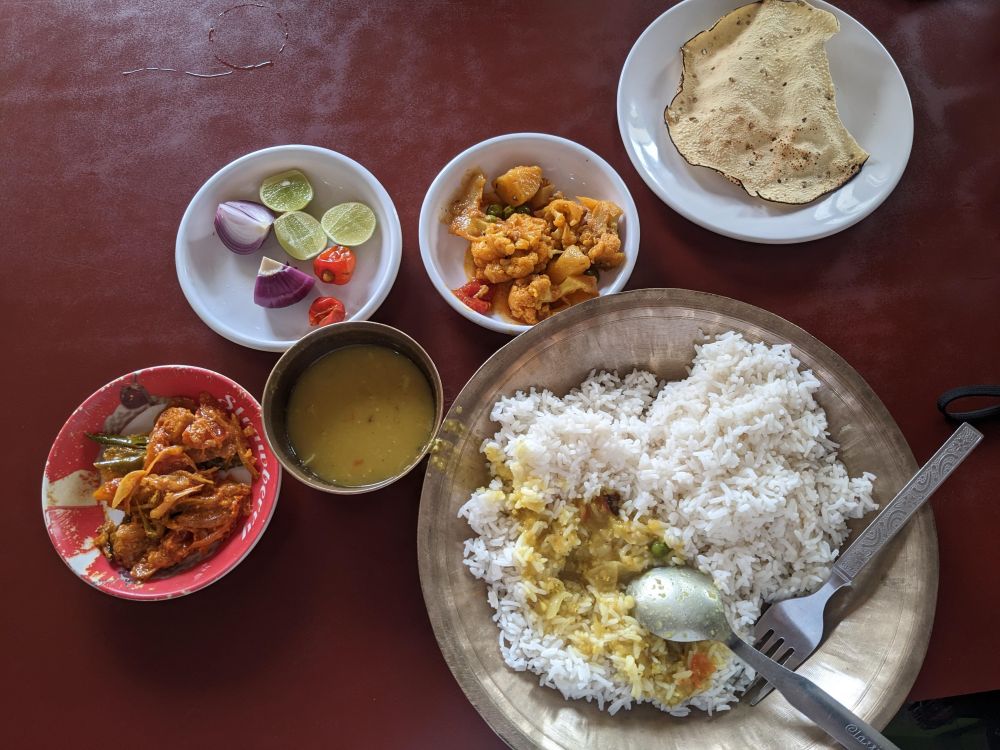
After Nepali, came the turn of Bengali thali. The restaurant guy served fresh chapatis in place of rice as we requested. The meal had dal, vegetable preparation, potato fry, salad, and chapatis: all unlimited. Most often we took second servings of lentils and vegetables and were replenished with hot portions.
Then we started avoiding both of those meals, slurped thukpas everywhere, and tried some fish thalis at other places. We dreamt of home food. Simple rotis, lentils, kadhi: a chickpea flour curry made with buttermilk, onion okra fry, and so on. We looked at each other with pity. We knew we wouldn’t get those North Indian dishes let alone together even individually anywhere.
One day, Sagar and I went to lunch separately. When you spend twenty-four hours together, you want to break each other’s head. At that point, we both slam the door in the other’s face and each go our way. By the time we return, we have developed a bit of patience to talk about the issues, or we forget about them.
Our travels have taught me important things about relationships that the linked article elaborates upon (at the reader’s risk).
That afternoon we didn’t talk. But the next day, we were descending the steep Gangtok alleys, hand in hand.
“I have a surprise for you.” He smiled.
“What?”
“Come to this lunch place with me. It serves everything we were craving.”
“What?”
“Kadhi, bhindi, chapati, rice, salad. They give everything. You can ask for as much as you like. I took refills of it all, and they gave.” He was almost arrogant with his discovery.
“And you are telling me now?”
“We didn’t talk yesterday. You also had bitter gourd at the Nepali place,” he retorted.
“It was pretty delicious with rice and lentils.” I smirked, knowing he likes bitter gourd.
The Rajasthani meal place was exactly as Sagar had described. Simple tables and chairs in a small room. A friendly boy confirmed if we wanted thalis. Within a minute, he placed two plates with various vegetable preparations, lentils, kidney beans, kadhi, fresh ghee-swaddled chapatis, salad, pickle, chutney, and papad in front of us. Everything tasted as if cooked in my kitchen and was oil-free. I ate as if someone was pulling the plate from under me. We got unlimited refills, and most of the time, we didn’t even have to ask.
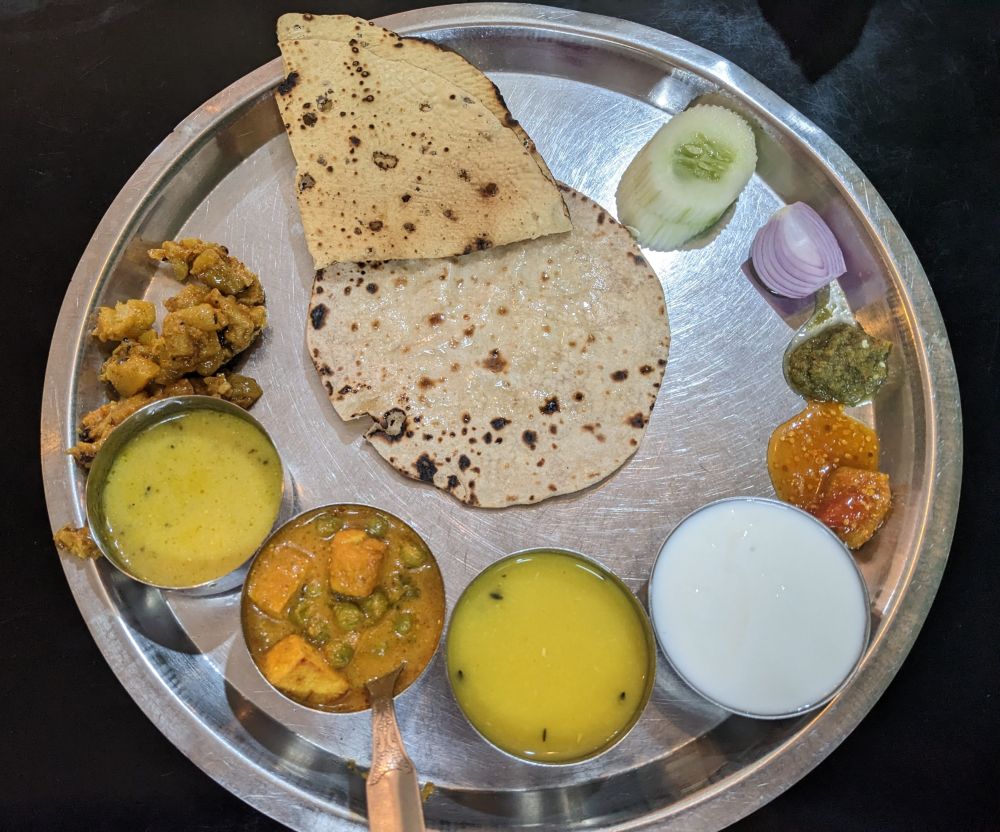
Within a week, we became patrons. We were given head nods as soon as we entered the eatery and served complimentary tall glasses of fresh buttermilk.
Can you believe we got such delicious and abundant food for one hundred and forty rupees (USD 1.5)? The place was always filled, mostly with men, and the boys served with a smile on their faces, insisting we take more.
I often told my parents over the weekly Sunday calls, “I had so many kinds of vegetables and dal and homemade delicious chapatis that I would have taken hours to cook all of it.”
That experience was one of those special ones that glorify traveling, the one you can sell to others: “Was it possible to discover such a magical place in my home town and use its features daily? No. At home, I’ll cook in my kitchen. But on my travels, I’m connected with the whole world in a more fundamental manner. I depend on others to be housed, fed, and cared for. And that’s the purpose of travel. To get down from our own cot of comfort and rediscover the world anew.”
Back in the room that had been cleaned in our absence, I made another cup of coffee. Looking at the incessant rain falling outside the window, I wrote until evening.
“Look, it is raining. We can’t go out.” I chirped to Sagar and read.
“Could you please switch on the heater. I’m cold,” he replied while working.
I obliged but kept the heater on low and the window slightly open. The cool fresh air from outside kept me up.
We stole days of fun in between. When we didn’t gulp down the sumptuous thalis, we got tofu, okra sautéed fry, and soups at an Asian place. Sometimes we got beer and potato crisps too. On weekends, Sagar watched movies in the theatre solo, bought fruits by himself, and stayed on Netflix into the night.
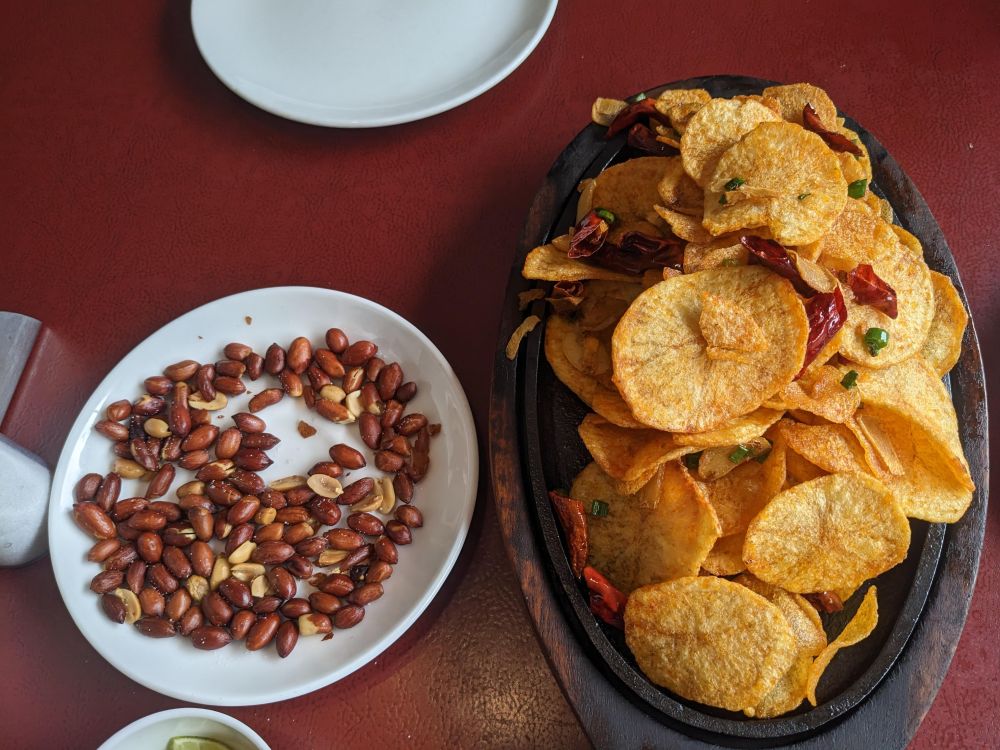
Things did get out of hand sometimes. I would huff and puff back to the hotel—the downhill twenty minutes was now uphill twenty minutes—and couldn’t figure out if the toilet had been freshened with liquid and the bedsheets were changed. I can’t imagine staying in any hotel room for three months, but I did it then. From returning to the room and exclaiming, “Look how clean everything is, and we didn’t have to lift a finger,” I started going back to “The housekeeping has not done this again!”
Though I didn’t know better then, I should have requested certain fixed practices. When the housekeeping staff changed, we started returning to our room only to find garbage still lying around the dustbin and a wet bathroom floor.
When you stay in a home, you might not clean it for a week. In a hotel, for that long, my primary solace was, “At least, the space is fresh and clean every day.” After all, the room was not only our bedroom, but dining, workspace, entertainment center, lounge, shower, bath, and quiet space too.
One day after lunch, I said, “I cannot do this anymore, and I have followed up enough.” That’s when I knew I couldn’t take the hotel room anymore. Sagar also wanted to leave. We wanted a change.
The room may not have been working out for us then, but we thanked the staff who gave us a home for so long.
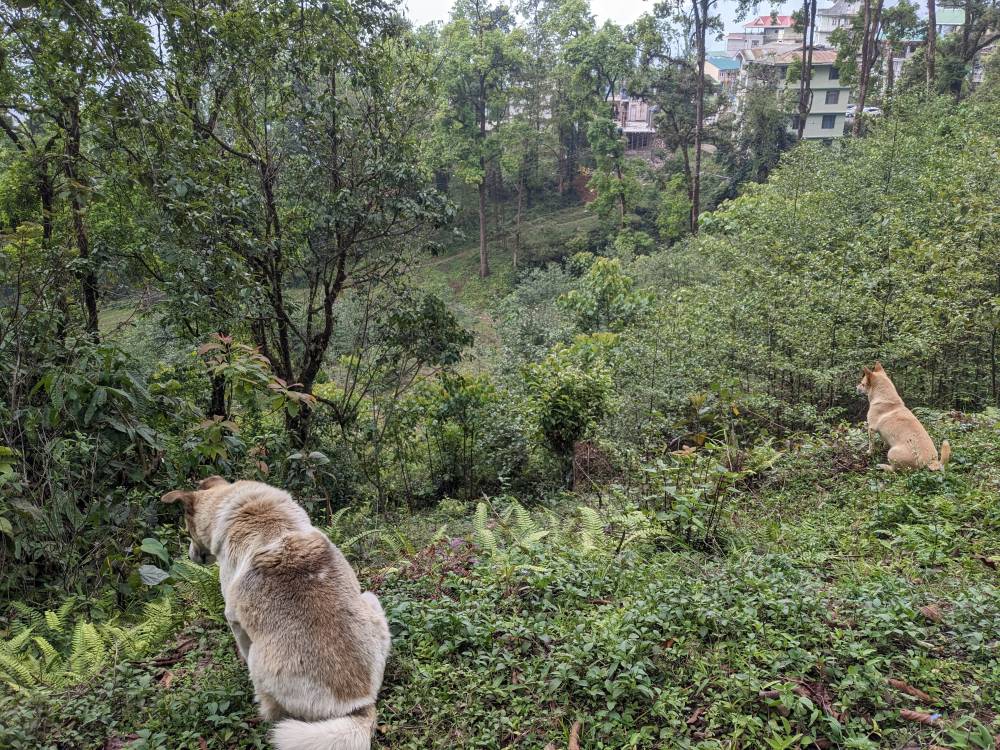
From the Himalayas of Sikkim to the Himalayas of Himachal
After a three-night trip into the countryside of Sikkim on which I managed to get lost on the Himalayan slopes behind the house, we were on the highway again. Our destination was Himachal. We hoped to stay in a home in a village in Mandi district that had housed us for three weeks in 2021 during our four months in the state.
“I hope that house works out. There I know I can sit and write. We’ll get food, everything is peaceful, and we know the system,” I said to Sagar.
“It will work out. Don’t worry,” he replied in his usual calm manner.
We didn’t call the family before leaving for Himachal. If it wasn’t their house, it would be some other house. We trusted the state. Its people had shown us enough kindness enough times and given us many moments of bliss.
On the way to the Himalayas, we drove through ripe corn fields of Bihar and arrived in Uttar Pradesh at night. In the next couple of days, we stopped at Agra, for the Taj Mahal, and Lucknow, for the food. Further on in Haryana, we put up at a friend’s house for a few days, eating homemade food and working in their home office.
Himachal did house us. During the first month, we revisited the Rewalsar Lake and Seven Lakes we had seen before, living at monasteries and family accommodations. Many days, we woke up at five, found our way to hidden lakes, and returned by ten am to work. One morning when a Rewalsar host said “This is how it works here; you can find something else,” we visited all the rest of the stay options around the lake. A monastery, after making us wait for four hours, said they couldn’t give us a room for a day, only longer. We weren’t sure of that guesthouse and didn’t want to commit for more than a day.
With our things in the car, at five pm, we headed toward Mandi, a city we liked and where we knew friendly hotels on the bank of Beas River. A plate of dal kachori (fried bread stuffed with lentils) and chana masala (chickpea curry) called us too. In the humid hotel that was our home for two weeks in 2021, we were welcomed by familiar faces that lit up upon seeing us. We asked for a change of bedsheets, wiped the tables and bedside stools (layers of dust), and hoped to make the place ours at least for a week.
“Do you hear the river?” I asked Sagar.
“Yes.” He smiled and hugged me.
Though we were lulled to sleep by the river crashing against the stones, throughout the night, I woke up from loud banging noises. I couldn’t believe what I saw. Three to four big and small monkeys were sitting on the balcony parapet. One would throw himself against the door, hoping to send it flying. They repeated this performance as I watched, my mouth wide open. The ripe golden mangoes on our table were visible from the balcony through the glass window. The whole balcony was filled with monkey poo, and I couldn’t sleep for more than a couple of hours. If we hadn’t turned our latch from inside, we would have been robbed that night.
We left Mandi, driving towards Kullu, a town famous amongst Indian tourists. Touts selling river rafting on Beas River hailed us every two minutes. We would have loved to go rafting but at that time we only wanted to escape from that loud lot.
“What’s happening here?” We exclaimed to each other and turned around towards the home that was on our minds.
“It’s time now,” I said to Sagar and called the host.
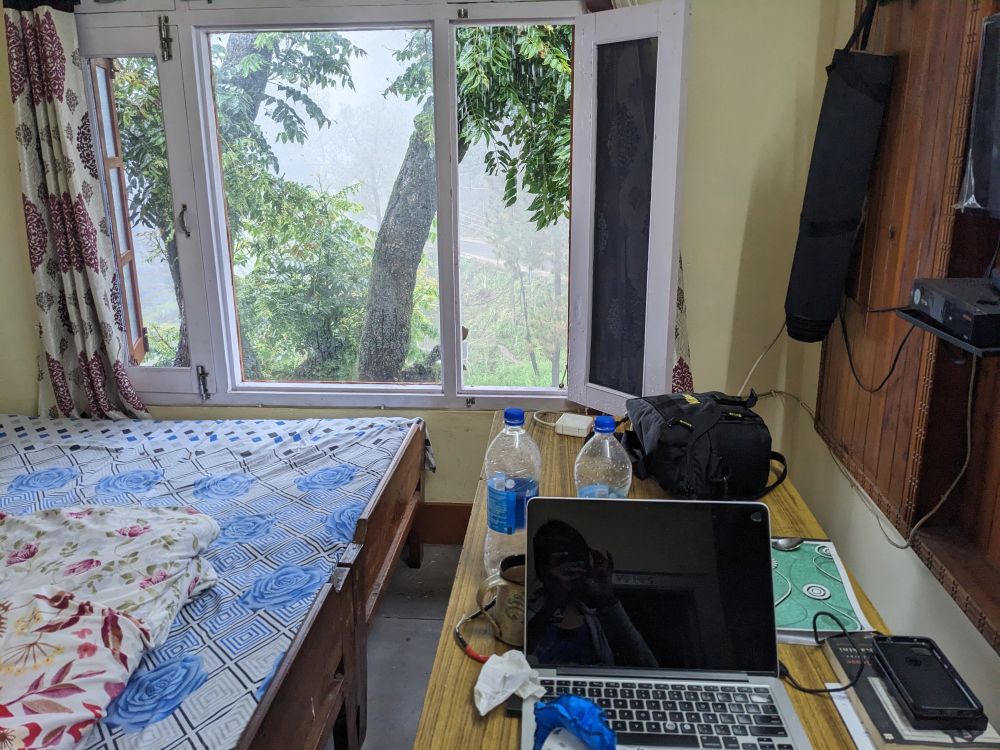
Nalagalli Village, Himachal Pradesh
From the beginning of June, we stayed in that village house until mid-October. Those were the summer and monsoon months when the entire news was filled with headlines such as, “another cloud burst in Himachal,” “flash flood drowned the village,” and “fifteen missing in the landslide.”
Our parents, of course, watched Himachal devastation headlines constantly on the news and were worried. The villagers were worried too. Mandi City and the surrounding villages suffered the most. As I updated in this newsletter, landslides were happening in the mountains around us often.
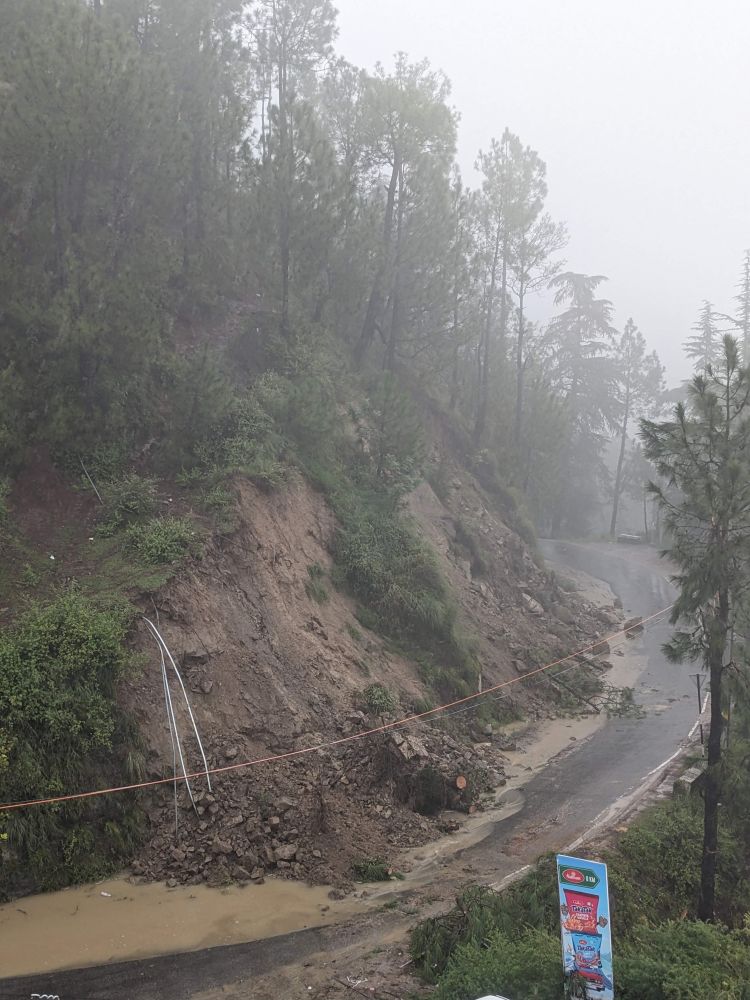
One day things got out of hand. Every half an hour or so, I went to the hall where Sagar was working and asked, “Did you hear that?” Our mouths hung open. From our window that gave us a panoramic view of the road and the valley, we saw uncountable landslides. When we walked on that road later, we crossed maybe twenty landslides, at least.
Villages were swept away. Every day our host told us news of which kitchen was taken away in a cloud burst and which woman was swallowed along with her cows. Even a part of the mountain on which our host family’s home was located was broken down by the constant rain. They lost many of their terraced fields along with the hill. The family of the boy who brought us cow’s milk every day lost the entire slope with all their farms. They were worried their shop might be swept away too.
The night was the scariest when our host came to us at night, knocked at our door hard, and said, “The neighbors are worried about their shop. We are tensed about our home. If you feel scared at night, if something happens, do run upto us.”
Though Sagar and I used to sleep in two different rooms (I slept at nine and he stayed up) that night we slept together. Now I might narrate this story as a tale to boast, or I might have teased the host, “You scared us last night!” But anything could have happened then. Eventually, the host family was safe, we were okay, and the weather calmed down.
We didn’t tell our families all the devastation was happening so close to us.
What could we do anyway?
We were glad we had electricity. The water supply was revived after a week. Mobile connections went down. Thankfully our families did not call us during a couple of no-network days else unable to reach us, I don’t know what they might have done. The raging rains and the rowdy rivers swallowed up the roads which weren’t fixed for months. We had to stay put.
In such rains, thunderstorms, and the deafening roar of the wind, I kept my laptop plugged in and wrote. When the power went off, I burned candles. Water pipes had broken. We drove to the nearest petrol pump and filled our bottles from the water cooler there. When the cooler was dry, we refilled from the tap of an eatery. We collected rainwater for the toilet and showered in rainwater too. For the first couple of days, the host family brought us lunch. When the timing didn’t work out with them, I cooked. As the fresh vegetable trucks had stopped coming, we cooked pulses and potatoes and whatever was available. Apples and pears were abundant in the orchard.
The weather offered isolation and dis-connectivity from the world. I put all my energy into my book.
Living without the basics, I learned we can adjust and adapt to any condition.
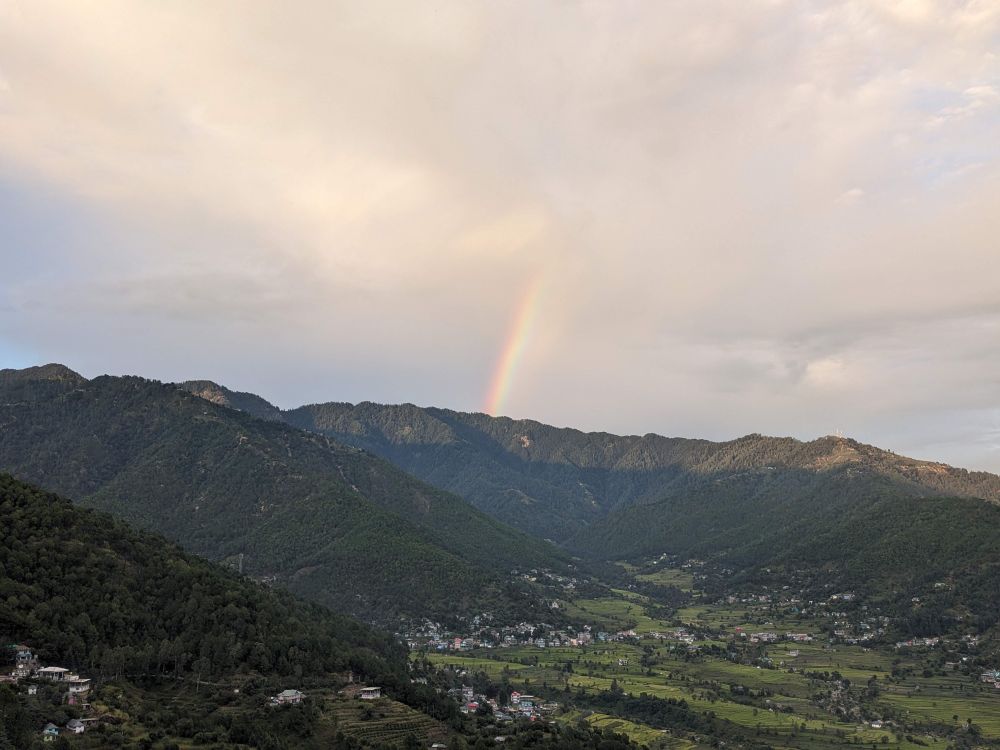
Also, I consider being in the lush Himalayas a privilege for which I even compromise on essentials. When it wasn’t raining, and it was safe, I went up the freshly washed slopes, ran around, clambered up and down shepherd trails, stalked wild animals, explored pine and cedar forests, climbed up pear trees, chatted with the family, and did yoga. Every walk and exploration took me up and down the earth.
We are the healthiest and happiest in the Himalayas, especially Himachal Pradesh. Our expenditure is the lowest in the state. We choose offbeat destinations (yes there are still many), we live in rustic stays, and the affordable prices of the state help us go lower than our budget. As a self-appointed vegetable and fruit plucker of the host family, I received a part of their produce daily.
In the past few years, the state has housed me for more than a year, and I could return to it anytime. The effect of climate change on the Himalayas is unnerving though.
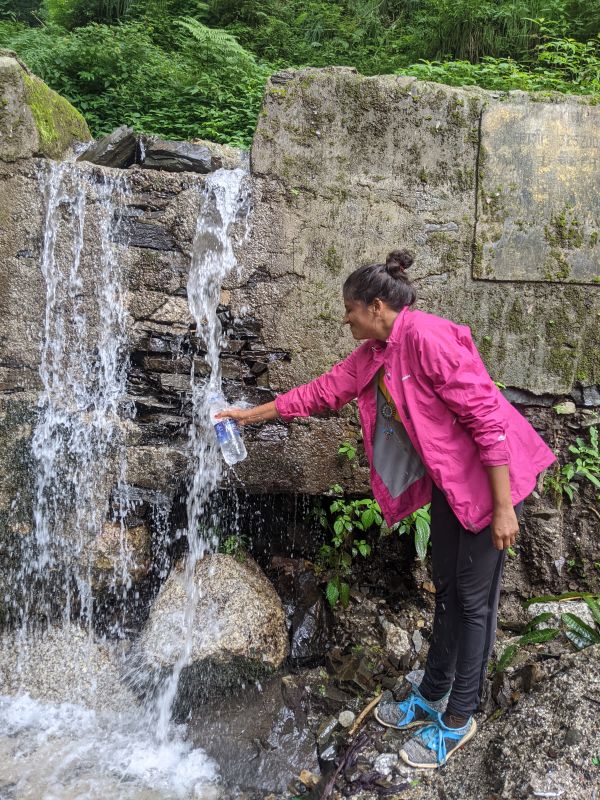
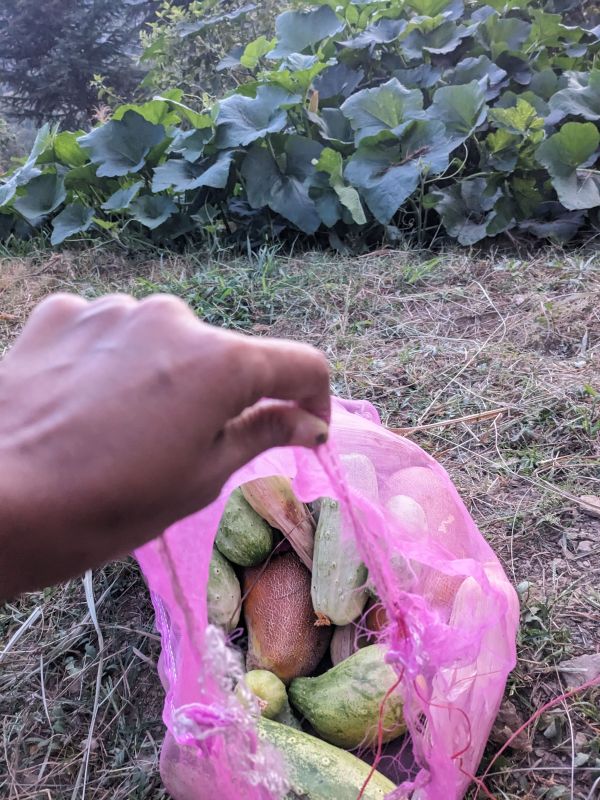
The family knew us from before. But in the first week, they were surprised that we weren’t hiking about as much as we used to and that we were working all day.
“Everyone is running after money,” Aunty, the mother of the family and the one who interacted with us the most said one afternoon as we sat in their home drinking milky tea.
I found it hard to explain to a family who ran a hotel and restaurant for money why my project was less about money, or that I left a job with much more pay to do something of my own. That my project book wouldn’t fetch me as much cash but I needed to do it.
While living in different cultures with people who don’t know us, we are used to hearing different opinions about us.
We are judged by our clothes, wake-up times, whether we get out to roam or not, what we cook and eat, et cetera. I can message a college friend in a second and say anything. My city neighbors knew I slept early. But the people we meet on our travels now—people we live with every day and depend on for food, water, and shelter—don’t know us at all. They don’t know where we come from, what is our education, how talented or decent we are, our family’s background or religion, and so on. They don’t have any reference to compare us against apart from their surroundings and neighbors.
Our challenge is greater as we stay in rural areas and remote villages. Some village families we have stayed with had never stepped out of their district, let alone state or country.
When so many eyes are upon us—in most destinations, people stare at us from both sides of the road as we walk— we have to make sure to be kind, respectful, and amiable. Our behavior is our only weapon. The current generation of laptop workers, aka digital nomads, isn’t much admired in the world—at least in India, where the common man works hard to meet the ends, and we seem to have an easy life with money flowing in while we type on our couches sipping coffee and kokum juice.
As we stay in most places for at least a few days, some people get to know us better. Others still consider us worthless wanderers. We are okay with that. That Himachal family does care a lot about us though, and they were just curious.
I wrapped up the project draft of the book by the tenth of October. I had written almost everything I wanted to say, and I couldn’t be so diligent anymore. I was exhausted.
“Send it for now. Do more edits later.” Sagar was proud of me, and so was Aunty.
If not for the book, I would have never stayed in that village for four months, never came so close to the family, receiving uncountable hugs from the grandmother (I hope she rests peacefully now), and probably never would have understood what it is to live in a real mountain home in a village. All of it is part of the journey; travel, like everything else, can mean many things.
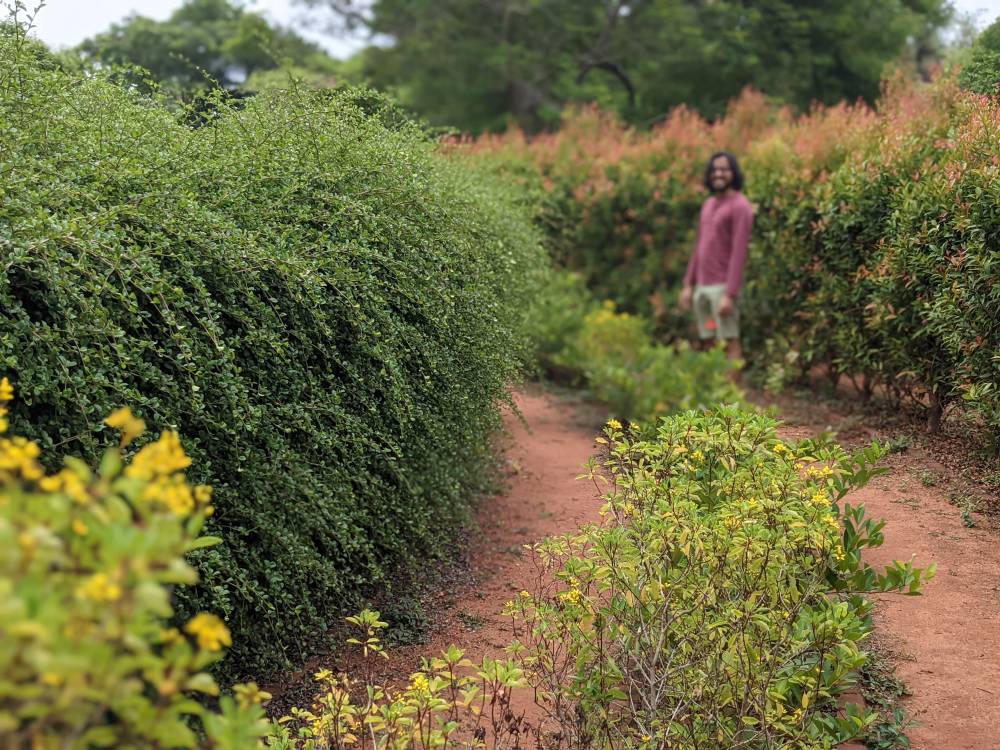
Back On the Road, Stopping On The Way
After a two-day rest and sleep stop in Chandigarh, we went to my parent’s home in Uttar Pradesh. I hadn’t seen them for two years. My parents seem to have grown older. I made a mental note to see them more often. I still couldn’t help but resent every time my mother asked me to serve my husband, Sagar, first or when she offered something to my brother before me. Beyond these sensitive matters of the heart, the two weeks passed by in a whiff.
We were on the road in less than two weeks. Through Rajasthan and Madhya Pradesh, we arrived in Nagpur for Sagar’s friend’s wedding.
Isn’t it amazing that we didn’t have to travel to the wedding specifically? We could attend it by stopping on our longer trip, as if all of India was our home.
After the celebrations, we turned back towards Satpura National Park. Both Sagar and I saw tigers in the wild for the first time. Now we were headed towards Goa to celebrate Diwali with friends at whose house we had stayed in Calcutta and who were vacationing in the beach town. We may not have a home to decorate and invite our friends to, but we can always go to them. That was the idea anyways, wasn’t it? To not be homebound and find adventures on the road.
On the way, we took one-night stops in towns as we always do.
One day, after a night-long fight which kept me up all night (not to mention the loud receptionist and the ringing desk phone outside my room), Sagar insisted I drive.
“But I haven’t driven since August 2022. You said relax and focus on work, now suddenly you want me to drive.” I cried.
We were in October 2023. More than a year had passed since I had driven. Throughout the duration I had been working so hard at home, I didn’t want to work on the road, too. At that time, driving did feel like work. While Sagar went out to buy groceries or food, I stayed back and wrote or ambled around the mountains, the coast, or the jungle.
This mental revision didn’t move my life ahead. After cursing Sagar for discouraging me from driving the past year, I couldn’t sit in the passenger seat anymore. It was now or never.
I hadn’t slept. I was angry. I was tired.
I took the wheel.
Once on the wheel, I drove as if I had been driving all along. Since then, I have been driving continuously. I have driven on highways, within cities, on mountain roads, and along narrow mud paths through the forests.
After waiting for years, I can finally say I have learned a life skill I thought I could never claim. Not because I didn’t think I could drive. But mostly men drove around me. Apart from Bangalore where every other car seemed to be driven by a woman, Sagar and I see few women drivers in most places and hardly a couple on the highway.
In a culture where tasks are segregated by gender, you have to encourage yourself to pick up something that is unexpected of you. No one else will. Most families said to Sagar after listening to our story (which we now don’t tell every time), “So you have driven from that far to here in your car?” He was the one driving us. Now when someone doesn’t assume and asks, we say, “Yeah we both drive.”
I let out a breath of relief after finally crossing the bridge.
From Goa to Bangalore, and Further Into Karnataka, Kerala, and Tamil Nadu
We slowed down in Goa and celebrated Diwali, I resumed work after a long break, and we put up in an apartment for almost two weeks. I can’t tell for sure, but out of those two weeks perhaps I spent 200 hours on the beach.
After traveling through more parts of Goa, we drove to Nandi Hills near Bangalore for another friend’s wedding. From there, Sagar left to visit his parents for a week, and I stayed in a hotel in Bangalore, enjoying my solo time and meeting a college friend.
I started writing the draft of this article in Bangalore.
I worked on my blog again, hung out with friends, and bought things I needed. We went to the dentist. We drank beer in bars, paid for expensive food, and found good hotels with difficulty. We fell sick, we fought, we made up, we got our medical tests done, and we celebrated Christmas and New Year with friends. Then we left, for good.
It was the perfect city trip. We got our chores done, met friends we had left behind, and worked. And we realized that we hadn’t missed the city at all. In fact, Bangalore had gotten busier and ruder than ever, and I was waiting to run away.
The plan was to explore a bit of Kerala and more of Tamil Nadu and other Southern states. Sagar hadn’t been to Kerala before.
To get into Kerala, we stopped at Mysore. Sagar explored the city more than me; I had been there earlier too. I stayed put, wrote, and rested on my period days.
After about nine days in and around Mysore, I drove us into Wayanad via the scenic Bandipur forest route. The border of Kerala and Karnataka is joined at the Bandipur and Wayanad National Forest, also known as Muthanga Wildlife Sanctuary. On both sides, the forest swayed as I drove slowly. At a natural water pool, a mother and baby elephant were drinking water. The road was beautiful, and the whole journey was surreal.
We traveled through Kerala slowly. Three nights in a forest guest house with deer and elephant just beyond our fence, three nights in a home with a kitchen (we went grocery shopping, we cooked, we hiked to a viewpoint, I explored the host’s coffee estate with his sister), and we spent seven nights in a wooden cabin by the lakes. We took many jungle safaris, we walked on the mountains, we saw ancient caves, we let nature absorb us, and I took many, many bird photographs. He worked, and I wrote.
For the first time, my parents also joined us, and we showed them around.
Kerala led us into Tamil Nadu. We explored Ooty, Coimbatoire, Kodaikanal, and many more places.
Then it was time to get back to the book. Driving towards the North slowly, we arrived at my parents’ home.
Parents’ Home in Uttar Pradesh
My mother had her eye operated and needed me. I needed her more. We happened to stay with my parents for five months, as I edited and brought my manuscript to completion, working together with an editor from the UK.
Dehradun and the Higher Mountains of Uttarakhand
In September 2024, we drove to Dehradun city in Uttarakhand with the idea to first be in the city for a couple of weeks and slowly make our way into the higher mountains. And that’s what we did. After a month of work, celebrating our birthdays, and enjoying the rain, we drove deeper into the heart of the Himalayas, hiking higher and higher every time.
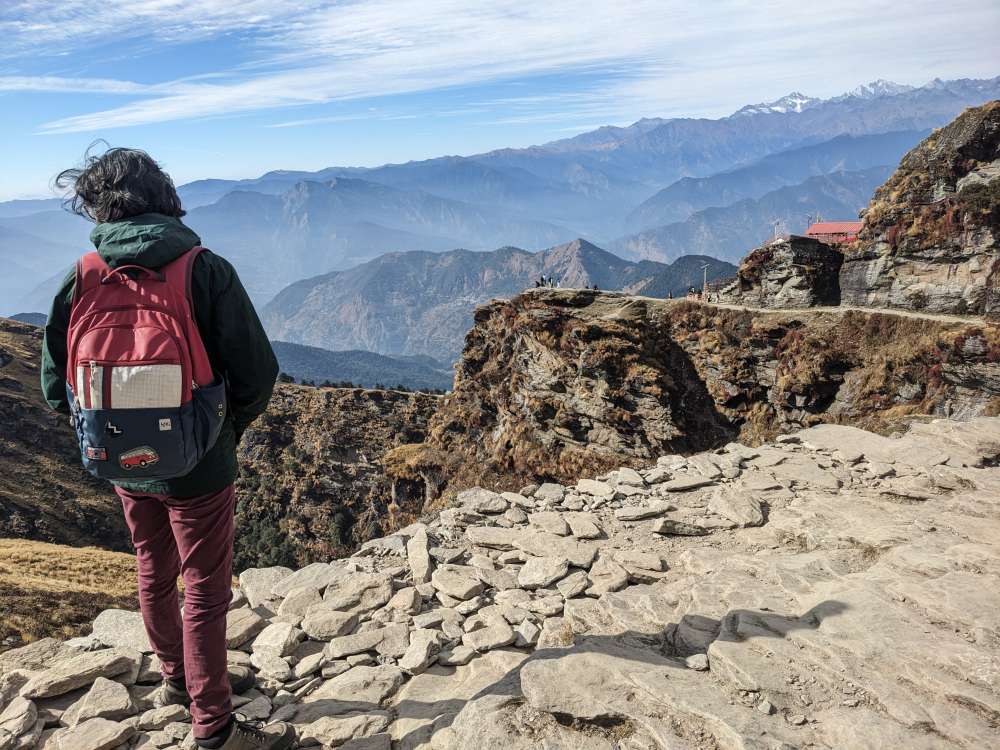
Many travel notes and posts from Uttarakhand are awaiting my attention. I haven’t forgotten them, just taking my time to edit and publish. Uttarakhand is beautiful and wild, and we had so much fun there. We drove on narrow, twisting roads, felt the breeze brush our hair (or the wind howl in our ears), and came close to many wild animals, or at least the warning signs. Sometimes we were the only ones in a guesthouse, the winter fast approaching, and late into the night we toasted ourselves in the wood fire. Instead of retiring to bed, I stayed up and worked on the book, wild animals creating a live orchestra outside.
As we drove and hiked around, my editor proofread my manuscript, and in January 2025, my travel memoir, Journeys Beyond and Within…, was published. For the final publishing work, we had again driven down to Dehradun, slowing down into the many Airbnb apartments the city offers. One or two experiences were nice and one or two not so nice. But we managed. A book had to be published, and it wasn’t going to do it itself.
In a Dehradun home, I held the first copy of the memoir, with goosebumps all over my body. When I saw my book on Kindle, real after years of hard work, tears streamed down my cheeks. Everything was so surreal, and the peaks rising all around us added to the otherworldliness of those days.
I won’t forget those sleepless weeks when I worked day and night, sitting next to the heater, eating fruits and drinking chamomile tea, rushing upstairs to the rooftop every evening to see the molten sunset bathe the mountains golden, and running down to discuss the book cover with my generous friend. Day was night, and night was day.
I think if I can write a book while living nomadically, then one can do anything. So yes, the journey has been hard, but to answer the question, it has been worth it.
Delhi and NCR
From Dehradun, Sagar and I decided to visit Delhi, to meet friends, whom we were missing a lot, and make further plans. What happened in Delhi is history! Walking around Connaught Place, bright books peering down at us from every glass window of multiple stores, I had a thought. “My book is amazing, too! It should be in these book stores.” I could never go back from that thought. Though I had rejected a big publisher’s offer to self-publish, I wanted my travel memoir in the shops.
I won’t go into the details of how I made sure Journeys is present in every book store in India, but Sagar and I made it happen. You will have to wait until I publish more articles on the book’s journey.
Living in Delhi wasn’t easy. The city was hot and crowded. Twice two friends’ homes sheltered us, together for some twelve days, for a few days a hotel worked out, and for the rest of the time, we stayed in my alma mater Indian Institute of Technology’s (IITD) guesthouse. When I went to meet a professor of mine on campus, he had told me, “You know you can stay on campus too?” As the sun started to set and the shadows deepened, around us students settled down on benches sipping coffee, and the birds began to chirp, I had this huge wave of nostalgia hit me. Aah, my campus! Green, full of birds, a quite recluse from the crowded city of Delhi.
Getting a room in the campus guesthouse wasn’t easy or straightforward. But out of, let’s say thirty days, I spent twenty-five on campus, and I have to thank my Mathematics professor who made sure I got a room, even if he had to sign for me and assure the authorities that he was taking guarantee for me. The guesthouse was expensive. It wouldn’t have been had I got a room in alumni quota, but, as I said, things are not so easy.
I am still thankful for being able to live on the campus again, something past students can only dream of, this time with Sagar. We roamed around, ate food from cheap, simple joints meant for students, walked around the campus that is more like a small forest, sat in the gardens, woke up to a view of the entire tree-shaded premises, attended events, ran into past professors, got print outs and photo copy done for cheap from a small shop five minutes from us and outside a boys hostel, sent my book from the quiet campus post office with ease, and relived student days.
Walking around the tree-lined roads under the evening lamps, listening to the birds chirp good night songs, passing by students with notebooks in hand, I realized how carefree my life is. Yes, I have work. But in many ways my life is still like of a student’s. No home to rush to or take care of. No pets or plants waiting to be fed or watered. No bills and plumbing chores or pending paint work. No children to send to school.
Just the ability to be anywhere at any time. My professor said that I could easily access the labs and the guards won’t stop me because I still looked like a student. I stopped myself from saying that I felt like one too.
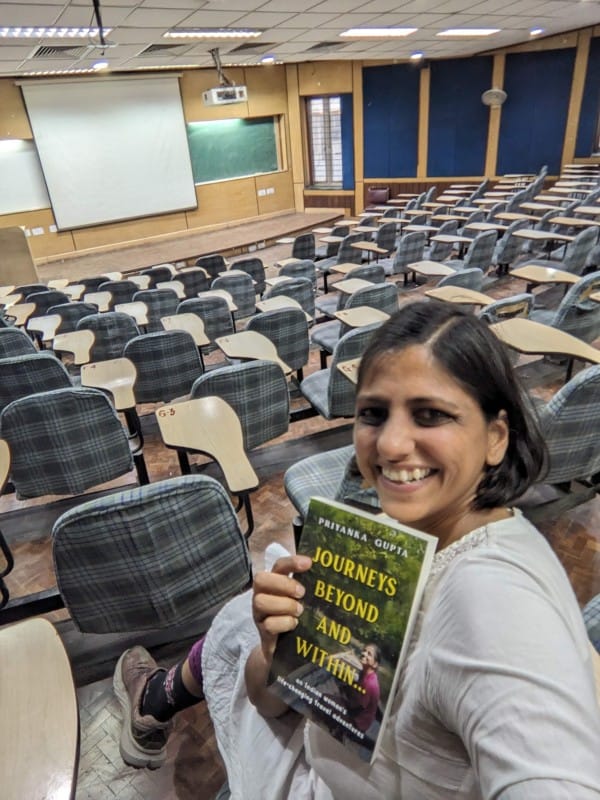
Even my parents visited and attended my talk that my professor had invited me to give to the present Computer Science students. He said the students feel a lot of pressure these days. He felt that seeing someone quit the traditional path and choose an alternate one might relax them a bit. Although only eight students attended the talk, it being a busy time of the year, fortunately my parents and brother were able to attend, they passing by Delhi coincidentally, and a few professors joined too. It went really well, and I was proud of myself.
After Delhi, I went back to my parents’ house to rest. Delhi had been hot and hectic. My parents have their own way of life though, and this time I learned that though a few weeks together are pleasant, more time than that can lead to confusion and unpleasantness. After all, it is their home and they want to live how they like with their rules. Meanwhile, we think we are the children, and we shall live how we like. Nothing good comes out of this, and I have promised myself not to stay at parents’ home for a more than a week or so in the future.
My parents are generous, and they open up their home for both of us every time we go. And every time I leave, I leave with the thought that perhaps I could have been more adjusting, more kind, and more patient. Hopefully the next time!
Back On The Road, Starting With Coimbatore and Jaipur, And This Time Without Our Car
After two and a half months, we finally packed, and Sagar went to Coimbatore for his yearly office outing (he still has a remote job), and I took a train to Jaipur for a book event. A book shop had organized a talk in which some thirty to forty people came and listened to me.
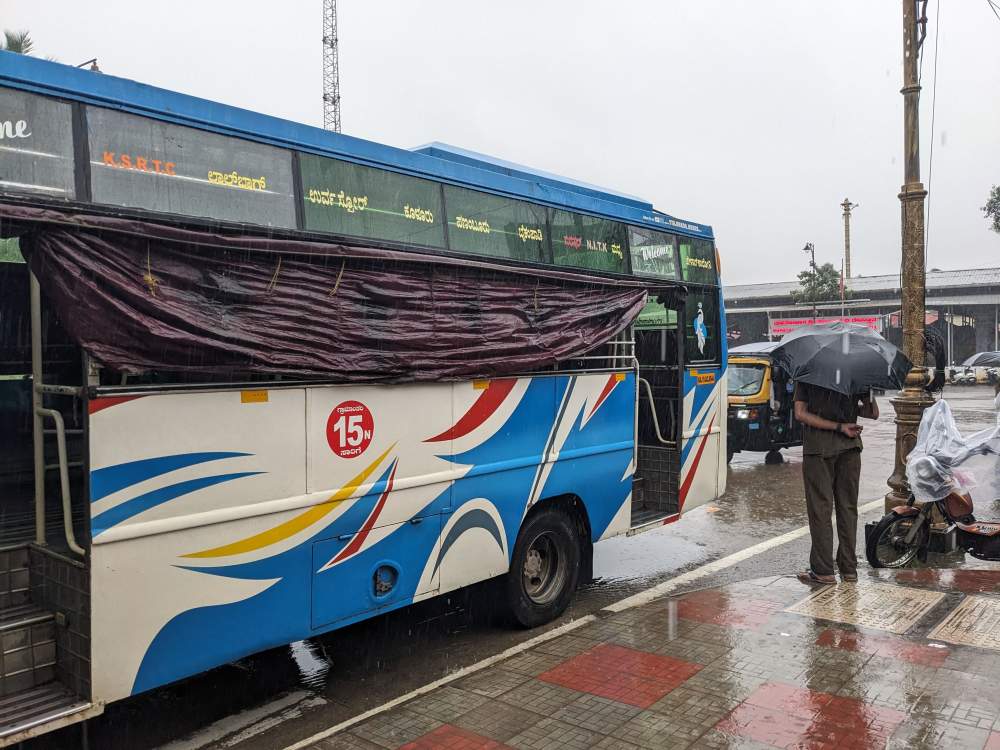
In The South Again: Mangalore, Udupi, Chennai, and Mahabalipuram
From Jaipur, I flew to Mangalore, the West coast of India, and the Western Karnataka which Sagar and I had always wanted to see. Mangalore is unlike any other place, and I have written much about it in the newsletter and more is to come on the blog. Mangalore and Udupi are not strangers to me anymore, and I would happily return to these cities any time. From the West, we took a train to the east, this time our journey being directed by where the travel memoir needed me to go.
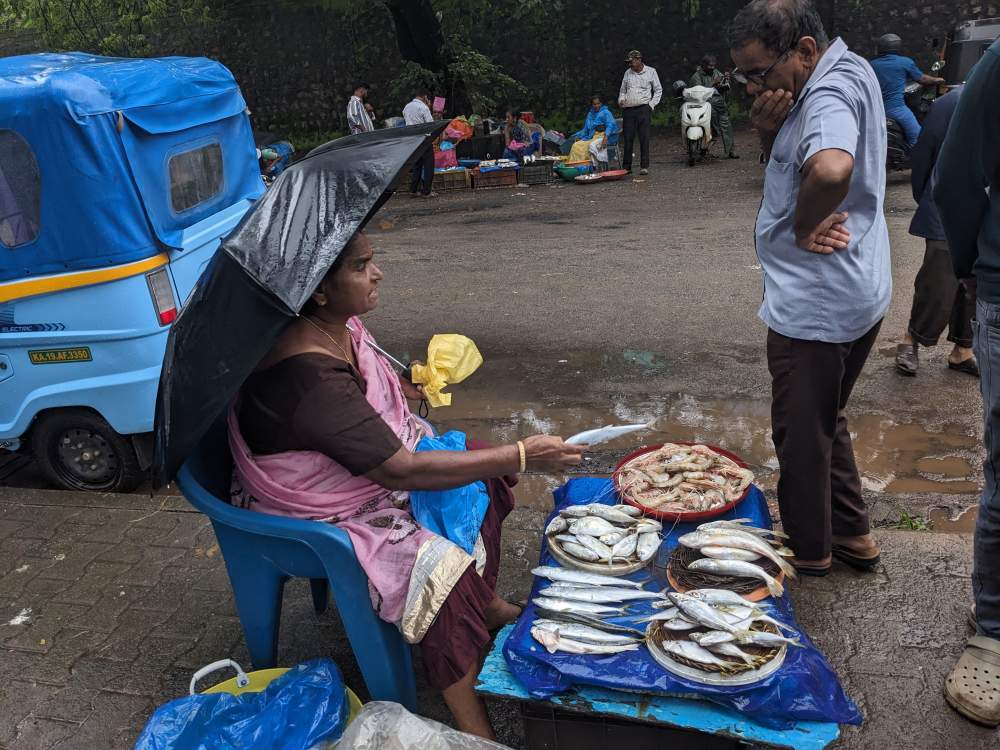
So in Chennai there were book signings and events. We lived in multiple hotels and Airbnbs and eventually in a friends’ home for about ten days. From there on we went to Mahabalipuram, a small coastal town where festivals decide everything. A kind local’s home, about two minute walk from the beach, sheltered us, and the house chickens entertained us and scared us to no limits. I learned that throwing water in their direction scared them away so I did that when I had to sit in the garden. Sagar enjoyed many freshly-laid eggs.
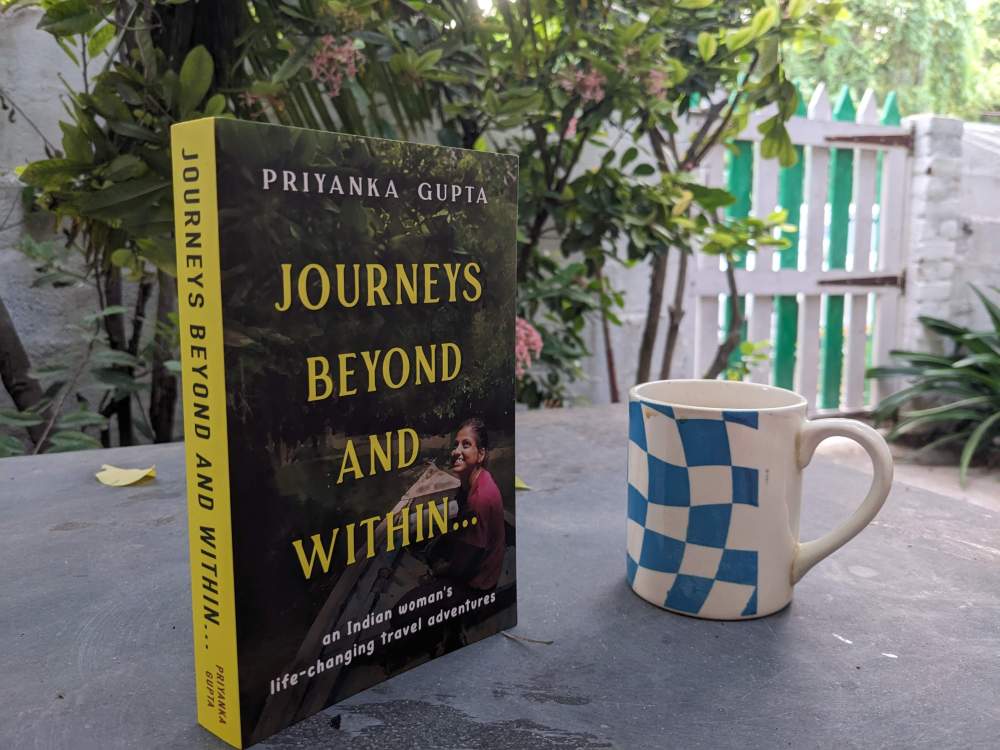
Calcutta (West Bengal) Again
Surprisingly we have been hopping coast to coast, as our next destination was Calcutta, a few more book signings bringing me to this city that initially housed us for two months when I was writing the book. We took another train from Chennai to Calcutta, and have been here since then. We have put up in more than ten hotels and Airbnbs since we arrived, and finally now we are in the little flat of a friend’s friend. I say friend because my Mathematics professor who has found us homes in many cities seem more like a friend now. I tell him not to trust strangers, and he doesn’t listen when I say I can find an accommodation on my own.
Well, so be it. Calcutta has been extremely fun. The grand Durga Puja festival, bustling local markets, hawkers coming to our doorstep every morning, old buildings, large gardens, and unempteen cats on the streets have kept us entertained. We are not sure where we will go next but my idea is to stay in and work here, and then perhaps go out of India. The plan was to leave earlier this year but the book delayed it all. Ah, well!
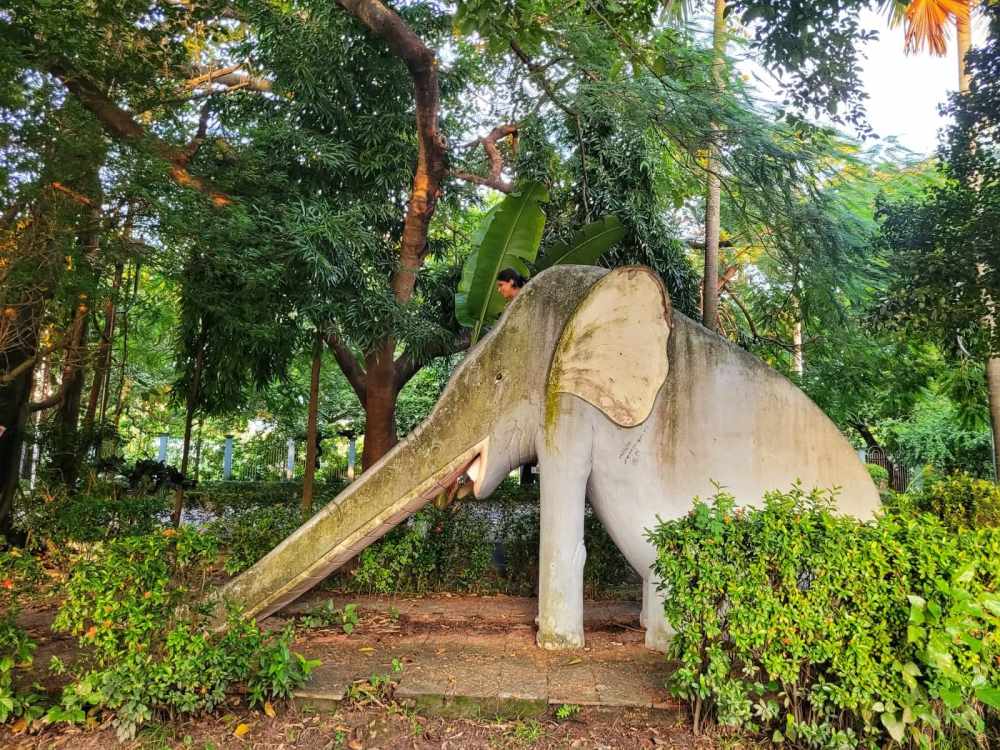
Update January 31’2026: A plan is being made, and indeed, I am going out of India for a few months. This time, we will both book one ticket each, our destinations slightly away from each other. But one needs to spend some solo time as well.
We are being slow. We are seeing, experiencing, living.
Now when I don’t go out one day, I don’t feel I am missing out as much as I did before. I am confident of our methods, and that other tourists leave the guest house early and come back late doesn’t bother me.
As I said: Travel has become a form of living for me. I travel, I live, I write. I can turn these phrases around in any order but they all mean the same to me.
We have had to work hard while ensuring every single day that we had a roof above us. A Sunday didn’t mean, Oh, let’s watch a movie today; It meant being at my desk at seven or getting ready to go to a national park or searching for a guesthouse.
As I told a friend, it is not easy, but having it easy doesn’t mean having it good. My travels have moulded me into who I am today, and I am thankful.
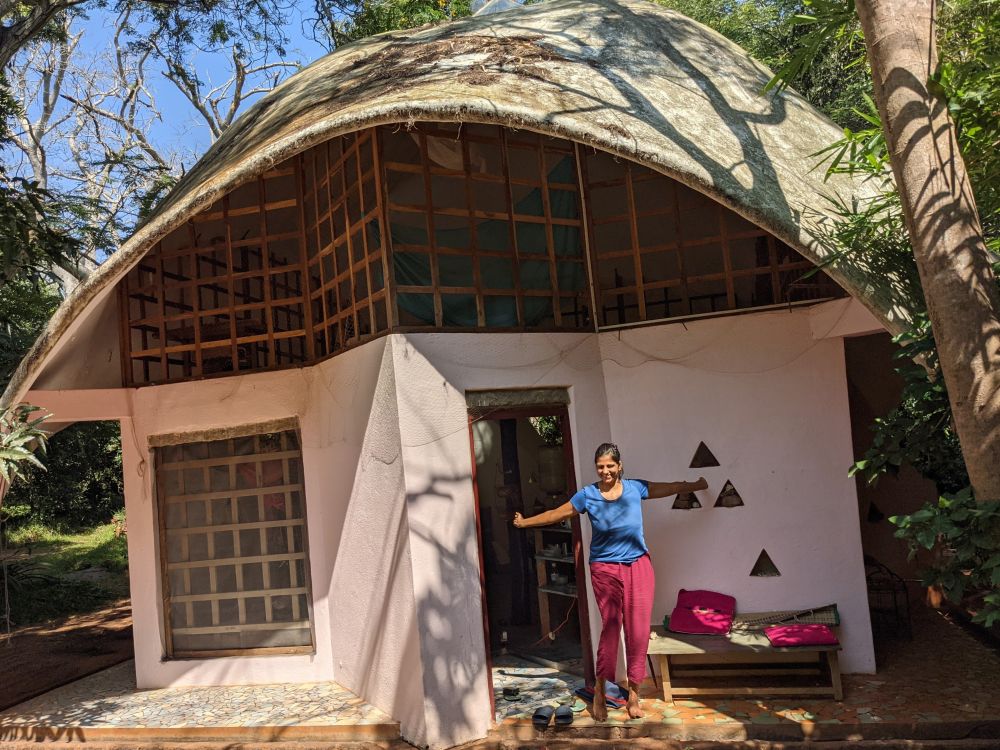
What About Food? Does Life As a Nomad Make You Compromise on Food and Health?
Sourcing food on the road has been both easy and hard. In the morning we might feel deprived, and by the evening, we could be overstuffed and content.
In 2021, our trip began from Karnataka, through Maharashtra, taking us to Rajasthan, and from there to my parent’s home. We were driving through India during the second wave of pandemic—my partner’s parents had gotten COVID-19 so we preponed our departure by weeks and left towards Mumbai to be near them. We were already out of our house, in a Bangalore guest home that we extended weekly, judging the COVID situation, and getting our new car ready. Hearing about their positive reports, we left at a moment’s notice.
Those weeks in Maharashtra were hard. Food had to be ordered in or picked up from the eatery. Restaurants were open to eat in too, but we had to be careful. Once, we drove on the dark Maharashtra highway, looking for a family-run food delivery joint. The owner was directing us on the phone. To avoid the toll hassle, and the charges, we parked our car on the side of the highway, crossed the dusty road on foot in the dark, stumbled around the potholed pavement, and somehow managed to find the place and pick up our packet. We had fish curry and fish fry, and that was our only solace that night.
In small Maharashtrian joints, we had the everyday meals of locals: dal, chapati, vegetables, curd, and so on. I can’t tell how many vada pavs, the cheap snack that many in Maharashtra live on, we picked up on the go.
We had great food, and though we tried hard, it wasn’t always the healthiest. Of course, we devoured local food that we wouldn’t get in any other place, whether it was healthy or not.
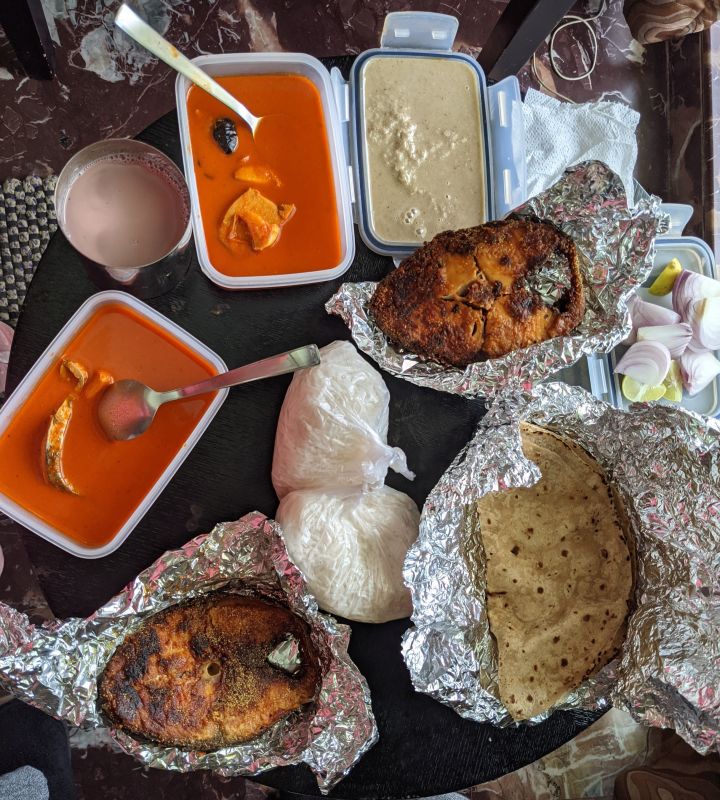
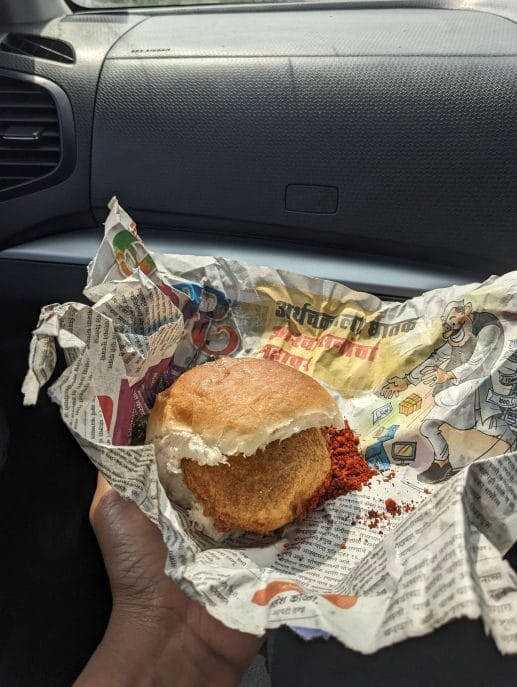
In Rajasthan, a tourist-friendly state, we stayed in Udaipur, finding a suitable time to continue traveling Northward. We planned to visit my parents and then go onwards to Himachal Pradesh.
Our hotel was dusty, had only two rooms occupied, and the breakfast had been discontinued due to low occupancy. One morning, while searching for food, as Sagar attended meetings back in the room, I stopped to drink tea at a place. It was a room in the front of a house. When the man said they had food, too, I was surprised. Due to the pandemic, they had to shut their shop and run it in hiding. I got a parcel of poha: flattened rice and a popular Rajasthani breakfast.
After that, we often phoned the family to order thalis: a plate of lentils, vegetable preparations, chapati, salad, and yoghurt. When the food was ready, they called us. Upon seeing our missed call, they opened their home, ushered us in, and closed the door behind us. The police or neighbor shouldn’t see they were still running food services. The family was simple and lovely and eating from their kitchen, we never felt far from home. Our host and the caretaker were friendly, too. We ate our meals in our room overlooking Udaipur Lake or went to the terrace to eat as the sun set.
Just a little update: Now re-reading this again in 2025, I feel fortunate. It was such a hard time, but it was still such a good time.
In 2021 in Himachal Pradesh, we mostly had a private or shared kitchen. So either we cooked or ate out at local eateries which served lunch and dinner meals for eighty rupees. We were delighted to get unlimited lentils, vegetable preparation, and rice in a thali. It was always simple, had locally-grown ingredients, and was oil-free. Imagine homemade food served by a dhaba, the local friendly street-side food joints in India that you don’t discover on Google Maps. They are found by getting lost in the back lanes and forgotten alleys of our cities and villages.
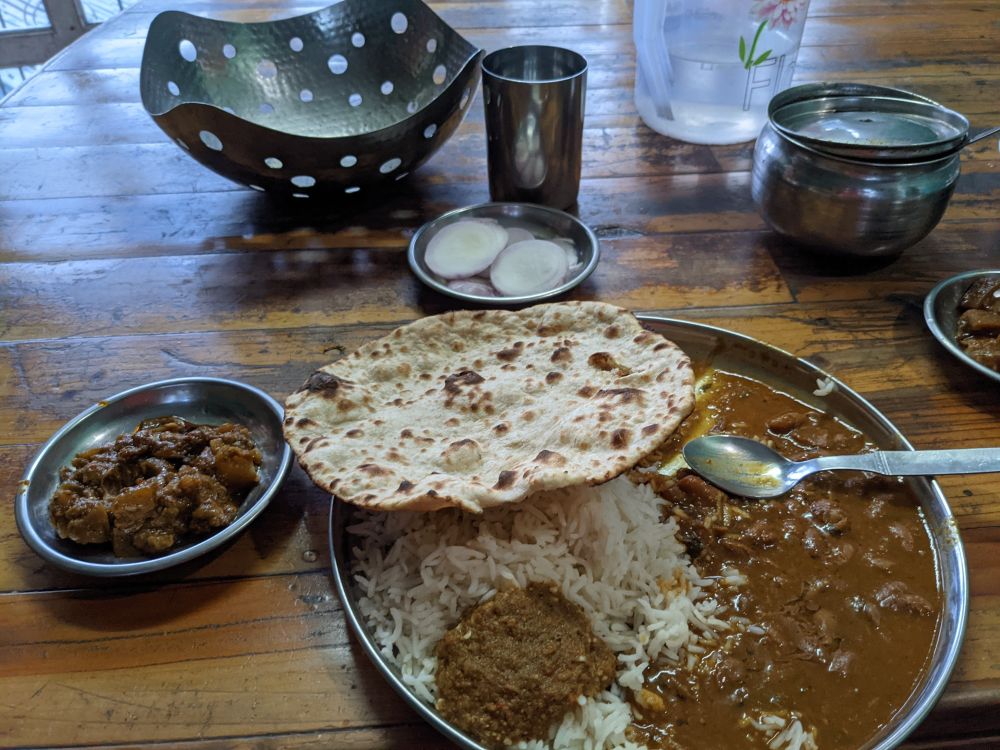
Getting the refills of dal and vegetables was a bit painful in the state though. While most locals took a few rounds of rice, we asked for more dal and vegetables for one rice serving (we never took more).
“More rajma?” they asked. “Yes, please, and some okra too.” We would say, slowly our embarrassment becoming less obvious.
Even ordering and eating food in a place as an outsider needs patience, confidence, and courage. We don’t always understand the language, especially the local food and ingredient names, have to repeat what we need unless we want to repent later, and can only hope that we will get what we asked for, or that we asked for the right things for ourselves. Then we have to navigate this strange meal that is now placed in front of us, hopefully without embarrassing ourselves too much.
Sometimes, my throat burns from the chili, and Sagar gets irritated when the staff starts cleaning the table while we are still sitting. Once in Kerala, I picked up a fried evening snack from a woman’s stall and bit into it. It was egg pakoda. I don’t eat eggs. What do we do in these situations? We breathe, keep patience, and try to get what we need from the system.
Food is such a personal thing that at times we have felt offended too.
“We are standing here while they are directing others to tables.” Sagar and I mumble.
Getting upset, turning away, leaving half-hearted, and sleeping hungry—are all methods we have tried. They don’t work. The only way is through.
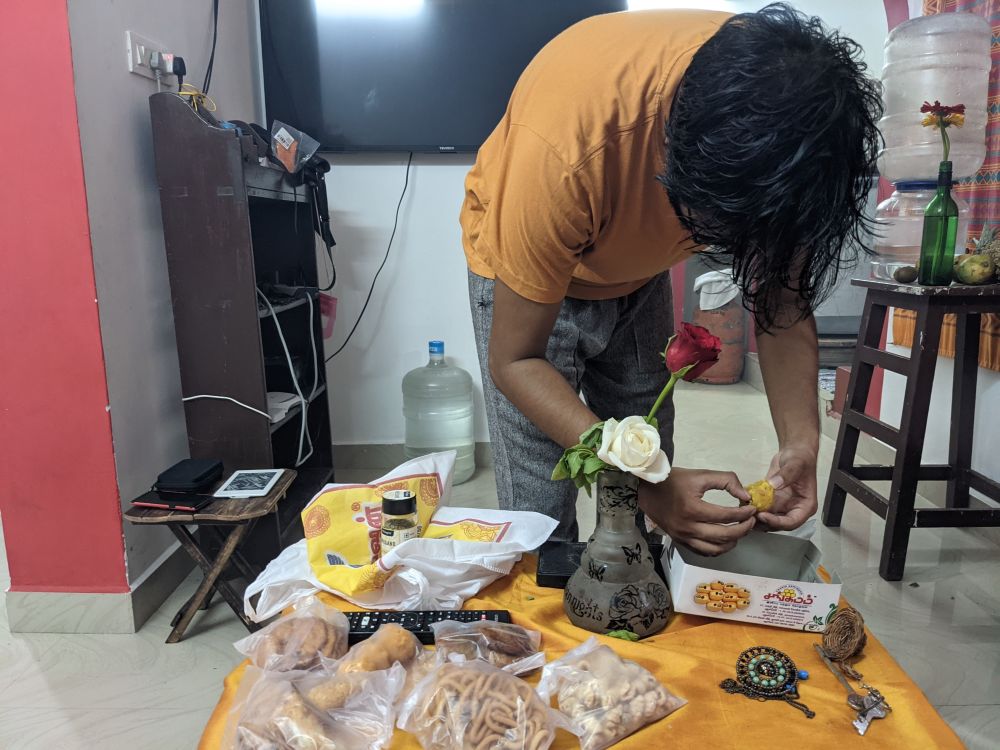
In Pondicherry (also known as Puducherry), we always had a kitchen except for a few weeks. We ate homemade food, tried out seafood at old and new local joints, or munched on the various fried snacks served fresh all day. In Auroville, too, we made it work with a gas stove, though our French host thought we cooked too much and charged us extra for it. We cooked one meal a day, and her small used gas cylinder ran for three weeks.
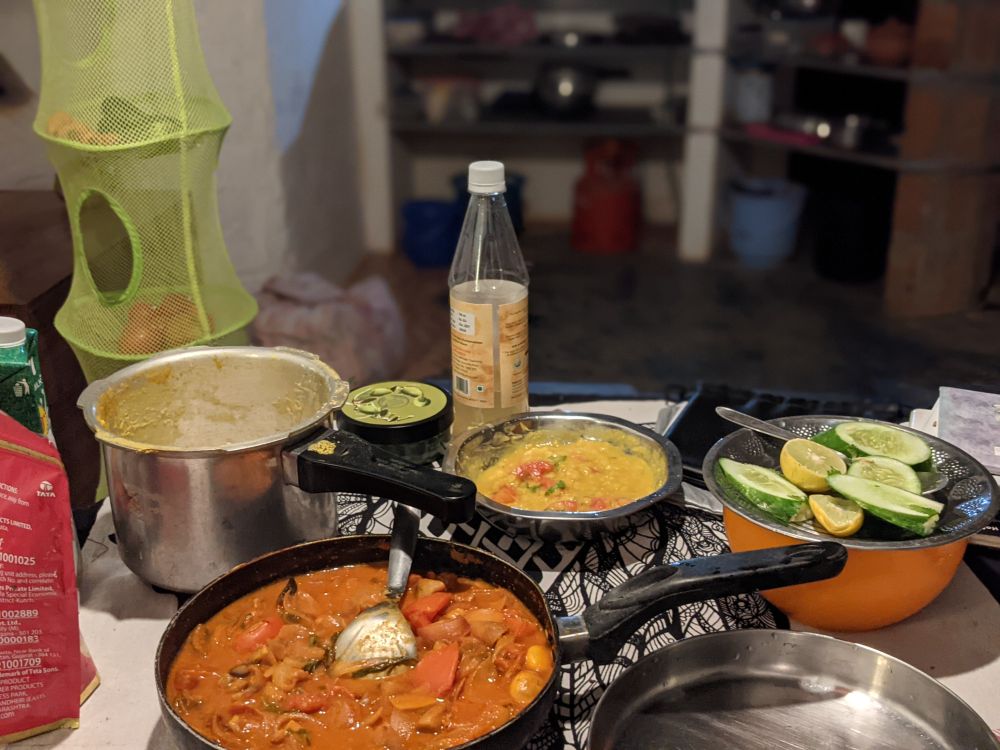
At the other guesthouse in Auroville, we could use as much gas, but when it finished, the staff refilled the same cylinder at the community’s gas service. One can easily imagine the issues associated with this method, but that was the system. I started informing the caretaker in advance, and after many follow-ups, I was assured they had a filled one we could pick up any time.
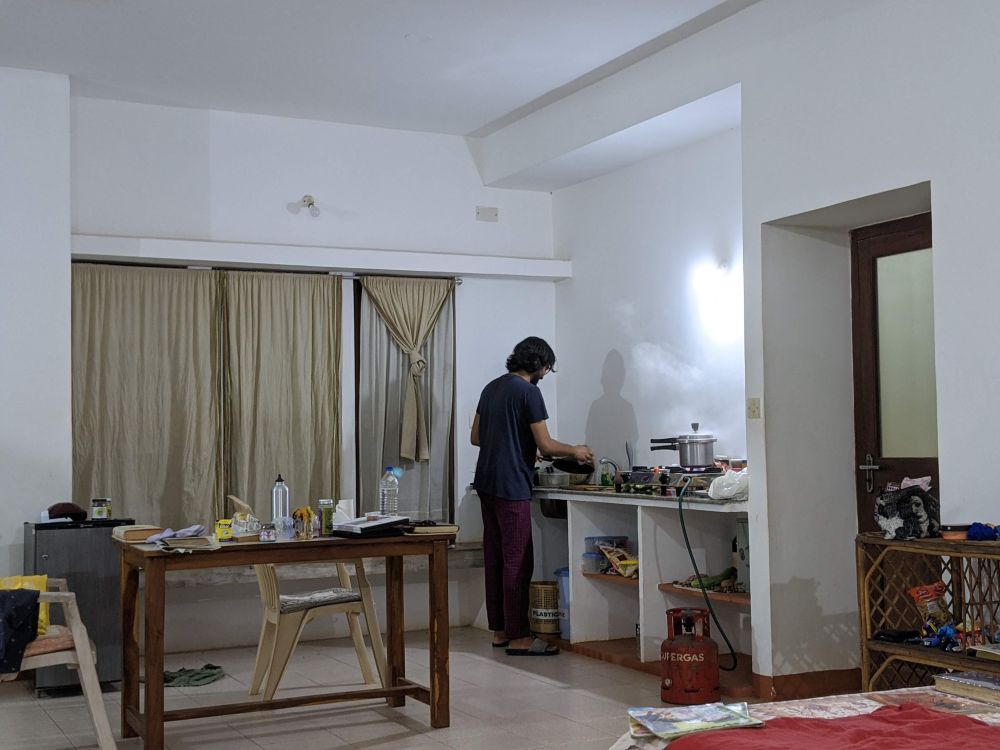
Of course, the Auroville cafeterias, restaurants, and community food centers helped too. The places had good, fresh food with great salad portions. Apart from the vegetarian meals, the plates weren’t always the most affordable though, and navigating some of the staff—who didn’t welcome outsiders, especially Indians—was hard. As Auroville has people from all over the world, we could try a lot of cuisines: including Japanese, Korean, French, and Italian in their authentic form.
My most memorable meals from Auroville are mostly self-cooked that I prepared from organic produce sold in the community store. I also can’t forget one Tamil beetroot preparation (that now I make myself), an avocado mushroom toast I devoured with basil chutney, and mille fuelle dessert from a French bakery in Pondicherry.
Of course, in Vietnam, we ate every meal outside. We were often struggling to communicate that I didn’t eat meat and that it wasn’t okay to give the chicken soup without the meat pieces. Many Vietnamese breakfast soups including the popular pho were cooked with meat, the children of the local food vendors told us in broken English over their parent’s phone that was handed to us. Rice and noodle preparations naturally included egg as well. Every meal was a struggle, but the delicious food of the country pushed us to keep looking.
The fish soups, grilled fish, rice rolls, noodles, hot clay pots, and fried sweetbreads enchanted us. But the most Sagar and I enjoyed were hot pots.
You get a boiling pot on your table. Meanwhile, you go around the buffet and pick as many vegetables, mushrooms, and greens as you like. Then you get a packet of noodles and the main ingredient, the protein, of your choice: we always take seafood or fish. Put everything in the pot in the sequence of their cooking times. The hotpot is so huge, and you overfill it so much that by the time you finish the pot, your bellies are bursting and your heart is singing.
That’s the right way to do things.
Though finding food in Vietnam as a pescatarian was hard, I still loved what I had and would love to go back any time. At any place, we have to keep our mind open towards how the locals make their meals. Now we eat what they give us, that’s all.
Vietnamese fish soups are out of this world!
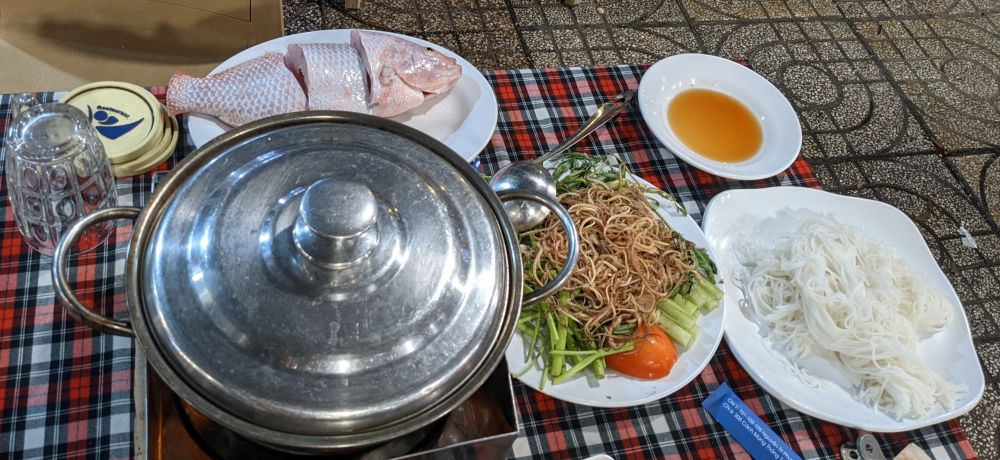
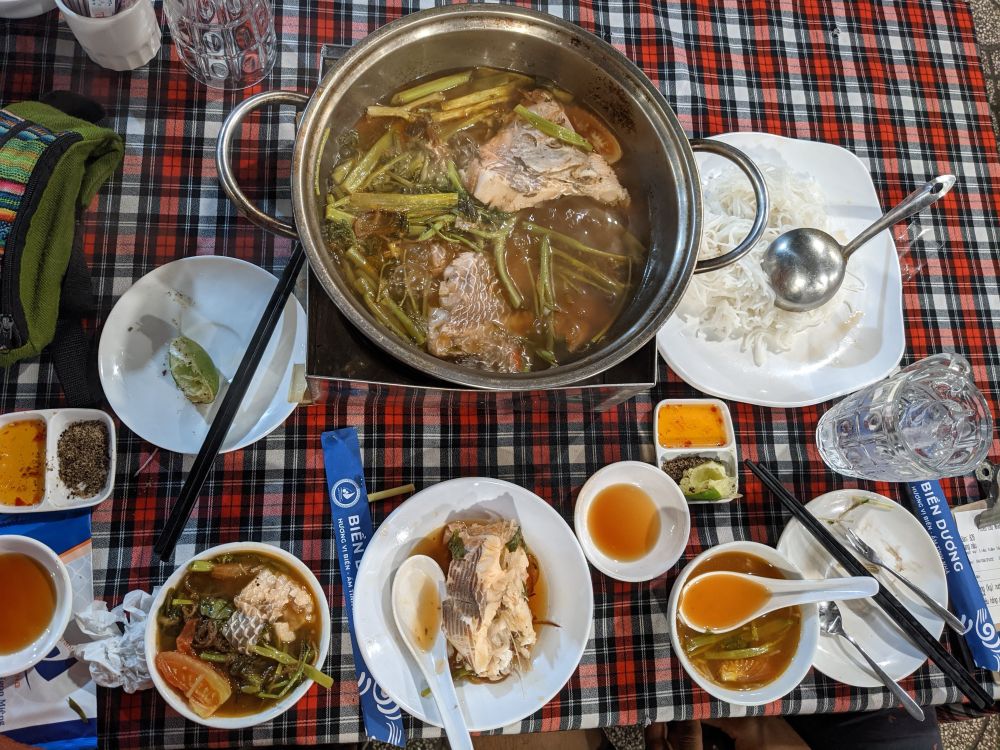
If we are staying somewhere long-term, we prefer places with a kitchenette or a kitchen. So that while exploring the cuisine of the place, we could still make some comfort food for ourselves.
Sometimes, the host puts up a makeshift kitchen at our request.
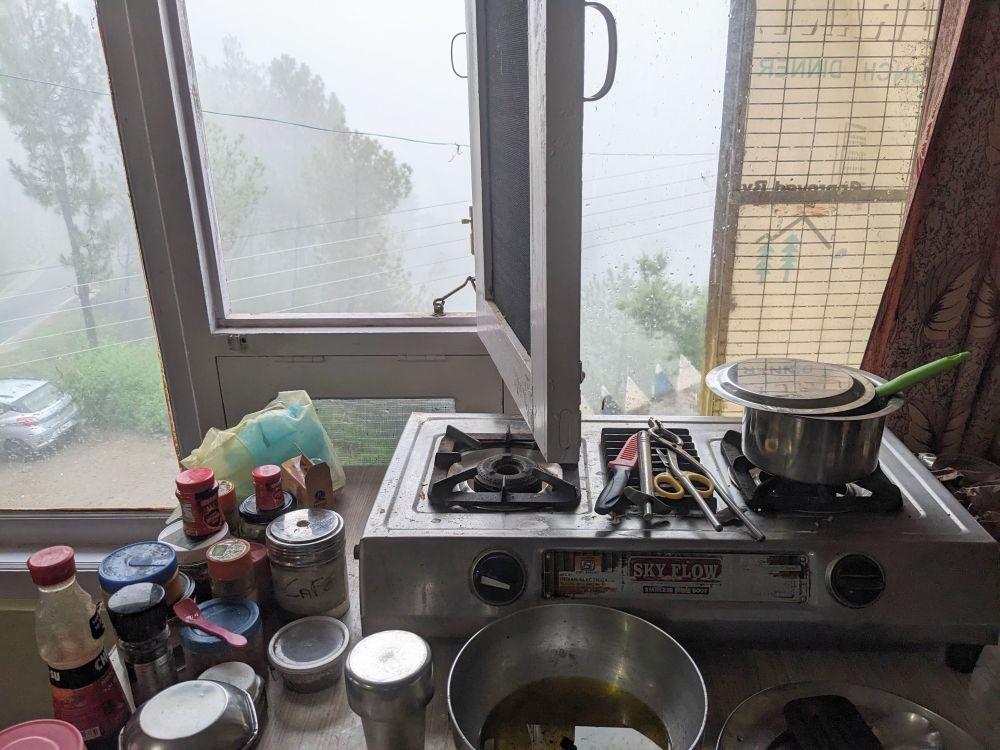
In 2023, we survived for four months in Himachal with a stove on a table in the hall. Thanks to the glass windows right behind the table, the villagers could see us from the road.“You cook your own food?” They often asked us when we bought local tomatoes or rice from a store below our house. One whistle from our pressure cooker alerted the whole village that the guests were cooking something. “What is it today?” They tried figuring us out by the food we ate.
We prepared lentils and vegetables and bought the rotis from a nearby dhaba. I would make a cooker full of yellow lentils and a wok-full of brinjal fry, and we finished the food by the next afternoon. We didn’t need a refrigerator. The cold Himachal weather kept our food fresh until we could finish it.
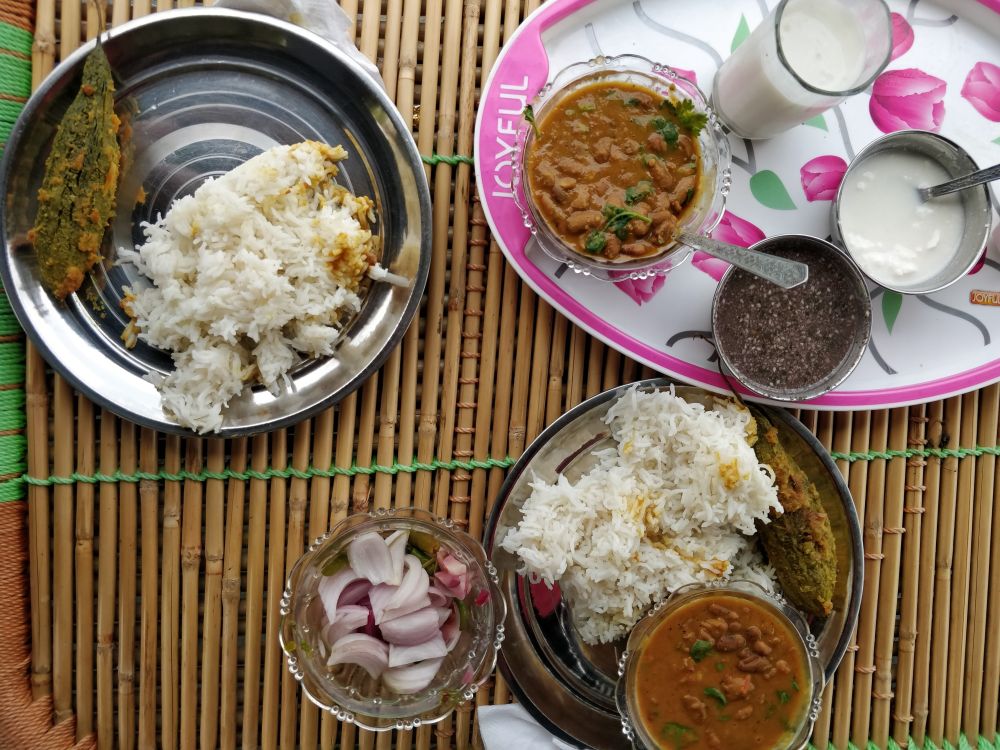
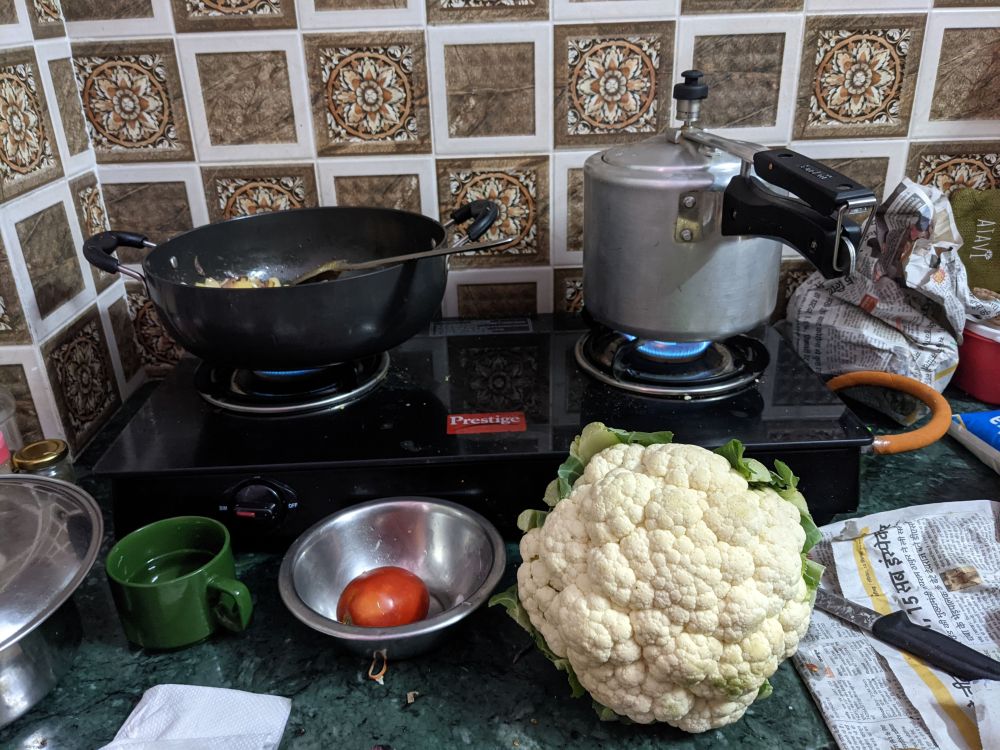
The packing details below list the things we carry. On such long stays, our utensil bag and spice bag both come out. Not in every place do we get clean and usable pans and pots, so instead of requesting every spoon as the need arises, we take out our bag. It has everything we need. Then we only require a stove and a cylinder. Or an induction suffices.
We also managed three months in cold Gangtok without even a microwave. We had a small fridge and a kettle only.
Before Gangtok, we were in Siliguri for more than two months and prepared our food daily. As always, I was overbuying vegetables from the weekly grocery fair. Cleaning the greens, cooking and storing them, and everything in between tired me out and consumed a lot of time. In our temporary stays, we do everything ourselves and don’t hire any help. We also prefer it that way and didn’t have a house help even in Bangalore, but definitely traveling, working, and house chores along with everything else becomes a bit too much.
The absence of a kitchen in Gangtok came as a relief. Without any distractions or house chores, I wrote. Lunch was then, as you have seen above, Himachali, Nepali, Bengali, and Rajasthani thalis. Lunch was so much more than a meal then. It was our daily outing, exercise (we climbed up and down to the market), socializing, shopping opportunity, date time, exploration time, and an opportunity to get our room cleaned without us having to do anything. Most often, after lunch, we roamed around the market, digesting the food, and bought some sprouts (for me) or momos (for Sagar) for dinner, shopped for fruits or a pastry, and many a times stumbled into local fairs. As soon as we reached home, I put on the electric kettle for coffee.
When we had to check out of our three-month Gangtok hotel for two days, (it had been fully booked for those dates months in advance), we reserved an Airbnb with a kitchen. We were craving homemade food and access to a stove. Those two days, I cooked all three meals and, of course, we packed boxes of vegetables and chapatis that lasted us more than a day in the hotel.
Oh: We stayed at Srigo Gangtok, and I truly recommend it. Clean rooms, quite street, and kind staff. Book the hotel here. I think they are now called the Yeasel Continental but it is the same hotel. Go for it.
When we are traveling a little bit faster, we eat out. Interesting local breakfasts and tea start our day. We might not have lunch if the breakfast was heavy or vice-versa. But sometimes we aren’t able to say no to the lunch meals served on banana leaves: thick local rice, sambhar, pickle, papadum, vegetable preparation, curd, and optionally, a fish fry. Dinner is generally fruits. Or a good plate of tapioca fry, oily fish curry, and a chutney made with onion, chilly, and coconut oil: one night a host in Wayanad Kerala brought this plate for us as a surprise.
“Kappa Chammanthi, we call it.” The kind woman smiled.
How lucky we are to eat the ancient food of different regions of India right where the recipes must have been invented and where the plants grow under the sun, bursting through the fragrant earth, drinking the rivers that flow through this beautiful country!
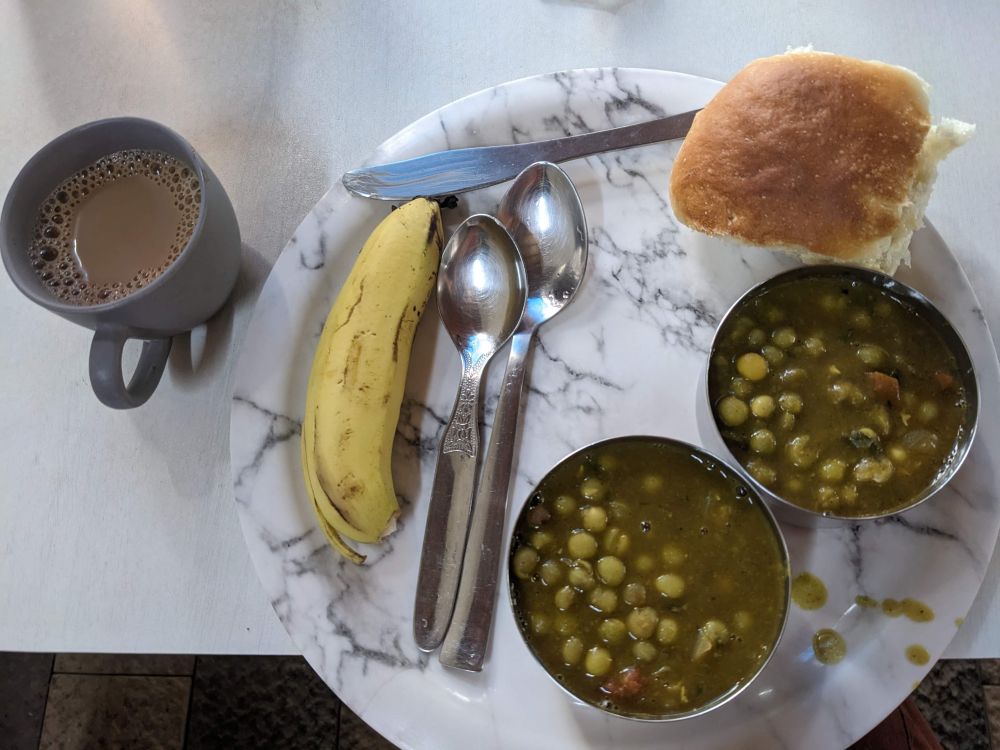
Though I have said it before, I should mention here that we don’t eat three meals. Both of us fast intermittently—I, to keep it light, and my partner, I guess, for ease of living. We don’t follow the traditional system of breakfast, lunch, and dinner.
As I studied and have noted down in this guide on meaningful and healthy living, intermittent fasting is not yet a proven method towards a healthier life, but the idea has strength.
The more you eat, the more your cells have to work to digest the food, and the faster they deteriorate. The faster degeneration of cells is directly related to ageing.
Here jumps in intermittent fasting.
In this method, you fast for more than twelve hours: sometimes even up to days. Sagar and I fast for a minimum of fourteen hours. Beyond fourteen hours without food, our body starts burning the stored fat. You can read more on the science behind intermittent fasting in the guide I shared above and its linked resources.
When I first started fasting in Himachal in 2021, I lost five to six kilos in about a month and a half. Sagar shed weight, too. We had one big meal, and the rest of the time we ate fruits, nuts, curd, and vegetable preparations but no carbohydrates. Everything was natural and easy to digest.
I also highly recommend eating local produce, like the old way. Eat what grows near you, saves both time, shipment, money, and resources. Regional food also keeps the belly good as it is meant for that climate and season.
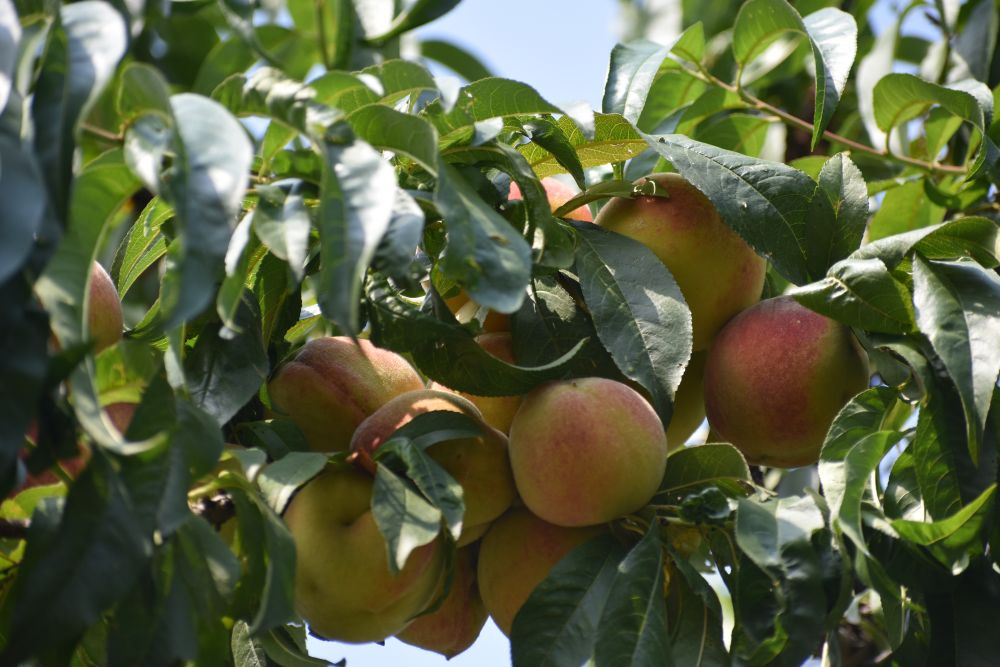
Fruits have come with us a long way too. I increased my fruit consumption when I started fasting. Now I eat fruits because I love them.
I buy fruits while on the way. When you drive as much as we do, you do not want to go out ever again (our feelings change overnight though). So we buy fruits whenever we can and keep.
This is one of the benefits of living a nomad life that I get to eat fruits and vegetables from all around India. I mostly pay a wholesale rate for the best fruits. Sometimes, I live with a family who owns an orchard. While driving on the highway we pass trucks and wholesale vendors providing fruits at lower prices. Many times, we buy directly from the farmers who sell items by the basket. Rarely do I have to visit a traditional fruit shop in a city. For someone like me—who consumes kilos of fruits every day, and so really does buys in wholesale—this access to India’s best fruits is a privilege, one that I do not take lightly.
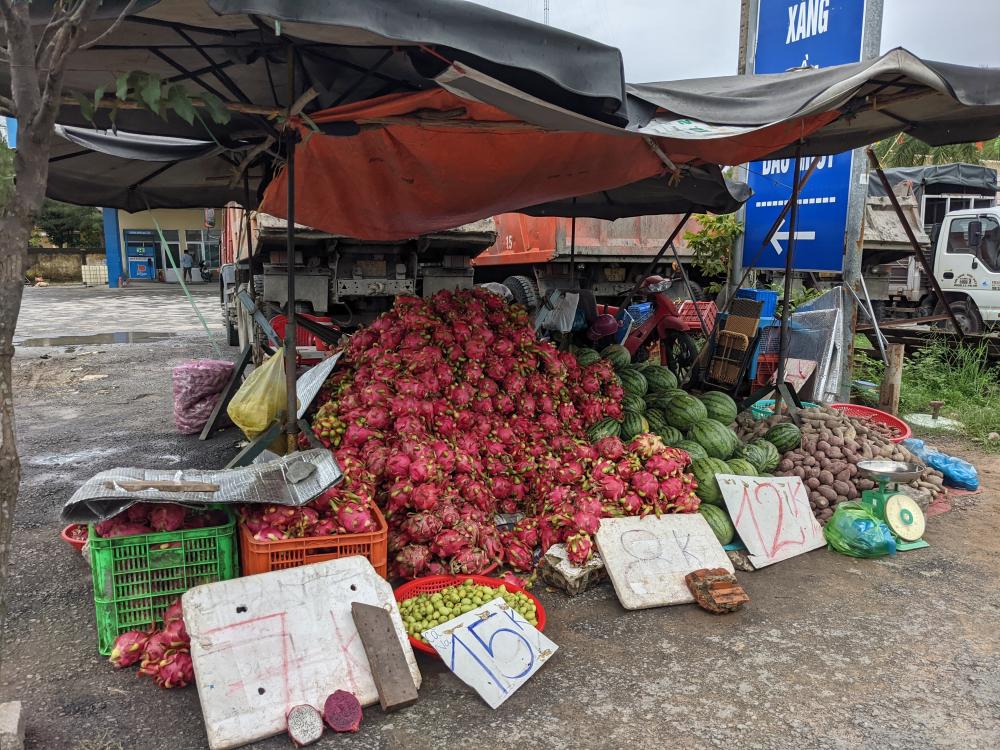
Our room and car overflow with a rainbow of fruit. On the road, when we don’t find a place to eat for miles, when we arrive late in an accommodation, while hiking or walking in the sun, or on a busy work day, the fruits that we either keep cut in a box for the journey or those we wash and gobble on the go are a life savior. (As I write this, my mouth waters imagining the taste of the pineapples and mangoes that now sit in my room.)
For two homeless travelers, the overflowing packs of fruits are a comforting sight. They assure us that we won’t starve.
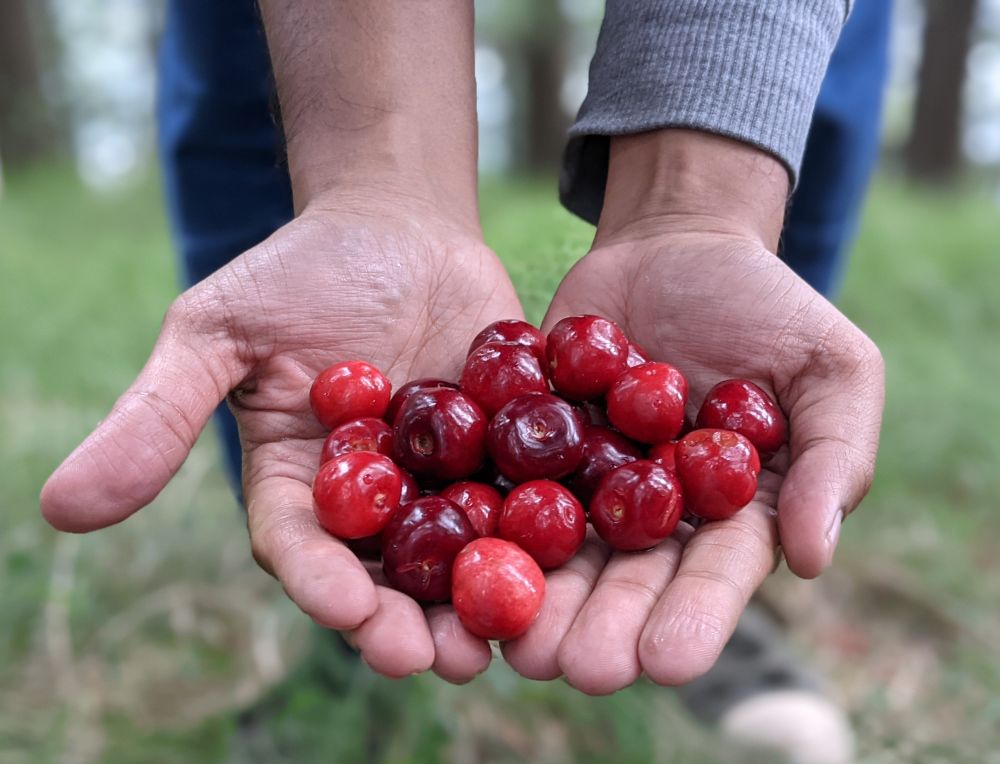
Thanks to intermittent fasting, our daily life has simplified. We don’t have to cook all day or think from breakfast to lunch and lunch to dinner. The freedom you get when you don’t operate in between meals and don’t have to buy or cook as much and clean up afterwards is liberating. Now we can also eat a larger variety of things.
Though fasting for such long hours was hard in the beginning, I felt strong. Every day, I hiked up and down the mountains, did long treks, and for a couple of weeks, ran a few kilometers up and down the steep road.
On a lighter belly, I feel more energetic, I am happier with my body, and if need be, I can manage without food for a long time.
Our recent full-body test reports came out good except for two vitamins. One is the notorious Vitamin D that my body never makes even if I stand in the sun for hours. The other one is the Vitamin B12. My friend’s elder brother who is kind enough to look at our reports every year says I have to take it in tablets and also eat fish three times a week. Right now I am in Calcutta, and fish would be the last thing one has to worry about.
So far, intermittent fasting has worked out. Of course, as we don’t have children or parents living with us or any kind of diet restrictions, we can manage this lifestyle.
We can get our bodies trained in any way we like. Our new routine soon becomes the new normal. As long as we are getting the required nourishment, we don’t have to follow any particular system. I have figured this out by years of experimentation with food and diet. Now, I look beyond our cultural food practices and assess the requirements of my body for myself.
People wonder why am I not ordering paratha with the cottage cheese spinach curry, our very own popular palak paneer. Some servers exclaim, “It comes as a curry, you know?” My friends remark when I reject dinner, “Are you doing intermittent fasting?” Only you know what you need. Often, I enjoy curries without bread, and my dinner for weeks could be semolina, milk, and jaggery pudding. I wouldn’t have it any other way.
We don’t always have home food and can’t make a bowl of soup even when one of us is sick or when it is cold. Then we wait and enjoy the outside food. We fulfill all our cravings when the time comes. And the time does come always.
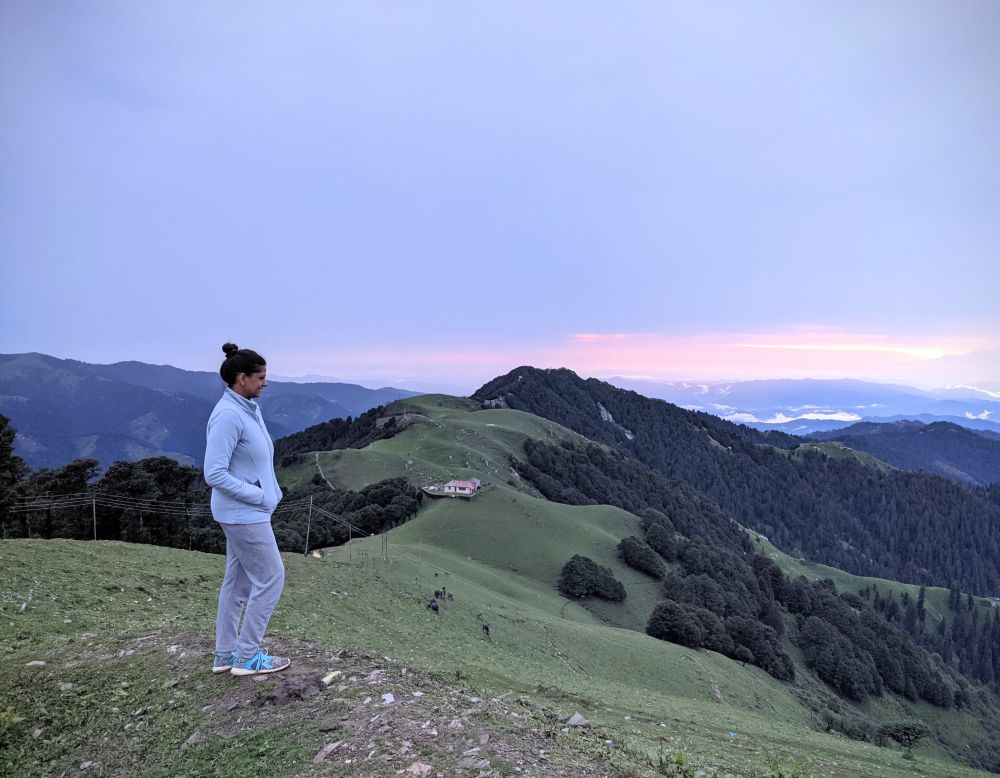
How Do We Pack For Long-Term Travel?
We started with a lot more. Now the extra is at my parents’ home, and this is what we have to be fully independent on the road,
Two backpacks: with our clothes, slippers, toiletries, a knife, mosquito repellants, tools such as measuring tape and a tiny screwdriver, ear plugs, a flashlight, locks, chamomile tea bags, and a first-aid kit and sanitary pads. This is the backpack that I use (in blue color though) and highly recommend it. It has been with me since early 2017 and still shows no wear and tear. I think it is one of the best backpacks for digital nomads, especially for women, because it is really rough and tough. My article on how to choose and use a backpack will be helpful if you are a beginner backpacker.
Two Laptop bags: holding the obvious, charging cables, a multi-plug, notebooks, pen, ink pot, and one or two books.
Let me stop you here. As, at the moment, that is in January 2026, we are traveling sin car. So all we have with us is two backpacks and laptop bags. But to know how we have traveled for most of these past five years, please keep on reading.
One Kettle bag: holding the obvious and milk packets, sugar, jaggery powder, tea bags, coffee powder, coffee filter, and two mugs in a box.
Document bag (pushed in the pocket of driver’s seat): holding the obvious and some important receipts from on the way.
Jackets in jacket covers in the seat pocket of the front passenger seat.
A yoga mat.
All of the above fits in the backseat of our car.
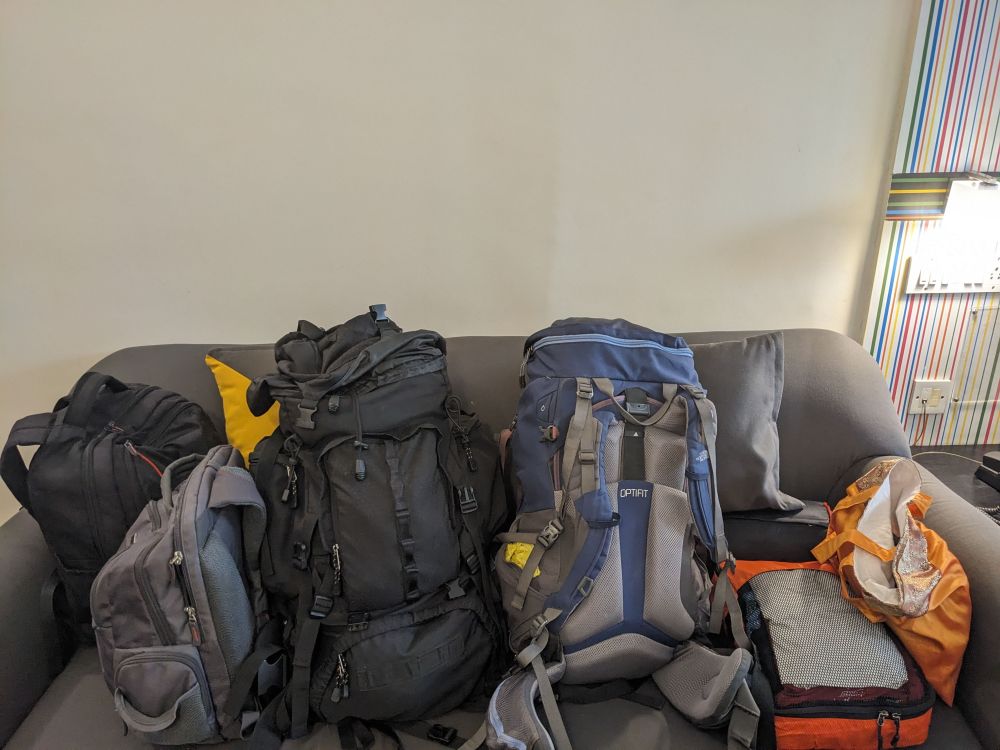
Now coming to the boot.
One suitcase in the middle holding our extra clothes, winter sweaters, and two saris.
A Utensil bag: holding the obvious and some jars with ingredients such as jaggery powder, wholewheat flour, some local rice and ghee from Himachal, spatulas and packing foil, cloth pins, and so on.
A Spice bag: as exotic as it sounds it holds the obvious, and salt, loose tea, tissues, tea filter, spoons and forks, pickle, a thin plastic cutting board, a tiny mortar and pestle (my father insisted), a small knife, and some leftover ingredients such as garlic bulb, loose flour, and pulses, and some ghee.
These two bags go on top of each other on the left side of the suitcase.
On the right-hand side of the suitcase, we have,
A Book bag: it holds some of my dearest and most important books and notebooks.
A Bedding bag: it holds the obvious and a few filter water bottles for emergencies.
Another little Peruvian bag with nothing much. It’s there to accompany us on adventures.
Now we use an Adventure bag for day outings. It has a picnic bed sheet in a ziplock cover my mother insisted we carry, games such as Monopoly and cards, and a shawl for cold.
These bags and bedding go over the Book bag.
Extras such as a laptop hard box, extra electronics we have to give away or sell but we haven’t been able to, two badminton rackets we rarely take out, and extra rolls of toilet paper along with a few shoe bags holding our shoes are squeezed in and around the leftover space in the boot.
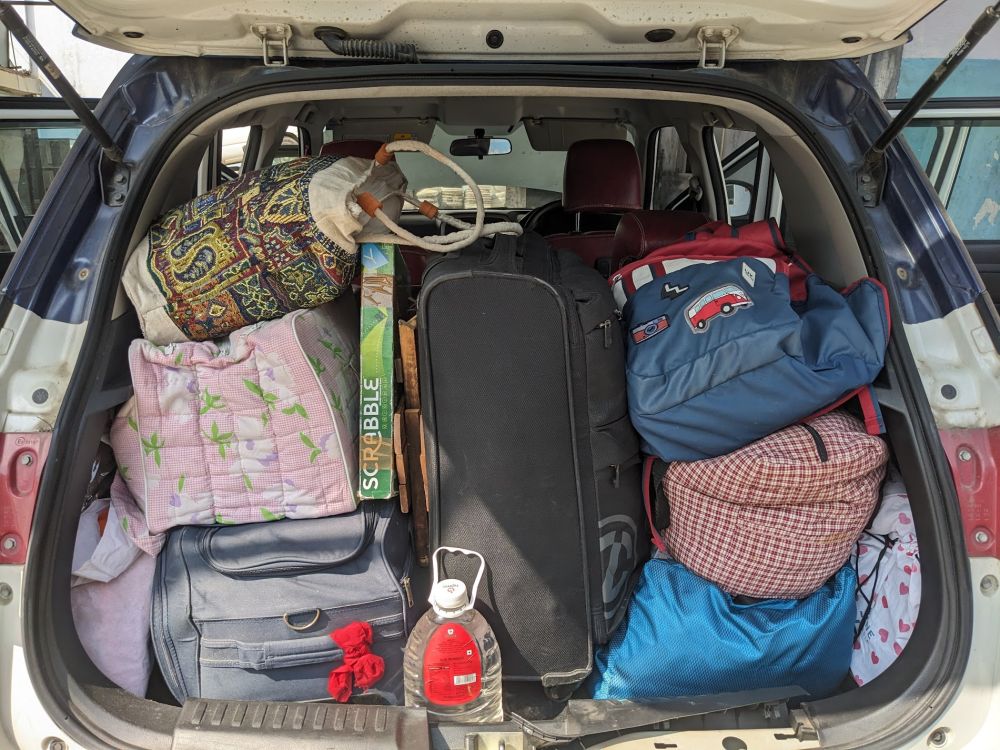
Two water bottles for our car also reside in the boot. In between the suitcase and the kitchen stuff, we have put in a box of Scrabble and a tiny wooden foldable table too.
Our fruit packs we keep on the backseat between backpacks and laptop bags. The backpacks pile on top of each other behind the driver’s seat: the bags are long and the driver’s seat doesn’t have to be pushed so further behind.
The laptop bags are kept behind the front passenger seat.
Wet wipes, sanitizer, tissues, cables for the car, a car charger with enough power to charge laptops, little things to eat, matches, car papers, and our wallets etc stay in the dashboards and the hand-rest storage space.
Do we have everything we need or do we have more?
We have used almost everything we carry in the past five years except our documents and degrees. Maybe we should keep them at our parent’s home.
We don’t carry valuables such as gold jewelry. Some of the artificial accessories I have collected from around the world come along on the journey though and stay in a little pouch in my laptop bag.
This was not the arrangement since Day 1. We reduce, exchange, and improvise. Right now it is pretty cool though. Update 2026: The car is parked at our parents’ but this was our last car arrangement. We were happy with it.
How Do We Manage Money Since Becoming Digital Nomads? What Are Our Nomad Living Expenses Per Month?
Many people ask me how do I travel. Where does the money come from?
The idea is to keep our nomadic expenses similar to our living costs. We are okay to spend at least as much on our journey as we would spend living in a home. A bit more is also okay as we are experiencing so much more than we would have at home.
What is the point of it otherwise?
Overall, in five years, we have stayed in places from half an hour (the place was filthy, so we left and asked for a refund) to six months. On average, Sagar and I have spent INR 30,000 per month (about USD 340) on rent including electricity, internet, water, drinking water, gas (stove, not car), linen and towel change, parking, and cleaning services. Sometimes, the rent even covered tea, coffee, local fruits and vegetables, dinners and breakfasts, and appliances et cetera. We have zero maintenance costs. No carpet cleaning, painting, or plumbing charges. No headache.
Our cab or taxi expenses are nill because either we drive or use public transport: buses, metro, or simple modes such as autos and tri-rickshaws. Mostly, we walk. We cycle. Only in one few-months-long stay, we had costs of moped, bicycles, electric bikes, and a scooter that I believe would be covered by this average monthly rent.
Some months have been more expensive. Our few-month journey through Chandigarh, Jaipur, Ranthambore National Park, Satpura National Park, Bhopal, Nagpur, hotels on the highway, Goa, Bangalore, Mysore, and Kerala cost us more than our average monthly budget, especially because of the petrol costs. I am sure this spend was averaged out by other cheaper accommodations, monthly rentals, and family stays over the next months.
Update January 31′ 2026: Today marks our five years of living as nomads, and I’d say the pattern repeats. We might spend more a few months, but then our expenditures decrease enough to average out the expenses.
Our methods and needs are forever evolving.
Once upon a time, I used to book the cheapest place for myself. Then, to comfort Sagar (the real princess), we reserved more spacious and presentable accommodations: those that promised a minimum comfort. I applied filters such as wifi and parking (or at least an approachable road) and prioritized cleanliness. Now, instead of one room, we look forward to bigger spaces, apartments, and larger hotel rooms. We got two rooms a couple of times in Himachal when each was four hundred rupees per night only. As our living space doubles as a workspace—and almost every other utility space—a larger accommodation keeps us from running into each other all the time. Later, we get into budget guest homes and average the costs.
As someone who used to choose homestays over other accommodations, now we prefer hotel rooms. Both are unpredictable, but family-run lodges are even more unstandardized and can come with unexpected restrictions and peculiarities. In a family-stay, you aren’t dealing with the staff, you are requesting a family, who takes things personally. Simply put, some host families have been pretty scary. Having said that, in February’2024, I was in two different homestays in the Wayanad district of Kerala, and both of them were mostly lovely.
On the road, never say never.
My partner, inspiration, and guide, Sagar
“Let’s not make anything of this. Let’s get our things done and move forward.”
How do we keep our costs low as we travel long-term?
The first thing that works in our favor is that we aren’t in a city anymore and don’t bear the costs of city life. The second good thing that happened to my partner and I is that we were raised in simple families. Easy is our way to go in everything.
Instead of booking the best, the most comfortable, the largest, or the room with the better view, we go for good enough. In 2021, when we were traveling from my parent’s home to Himachal, while the second covid wave was at its worst, the first accommodation we booked was a one-bedroom house with a kitchen and a little hall in an unknown location. We had to adjust to many things (as I write in the linked narrative), but, at the end of the day, we had a nice little mountain home where we lived, cooked, worked, sunbathed, watched birds, and from where we set out on hikes to leopard-infested valleys. The rent was INR 850 (about USD 10, as of October 2025) per day.
Often we booked the Himachal state government guest houses which were basic and where one couldn’t expect any service but which cost thousand rupees a night.
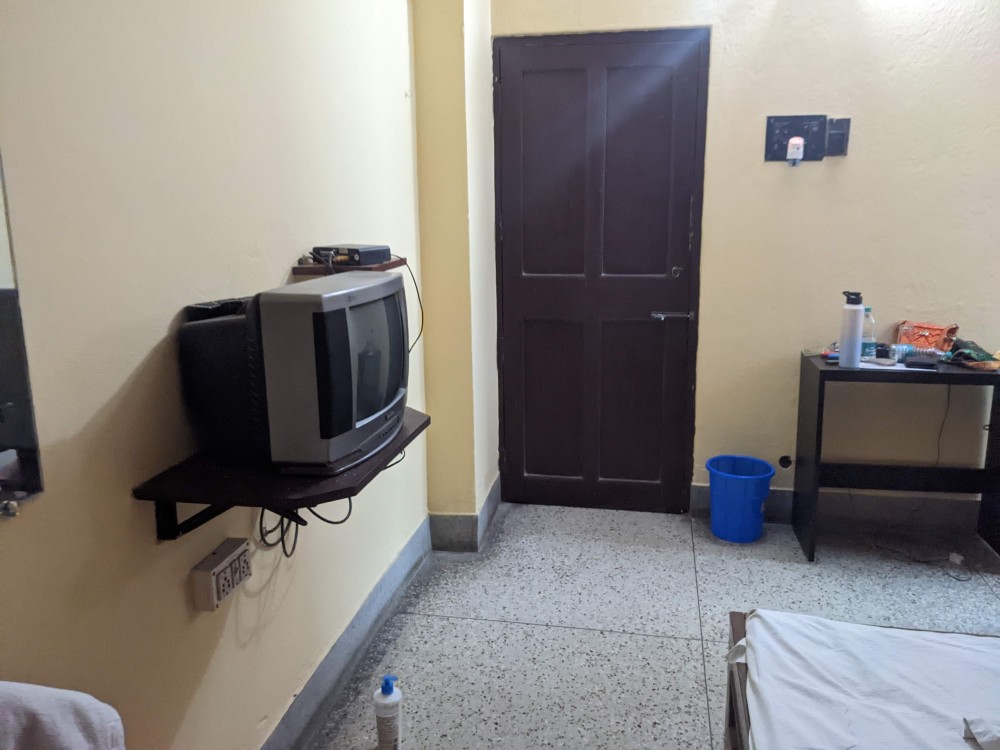
We never go for villas equipped with chandeliers, a fireplace, a panoramic valley view, and home-cooked meals at our table three times a day. We take simple rooms or two-room houses, prepare food ourselves, and light our own candles. Even a smaller hut which saves us four hundred per day is preferable over a more spacious, well-finished home. But you will ask—You said you take larger accommodation for the two of you? We do. If the place has good outdoor seating or a balcony, then even the smaller option works.
Instead of the center of the town, we might go a little towards the outskirts—the location comes with the added benefits of less crowd and more nature (in general). In Siliguri, rather than choosing a fancy house or leaving the city for a popular mountain destination Kalimpong which was fairly more expensive, we chose to continue staying in the Siliguri outskirts. Squatters and open grounds surrounded us. On some nights, the loudspeakers blasted sentimental songs until midnight. Not many good places delivered food to our house. But then our rent was twenty-one thousand per month (including everything), the host was interruptive but not bad (the same could not be said about the ground-floor neighbor though), we were mostly the only tourist in the area, a grocery fair was held every Monday ten minutes from our home, and Bengal’s deep forests were five minutes away from us.
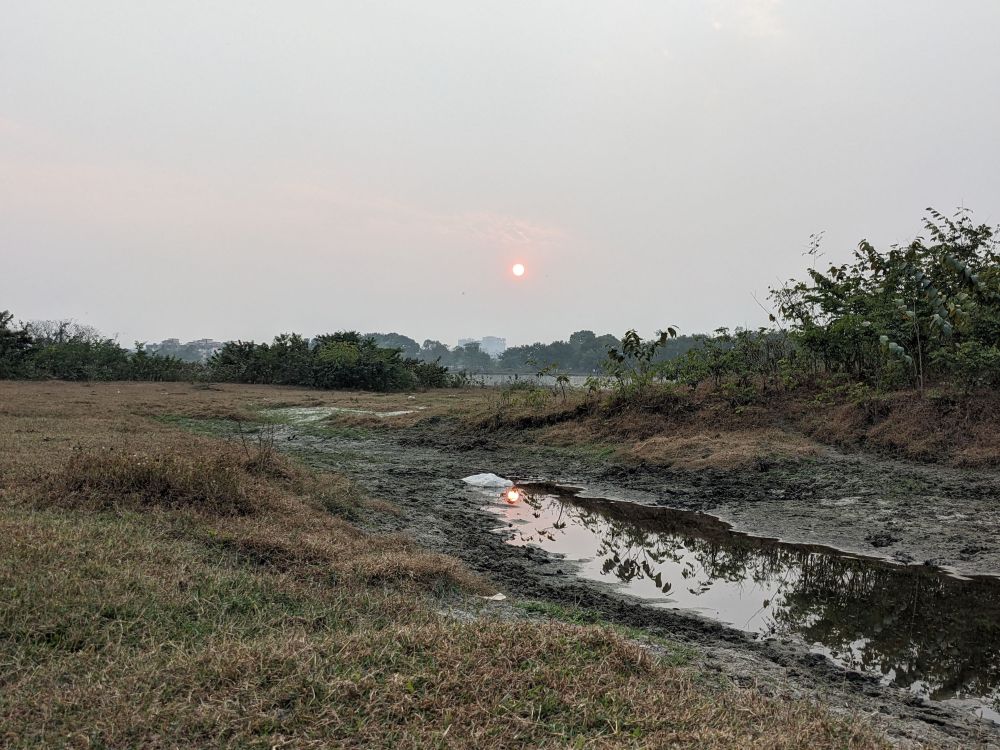
Our choice of less visited or remote and rural places might make us the oddities on the road, but it also enables lower costs and a more authentic local experience. Even if I wanted to spend more, I wouldn’t go to one of the villas of Kalimpong. I just don’t like those luxurious kinds of stays where you sit all day and are served unlimited food, and the whole experience is about a new plate at every turn of the sun. I want to do and be out and about, and that’s not so easy after those big meals.
We don’t chase peak seasons. But as we travel without much planning, sometimes we land at a destination in its peak season. So the Himalayas in the rain and Pondicherry in the summer. We have trouble finding guest homes on public holidays or festival days, but somehow, we are under a roof by the end of the day. When we arrive at a place in low season, our expenses from other destinations are averaged out.
We also tell the hosts that we have been on a long trip and, as we stay at the place for at least two days or longer, we get better prices. Not always, but often.
Rather than expensive experiences curated for tourists, we choose simple accommodations and find our own adventures. My partner and I like doing things on our own so this is the only way for us anyway.

We don’t take expensive tours unless it’s the need of the hour, like a jungle safari in the BR Hills or the Wayanad Wildlife Sanctuary recently. We commute ourselves. We hike and trek on our own, not with expensive tour companies or adventure brands. In a lot of places, we enjoy the free things to do: visit libraries, parks, and places locals see every day. Instead of parking in the paid parking of the attractions, we park a couple of hundred meters away. Maybe we saved a few hundred but also avoided the hassle of getting into a busy and, often, tight parking space.
We do pay for jungle safaris, boat rides, river cruises, ferries, kayaks, entry tickets, play tickets, an occasional bonfire, viewpoint entries etc. But then we are privileged to be able to see and experience so much. That was the plan. As we don’t book through any travel agent, we pay fair and square for the service.
Our one or two-meal-a-day plan keeps our costs lower too. One meal is fruits—the cost of which is sometimes lesser when we travel than it would have been in the city, another is breakfast which is mostly included when we travel faster, and the one big meal of the day either we cook, take from a local eatery at reasonable prices, or choose an elaborate local plate at a higher cost. Eventually, everything averages out. Our luck is such that we get home-grown fruits and vegetables (often I even pluck from the orchard) and when we offer a plate of our food to our hosts, they keep their curries and chutneys in our space without asking.
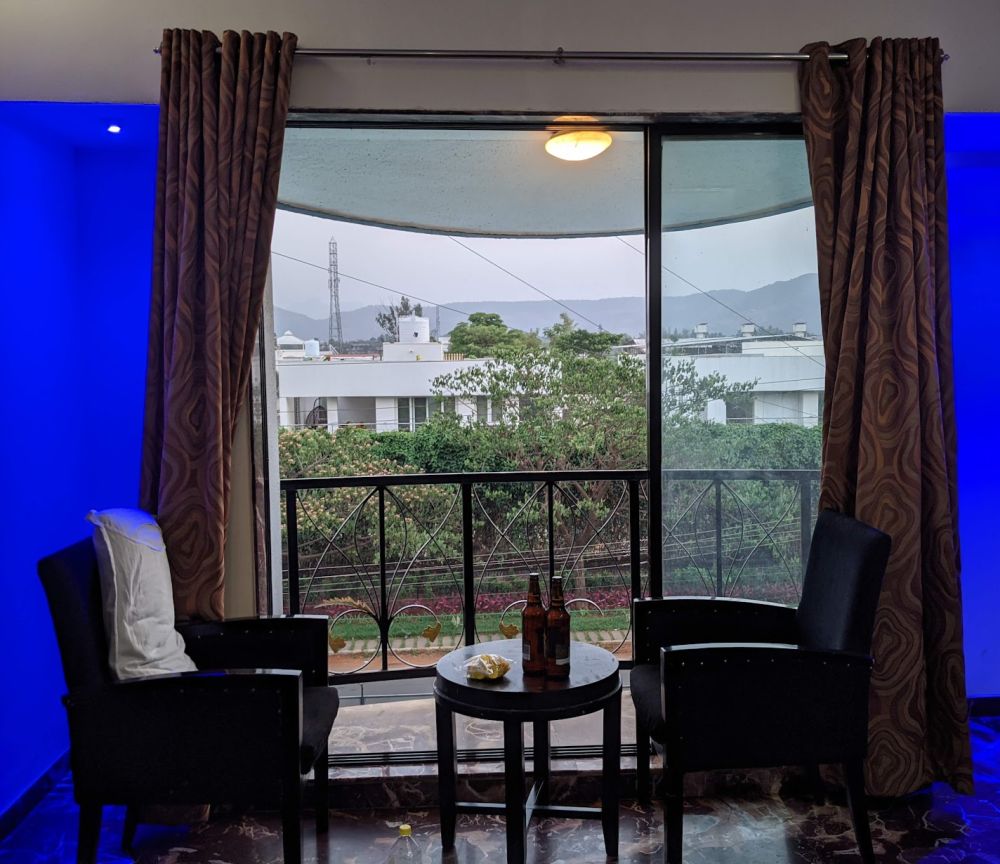
The sad part is that unlike in other countries, we don’t get any frequent traveler benefits or points. Recently, for the nth time, I asked Kotak Bank if they have a debit card or credit card with free international withdrawal or swipes. They don’t. None of the Indian banks offers cards that make tourists’ lives easy. So unlike this North American couple who also haven’t had a home for three years, we neither get flight nor room upgrades nor any benefits.
Our benefits are reversed sometimes. Some accommodations that offer genius member privileges on the Booking app, a genius is a frequent traveler who gets added rewards, refuse to provide the free breakfast or discount. Probably, they have accidentally agreed to genius benefits but don’t want to give them out.
How Do I Make Money While Living As a Nomad?
As soon as I started the blog, I started doing freelance writing. I work hard on my blog, and now I have published a book, too. So I am working, throughout the year, seasons, and places.
I receive affiliate income from my blog. Now I have book royalties coming in, too. After contemplating a lot, I have added the option of receiving donations on the blog too. For eight years, I have read and written day and night to keep On My Canvas—my sustenance and life’s focal point—going. Everything here and my weekly newsletter “Looking Inwards” is free. I don’t take advertisements, sponsored posts, or paid reviews. So I request those who have had some good moments reading my posts or felt hopeful on a lonely day to make a one-time or consistent donation.
You can go to the end of the article to donate. Thank you.
Now and then a deposit in my bank account does make a hard day easier.
When I quit my job and started writing full-time, I made sure I had substantial savings. Those were to be the cushion while I learned the skills of a new profession. Now a part of those savings have been spent, and the rest is invested. The investments are growing too.
These years when my learning curve is steeper and income is not stable are investments in my career.
This is not how everyone would do it or be okay with. But this is how I do it.
Some things to note,
- I don’t take sponsored posts: articles for which businesses want to pay me to publish on my blog
- I don’t do sponsored travel—Sponsored travel is when a business, accommodation, or tour company pay your travel costs. I pay for all my travels.
- My partner and I both share the costs
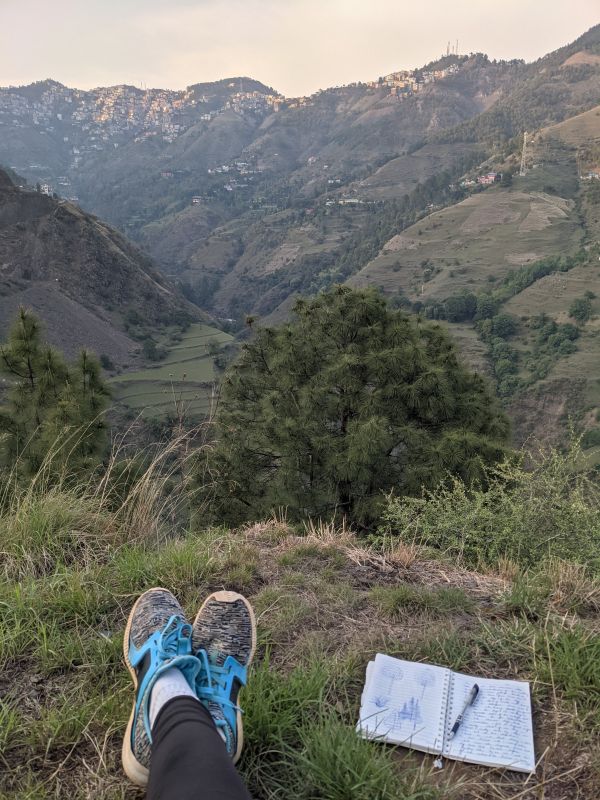
Traveling Constantly, How Do We Ensure Low Footprints?
Sustainability is not the need of the hour, it is the only way to go.
Simple, mindful practices and alternatives every day can make so much difference in how much footprint we leave. I won’t go into details about the petrol consumption of our car, but I want to list some other day-to-day things that make a larger impact.
We might have driven twenty-three thousand kilometers in three years (and now we are not in our car), but we still had a choice to make in more than a thousand meals. We cook, share our food with the family we live with, or go out to eat. Our online food orders are few, and thus we avoid one-time-use plastics and packaging.
In five years, Sagar and I have said no to hundreds of one-time-use plastic water bottles given to us by guesthouses, only opting in when we don’t have any other option.
So what do we do? We use Lifestraw water bottles that come with an in-built filter, reuse plastic water bottles we had to take, and pester the staff of every accommodation to bring us RO-filtered water.
A note to hotels, restaurants, government recreation centers, and the tourism industry everywhere: Rather than providing one or two complimentary water bottles or keeping a mineral water bottle on every table, please provide RO water jugs. How can two or three people be expected to survive on one litre of water a day when a human should, at the least, drink three to four litres daily? Hotels: Not only is RO water more cost-effective for you, but you can save the planet with this one change.
We do many other small things too—like carrying reusable shopping bags, reusing soaps, not opening shampoo sachets given by hotels, and sometimes refusing the linen change. Even when we have an air conditioner in the room, we hardly turn it on, unless Sagar and I want to compete in a sneezing championship. Now in Calcutta, I don’t even have an air conditioner at my current place.
Just by quitting our life in the city, we have contributed to the overall wellbeing of the planet.
In a city, our dry garbage used to be collected by the city municipality. What happens to that garbage? We all know. But in rural areas—which are most often our homes—our garbage is burned. Sometimes we put fire to it ourselves, dodging cows and goats who nibble on plastics and paper, dragging them out od the live fire. Generally, we choose places with cool or moderate climates, most often forests, and don’t need air conditioning or heaters. As we live in shared housing, we don’t have separate connections for everything. We join in the community and use what is being sourced already.
Our car is more of an inter-destination mode of transport for us. Within a place, we walk, bike, run, use public transport, and/or hitchhike. Oh, in July 2025, I took a domestic flight after four and a half years.
Still, whatever we do is not enough. Wherever we go, locals tell us the climate has changed a lot. “It wouldn’t rain so much this month,” “It was never this hot so late in the year,” and “we can never tell how the weather would be now” are only some of the concerns.
As these twenty-seven pictures will show, nature is still trying hard to survive.
Reflecting on My Journey and Life as a Digital Nomad
I am in Kerala now (today is February 18′ 2024), I am in Calcutta now (today is January 31′ 2026) but here is a relevant diary entry from Bangalore.
***
January 9 2024, Bangalore
Today is our sixth anniversary. Six years ago, Sagar and I decided to be together going forward.
Cars honk non-stop outside on the road.
Lying down in bed in the morning, I was thinking: These people are already on their way. Where do they have to be so early? They got up earlier than me, got ready, and even took care of their family, house chores, and so on. Or perhaps someone behind them (maids with keys) will go and do their chores for them?
The fear of missing out gripped me. I am in bed, they are out. Already on their way to work. Even at 4:15 am when I woke up from the sounds of Sagar blowing his blocked nose, I could hear the honks. Who was going around then? Call center employees and double shift workers?
Is Bangalore becoming another Mumbai—the city that never sleeps?
I couldn’t sleep for an hour. I was worried Sagar hadn’t slept well so I shifted the early alarm to 6:15. When another alarm rang at 6:45, I stayed in bed. He would wake up if I got up. I didn’t feel so well-slept myself. Last day in this room. I should take comfort from this bed. Such a comfortable bed.
I got out of bed at 7:30. While getting ready, the honks made me think: I’m just putting on my jeans, and then I’m ready for work. All these people on the road wouldn’t be though. They have to be somewhere. But that is not necessarily a good thing. Them and me, we are different. I have chosen a different path.
Now, close to the completion of our three years on the road, we are back in the city we began the journey from. Bangalore is a perfect place to reflect and build a perspective on the trip.
***
Update 2026: Completing five years of the nomad life, I have put on my thinking hat again.
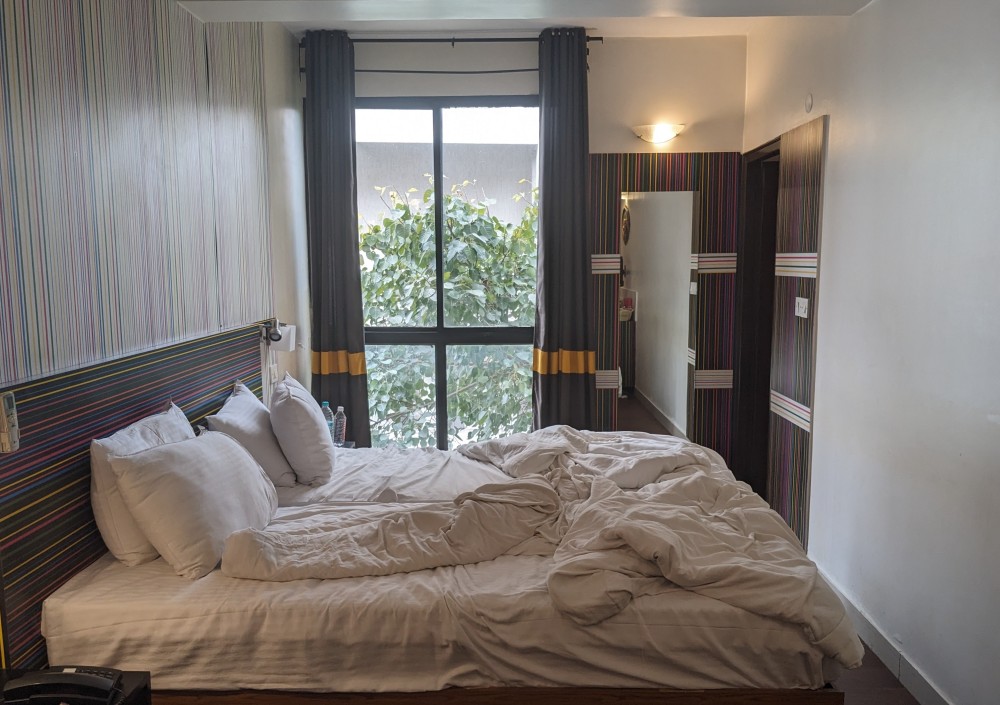
A Fairy Tale
To a home-dweller, our life of wandering might sound like a fairy tale. To many of my friends, it appears challenging though. And they are right, in a way.
It is hard to arrive at a place or leave one after a few amazing days only to realize we don’t have a home to go to. That we don’t know where we will sleep is a discomforting thought.
At one moment, you are seeing the most beautiful landscaped garden or have stumbled upon a tortoise on the ground and are eating the best corn roti and lentil curry you have ever had. But the clock has struck eight pm, and you still have to find a shelter. Your search for a guesthouse has been futile. As you drove all day, hiked to a waterfall on the way, and walked around this dam for hours, you are tired too (true story).
The regular work of packing, unpacking, paying, and filing water bottles and chores such as laundry, personal grooming, replying to emails, making sure you will have an address for the order you need to place soon, grocery shopping, talking to family and friends, finding food and tea, ensuring the car is okay, and so on are always there too. Of course, this is all in addition to finding ways, getting used to new roads, staying out of No Parking, and so on.
For every external activity, you coordinate with locals who mostly don’t know your language, and you don’t know theirs. Good luck with that. (Perhaps try learning the local language.)
Also, good luck staying patient with your travel partner who constantly forgets to leave his outdoor shoe at the door and the one who nags about cleanliness.
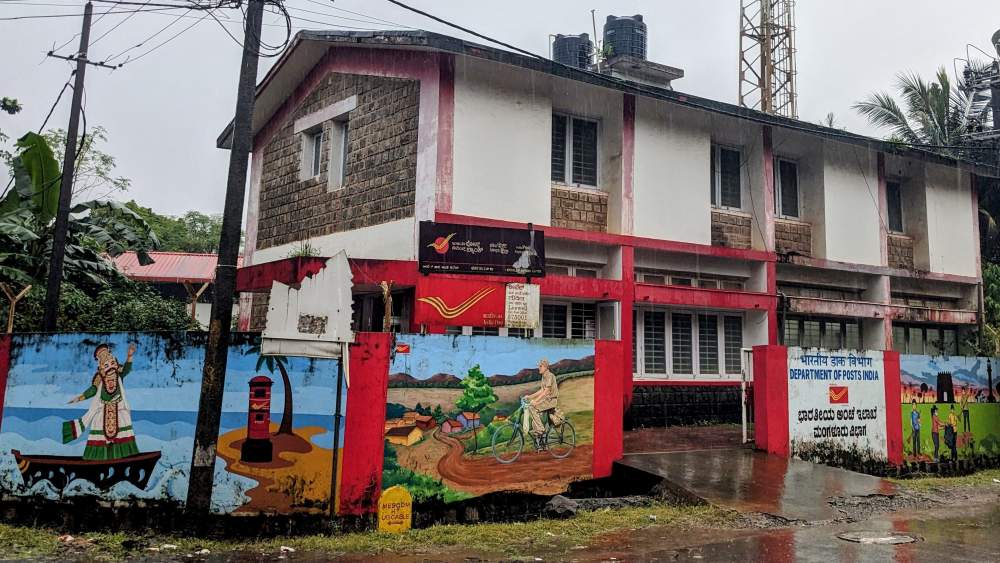
On most days, apart from all this, we work too. Work from home, hotel, road, car, basement, stairs, terrace, mountain, garden, bathroom, we have done it all (here are some tips to be productive). Tasks such as regular health checkups, investment planning, and taxes catch up with us as well.
Not that others don’t have chores. But when you are not in one place and don’t have a fixed bed, desk, wardrobe, washing machine, shops, doctors, service centers and so on, every task needs fresh trial, calibration, and research. The previous iteration of that activity won’t help this time.
For example: In the past five years, our car has been serviced in Goa, Jaipur (Rajasthan), Lonavala (Maharashtra), Mandi (Himachal Pradesh), Tamil Nadu, Calcutta (West Bengal), Karnal (Haryana), Noida (Uttar Pradesh), and Dehradun (Uttarakhand). I might be missing one or two locations.
Every time we had to empty the car. Either we hauled our things to the room or spoke to the staff for a secure storage. Sometimes when the car was not cleaned properly, we had to send it back. All done, the bags were carried back to the car and arranged.
The entire activity was performed in front of the hotel staff, guards, people on the road, villagers, families, and curious cows, dogs, and goats.
Thankfully, my dental checkup was done inside the clinic. My gums have been inflamed since November 2021. A dentist in Pondicherry couldn’t figure out the problem. I didn’t have the heart to visit another one. It took us two years to get to a dentist (in Bangalore) who had treated me well in the past and whom I could trust. I was relieved to hear that my gums were well.
Imagine two years of living with sensitive gums as pink as bougainvillaea, wondering what is wrong with them.
Becoming a nomad implies that even the most regular of your tasks would require much more effort and time. I have broken many myths of nomadic life before, too.
At times, we have to plan for some future date too. Maybe, we have to be at our parents’ home for a festival or occasion, or I have calls with editors or podcast interviews.
Every other day in a new destination, we are wary as well. So whether the hotel is safe, is someone following us home, are we parking outside someone’s home or under a coconut tree, are our wallets still upon us in this chaotic street, or why does this door doesn’t have a latch on the inside are our general day-to-day concerns. Landslides, cloud bursts, flash floods, rallies, protests, and other human-made or human-concerning disasters hit the areas we visit often.
All these action verbs describing our chores are part of our routine now. In a weird way, they make our life a fairy tale.
We may sound like superhumans. But we are two little beings who want to see, connect, enjoy, and create.
If someone told me they live like this, I, without a doubt, would have thought: Their life is so different. Maybe worth trying, one day.
Having come so far on the journey, I say, “Yes, this itinerant life is worth its challenges, perhaps like every other life.”
If some tasks loom larger, so much is easier too.
When the entire Gangtok city didn’t have water, the locals were lined up on the main square to receive only one-fourth of a bucket for a day. Our hotel had water tankers come in separately, and we had enough water. Our convenience in others’ suffering shouldn’t be flaunted, but I should highlight the perks, too.
Most often, I don’t have to sweep my room, change my sheets, or clean the bathroom (I just oversee.). There is no house to be maintained, no tedious neighbors or plumbers to deal with, and no commute to the office. We don’t have to follow any apartment rules, and the rocketing air pollution doesn’t bother us (at least not every waking moment of our lives, though we do worry about those who live in highly-polluted cities).
On any given day, we can get up and decide to be anywhere.
As I might have to leave a place soon, I try to see, do, and write as much as I can. People say deadlines are good for writers. For me every day is a deadline—”We might not be here tomorrow. Let’s see.” Or, “Let’s finish this article by tonight, so we visit the temple and the elephant sanctuary in the morning.”
The road has been so kind to me that my story pot is overflowing. I haven’t been able to publish on the blog as much as I wanted to, but the big projects book must have made up for the deficit.
Another good thing—as one doesn’t want to fall sick while digital nomading—we have naturally become more aware of our health. We take care of ourselves much better than we did at home.
We take yearly health insurance, and for the last two to three years, have been doing yearly medical checkups. Even after staying in Siliguri, Gangtok, Himachal, and other places with different environments and eating mostly one meal a day, our test reports have been good.
On most days, when we head out to explore, we don’t question each other: “Do you think we can walk that long?” We walk or hike as much as we have to: often ten to fifteen kilometres, and our legs don’t hurt the next day.
And the most important of it all.
We have learned to appreciate the most taken for granted things such as a hot water geyser, a big wash basin in the kitchen, and drinking water directly from the tap. We know how it is to not have these. Only long-term travelers like us grin when they see a stove, a good working chair, or a washing machine.
On any regular day, we might find ourselves next door to the adorable fury kittens who jump in through the window and allow us to pick them up. They meow for our caress until they can’t meow anymore.
We are farewelled by people who didn’t know us until a few days earlier. They stop us, ask us if we are leaving, and with eyes welling with tears, wave us goodbye with promises to visit again.
We have encountered extreme kindness from people. Food packed for the road, calls and messages to check up on us after we left, and help, love, and friendship from strangers when we least expected it.
Their stories inspire us to keep going. Their resilience and repetition harden us up. Their restrictions remind us of our freedom.
Then there were the dolphins swimming in Ganga, driving a geared bike for the first time on slippery and sodden North Vietnam mountains, and that autonomous woman in a coffee estate in Kerala who wrote poems on being happy in loneliness.
Every day, the universe surprises me. Suddenly, I make a new friend. On uninspiring afternoons, I discover truths so obvious but that were hitherto hidden from me.
Every day is exciting. Sagar and I are dealt with some bad cards but we get the best of each place, too. I don’t have to think—one fine day I will retire and see all this. I see and learn something new about the world every day. I never want to retire.
Someone might think I am trying to justify our life. That the choices we made have worked out well for us in the traditional sense. That the basic pillars of health, work, family, and happiness stand strong even in our bohemian life.
I guess those standards have been my benchmark till now, too. But now, other things, such as the way I live every day, what I do with my time, what are my priorities, how I behave with others, whether I am good to my partner, and if I am kind to myself are starting to replace the previous standards of deadlines, financial income, performance, productivity et cetera.
I am asking different questions.
Maybe I am changing as I am growing older. Or perhaps, while living from day to day, I have been able to focus on and evaluate what is important to me sans the world’s standard. I am not ashamed to say that some days I am not as productive as I would be in a home. But then, what is productivity?
I didn’t write as many words or publish as many articles as I did from my Bangalore home in the lockdown in 2020. Instead I laughed and exchanged words of Malayalam with the locals in Kerala, understood a few things about human nature, saw bright birds I had never seen before, rejoiced around the backyard lake, ate delicious home-cooked local food, wrote and worked, and had ethereal moments when every inch of me was crying out loud: how amazing is this all and how lucky I am.
Now, this is the kind of life I am willing to live. It is not always the most productive, but it is the most wholesome, and so, it is productive in a wholesome sense. This is my ikigai, the thing that drives me: to let myself grow into the human being I aspire to be. Everything else will work out on the way.
I do want to talk about the feeling of shame for being different from others.
I was embarrassed to ask a friend for her address so my father could courier my new driver’s license to her. My Goan address wasn’t good enough for the courier service. At friends’ homes, squeezing into their comfortably settled multi-children, multi-worker, multi-room, multi-car life, I am conscious of the fact that I don’t even have a home to call my own. No permanent address or abode to invite them to. Not to return the favor but to be able to say, “I’m going home,” “do visit me,” or “this is how it happens at home.”
Even sometimes while telling the guest-house staff that we have been in their state for so long and have been on the road for so many years, or negotiating prices and trying to extend when they expect us to leave, again, I am apologetic. I am dependent on them to provide me with a home at my conditions. I don’t have a home to go back to. Or when some families or friends pack up and check out of a hotel to return to their houses, I feel a tinge of jealousy.
They are going home. I can’t. The concept of home, घर in Hindi, after all, is as ingrained in us as is of a mother.
We don’t have an address, for god sake.
At such times, I have to remind myself I have exchanged home for this life, for the nomad way of life, for my life. Nothing comes for free. One has to decide what one wants and pay the cost. You can bear any price as long as you know what you are paying for and why.
Sacrifice isn’t sad. Sacrifice is saying no to some things for something else you want more. We have to set our values and priorities right. Else we will have everything but we will still be poor.
Distance yourself from things that do not align with your wellbeing, growth, and serenity—without the guilt, shame, or fear of being misunderstood.
Morgan Richard Olivier
After 60 Months of Hotels, Hostels, and Guesthouses, Do I Miss Home?
I miss home, or, more precisely, the feeling of having a home.
At moments, I want to leave everything and go home. A place where I wouldn’t have to wake up in the morning and think, where do I go today? Which I can retreat to, which I don’t have to book, where I can stay for as long as I like without having to pack and leave at a specific time. Where a day spent idling wouldn’t feel like squandering a day’s rent. Where I could amble to the kitchen and make a cup of ginger tea without first having to find a restaurant or bring out my kettle. Where either I clean or have some permanent help whose schedules and behavior I am aware of, rather than requesting new people to prepare my space the way I like every day.
Where I can call the laundry guy to clear up last month’s bill. Where a cafeteria in the alley would keep a few chapatis ready for me at noon. Where a fury cat snuggles me in bed.
Where my friends could come over. Where my parents could visit. Where I could keep all the things I need. Where I could do whatever I like without worrying if the staff would think I haven’t stepped out in two days.
Where every night I don’t have to figure out new power switches to turn off to black out the room, where the fan would be on its default speed, and where I wouldn’t be surprised by a fat pillow and a hard duvet.
When I leave any home/hotel/hut, I get a sense of displacement and unpredictability. I feel uprooted, I get restless, and I become a little anxious.
While getting into the car, I know that finding a good place to stay might be hard. My uneasiness is just my body preparing for the upcoming hard work, as the neuroscientist and the author of the book How Emotions Are Made, Lisa Feldman Barrett would have said.
My piece: You Aren’t the Emotional Fool You Think You Are is founded on her seminal research of our brain.
At times, we had to look for a hotel at eight or even at midnight. One night at eleven pm in a highway hotel, we were refused a room because we didn’t show our marriage certificate (most hotels in India don’t want to give rooms to unmarried couples). Once after suffering in a poor guesthouse, we paid ten thousand a night at another place. Even that expensive accommodation didn’t know a thing about hospitality. Many times, I have had to stand outside the door when I am so sleepy I can almost fall, waiting for the cockroach-ridden bedsheet to be changed. I may have had to train a few housekeeping staff.
Often we have been refused what was promised, and we have been judged on our complexion, religion, regionality, food preferences, relationship with each other, clothes, shopping bags, and schedules.
Plans failed. Many times, we were on the verge of collapse. We did collapse a few times. Once someone deflated our car tyres in a village in Karnataka mountains, we dealt with a host legally, and one afternoon during the pandemic, Thane Mumbai police threatened to seize our car and screamed at me without any women police at the scene.
Sometimes, we had to climb for thirty minutes to get vegetables or lunch. We have stood at the host’s door, asking for a refill of a simple vegetable curry that usually came with refills, and have been refused. At times, I missed deadlines because it was too noisy to write. In a deep Himalayan forest, Sagar slipped on a mossy rock, he couldn’t walk, and we lost our way.
Once after a horrifying experience, every day I dreamt of fat rats invading our cottage at night. Once in Karnataka, a scooter followed me on a lonely mountain road as I jogged from a lake to my guesthouse.
Everything that could go wrong has gone wrong. Some mornings, I have thought of quitting everything and heading to my parent’s home or buying a house as soon as possible.
I haven’t quit so far. But I have gone straight ahead to my parents’ home, and even stayed put for as long as five months.
If in India, we could park our camper van anywhere and put out a tent, we might have been more comfortable. This need to find a roof above our heads for tomorrow wouldn’t have been there then. But camper vans aren’t legal or common in India. Nor are they safe.
And does the other life of having a settled home come without troubles?
Even when I had a place, I resented its upkeep.
Would we be happier or more comfortable in a permanent home?
Perhaps.
I can’t tell. How can a fish comment on the life of a bird? Or a bird about the life of a fish?
At times, we might have been more relaxed in our own home. Something else might have tensed us though. We find reasons to worry no matter the situation we are in. Soon the best becomes our normal, and problems find their way in.
One thing is for sure though. If we were living in our house, we couldn’t have visited so many places. We would have stayed in, may have traveled to some destinations, and then returned home because we could.
The absence of a house has kept us on the road. We have made big blunders, learnt important lessons, went on uncountable adventures, and got connected to the needs of daily life like we couldn’t have in a permanent shelter.
“For my part, I travel not to go anywhere, but to go. I travel for travel’s sake. The great affair is to move; to feel the needs and hitches of our life more nearly; to come down off this feather-bed of civilization, and find the globe granite underfoot and strewn with cutting flints.”
Robert Louis Stevenson
So far, I haven’t had to sleep on the road. There are still enough homes that at least one could shelter us every night. So what if we have to find it? Mostly, a roof appears on the way when we go along in good faith. (Like in Rewalsar in the Himalayas on a stormy day.)
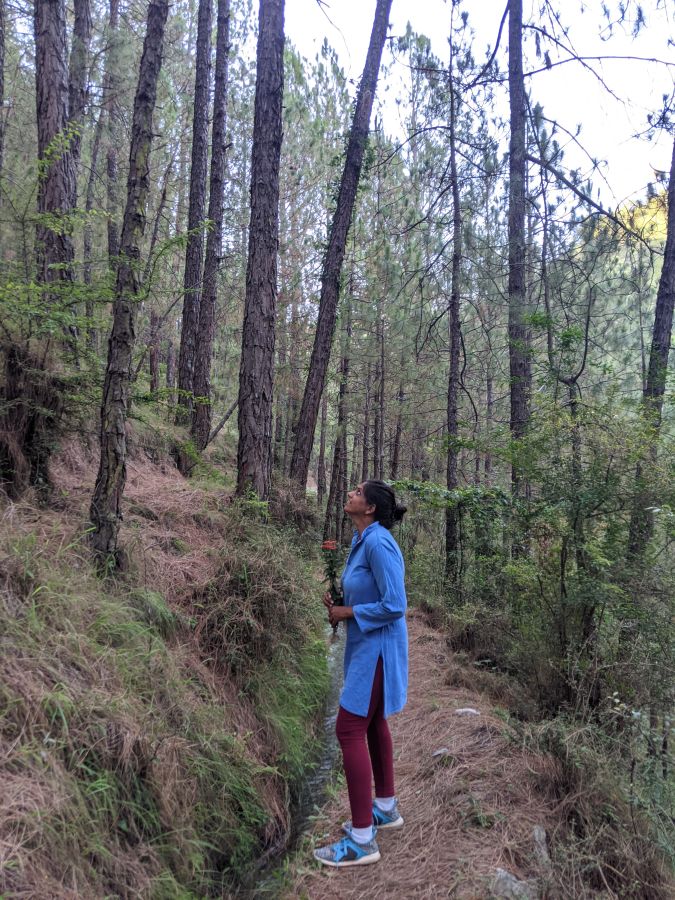
I do succumb to hopelessness like everyone else.
Why should I travel where no one understands me or cares for me? To be able to say we have seen the world? Why do I have to keep on moving from place to place? Why do I have to pack and unpack and forever figure out a new tea pan?
To see and discover the unknown. I am forever wondering, “What lies beyond that path?” So I go.
With the awareness that we don’t matter to others as much as we thought we do comes the liberty that we can do anything. The acquiescence that we are minuscule in the vast universe is humbling, hopeful, and liberating. They can never know us, we can be anyone, but then we can be ourselves too.
I don’t have everything, but I have most things I have ever wanted.
I don’t mind the honks outside the window for I don’t have to join them. I am already at work and can design my day the way I like. Soon I will be gone, understanding a new place, taking what I need from it.
Why Did I Become a Digital Nomad? Why Did We Leave Home?
I wanted to see the world. Sagar wanted to come along with me and also wanted to see the world.
What if it didn’t work out? We had asked each other.
We will chuck it and rent a home again. We had told each other.
We didn’t know the way was one-way though. Once we set on the ride, there were no u-turns, like always.
How Did Our Families React To Our Nomadic Lives?
My partner’s parents read my blog. Though they didn’t like what they read, they knew what I did.
My parents are slowly coming along. My father has many names for me, including gypsy, banjara, and so on. They often ask, “So when will you take an apartment?” or subtly hint, “Bangalore is a good city.” Right after Sagar and I completed three years of being nomads, my parents joined me in Kerala for their own nomadic exploration.
When I asked my father how long would he like to stay, he replied, “We’ll see when we are there. How it goes.”
When I told my mother they didn’t have to go about every day, and the journey could be restful, she replied, “We can go around every day.”
Now they have calmed down too. Often my mother is giving me tips on how to cook in a makeshift kitchen, and my father asks what did I see, eat, and explore.
Perhaps they have gotten used to our digital nomad lifestyle, or, maybe, they think we are too far gone and there is no point in asking.
Either way, the situation is mostly peaceful.
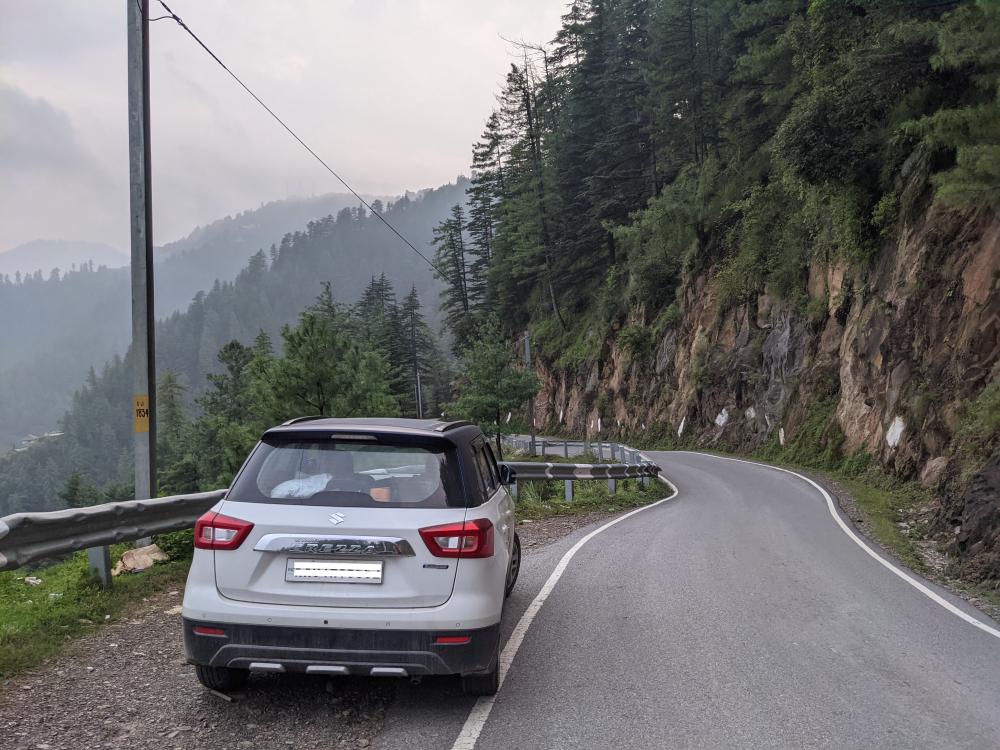
Scooby Dooby Doo, Where Are You?
There was a dog who showed us the way through the high and wild Himalayas one misty day.
Whenever the dog disappeared around the curve, Sagar sang, “Scooby dooby doo, where are you,” and soon enough, the dog was in sight again.
So the dog was Scooby, and now our car is Scooby, and it is our best friend on the road. This incredible journey wouldn’t have been possible without her.
Even objects can take on life if you depend on them as much as we rely on our car. When there is so much love to give, why not give a little bit to the artful pieces of engineering?
Life has come full circle. From an engineer’s heart, a writer’s mind, and a wanderer’s eye, I see the world. I am amazed so far and plan to continue being amazed.
Are you amazed, too?
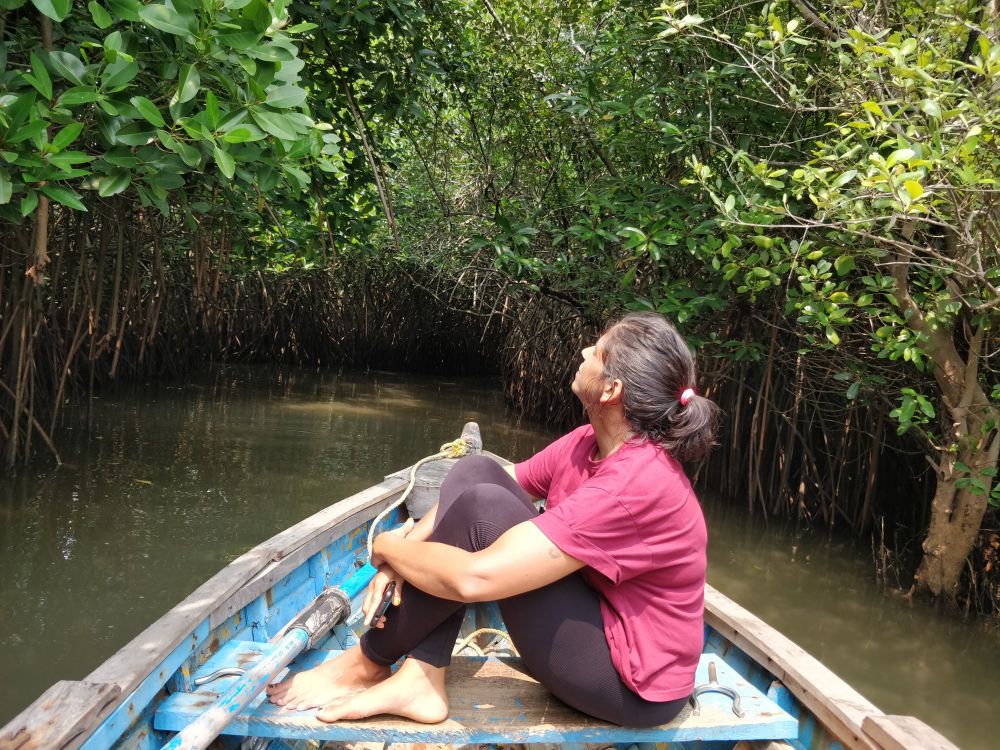
Homeless For 5 Years, Or, With a Home Everywhere
As a friend said, I am not homeless. I have a home everywhere.
Years ago, I wrote “my partner is my portable home” in a moment of inspiration. Now, I have been living the reality. Sagar and I have a home with each other.
Wherever we go, we can’t have enough of each other. We travel together, work in the same space, sleep together, eat together, and so on. But we can spend even more time together.
I believe that is a good thing.
Three things we have learned and that we practice to be better to each other.
What Have I Learned?
Lessons From 5 Years of Nomadic Travel
- Life is the same everywhere. People are the same.
- Learn their language to become one of them.
- Humans can do anything at any time. Mostly what they do is driven by the thinking—“What is best for me,” and not—“What would hurt them more.”
- A kind word and a kind act travel far.
- Food is the identity of every community. To join someone’s table is a great privilege.
- Don’t explain yourself to anyone because they won’t see you as you do. Stop convincing and seeking approval.
- Don’t scream, fight, do self-pity, or cry. The only way out of the quagmire is to do what is to be done.
- Leave the ego behind.
- People believe what they have been told; that is their eternal truth. But a few curious souls are following the faint light of their true feelings amidst the darkness. They are the scientists; they will lead the way.
- Most people never change. They don’t know they can.
- A glance of recognition, a namaste, or a smile can brighten up my day.
- Let go, always.
- I will not treat you the way you treated me. I will offer kindness, love, and humor. That’s what I’ve learned to give, and I’d give it for free, for it costs me nothing.
- Nature is the best cure.
- Work with a routine. Our schedule can make or break us.
- Watch out for yourself, no matter the external promises.
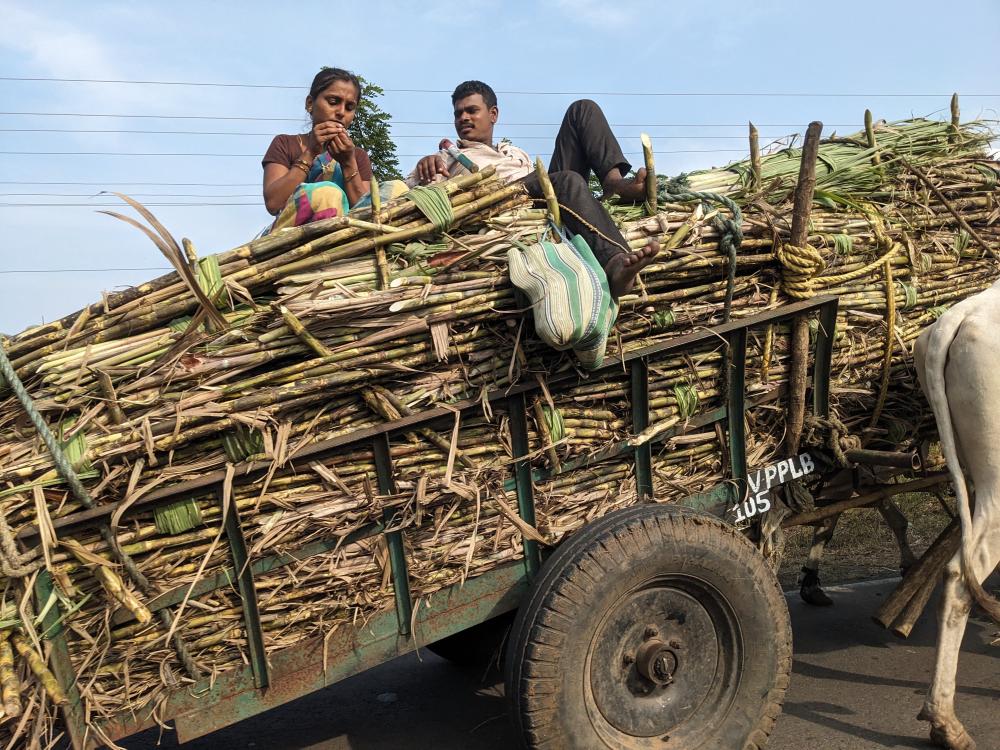
- Plans only work out in the head.
- Simple food, fresh air, clean space, and cool water can pretty much keep you going all your life. And for some of us, work can bridge that extra mile to a life worth living.
- Not being thankful is the most unfortunate.
- Human beings can adapt to anything.
- Solutions are simpler in smaller places. Things are not easier in big cities, they are harder.
- People are living simple lives in rural areas. Their down-to-earth connected-to-nature daily rhythm can calm down anyone.
- If we remember that nothing is permanent, that even this moment will pass, we can overcome anything.
- Play more.
- Don’t let your defense shield kill you.
- Comparing our life with others’ is like trying to match the ending of two books. Appreciate what you have.
- We can complicate our lives to no end.
- We can simplify our lives to no end.
- Pass over the baton of responsibilities to deadlines.
- A small step finally leads us to the summit. Doing little by little every day gets it done.
- Keep doing the things working in your favor. Find out what works against you and get rid of those habits.
- The more you discover, the less you know.
- Forget everyone, laugh at everything. (Inspired by Anne Frank and the people on the road)
- As long as there is this sunshine, how can I be sad? (Again, inspired by Anne Frank and The Himalayas)
- Quieten the voice always explaining things to you.
- There is no path to happiness. Happiness is the path to everything.
- You are as oldest as you have ever been and the youngest you will ever be. I read this quote somewhere, and it has stayed with me since. On this journey, where we aren’t stationary in one place, I notice the passing of time more than I did at home. We are always leaving, arriving, or doing. A day passes, then it’s already a week. Every moment is a learning. Sometimes we can’t believe we did so much in an afternoon. Within an hour, things can turn upside down. My best weapon is patience and the awareness that this moment shall pass, too. I have to appreciate—after all, this is the youngest I will ever be and the oldest I have been.
- People remember how you make them feel. It’s one of the best gifts of the universe.
What Is My One Takeaway From The Journey?
Trust the universe. Things work out in the end.
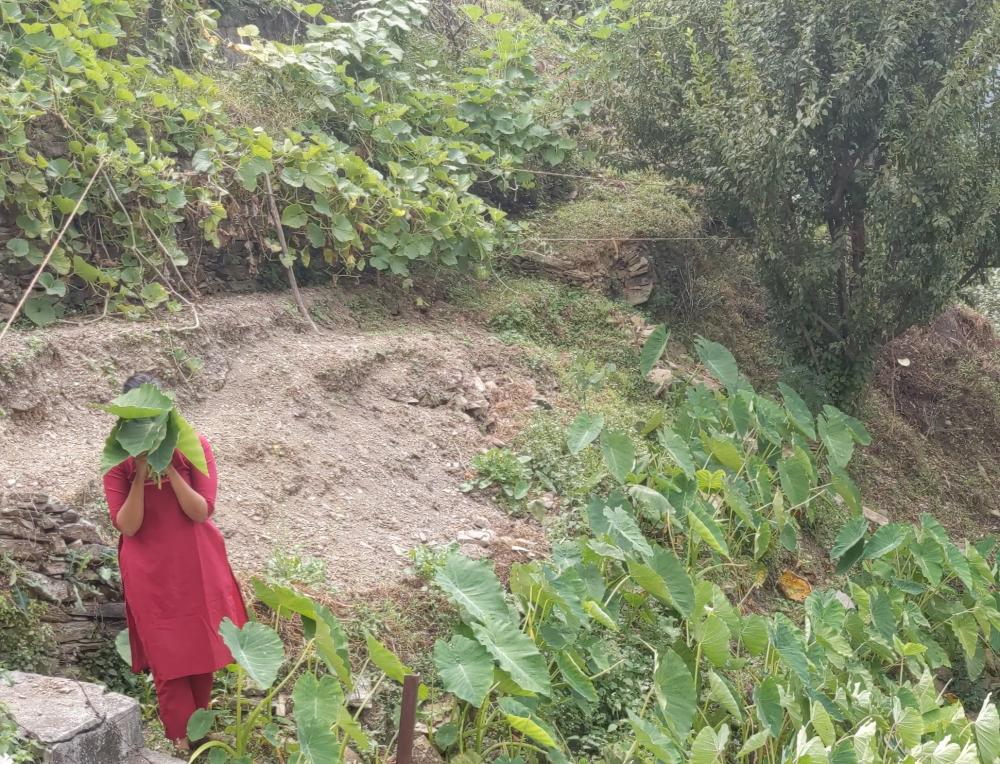
What Is The One Thing That Has Helped Us The Most?
Staying prepared. Not the sort of planning such as booking hotels or knowing tomorrow’s destination. But always making sure we have health insurance, water, fruits, basic medicines, and our documents in the right place. Apart from my credit card bill, I never say we will see later. Mostly, both my partner and I, though in different areas, are on top of things.
What Is The One Thing We Never Take For Granted?
Our health.
What Is The One Thing I Could Have Done Without?
The unstructured nature of the Indian tourism industry.
What’s Next?
Sagar and I can finally say we have seen enough of India, for now.
I want to wrap up this long trip for good. We have been in Calcutta for five months now, our bags resting in the dusty cupboards, and we have had some rest too.
Now a plan is being made, and I am going out of India for a few months. This time, we will both book one ticket each, our destinations slightly away from each other. One needs to spend some solitary time as well.
I also want to take Sagar to South America, especially Chile, and Malaysia, and we have a lot of new countries on our minds too. In my visa guide for Indians, I have tagged the countries I want to visit. Hopefully, the hospitality industry overseas will be more systemized and assurable: as has been my experience on the past trips. But all this in due time.
For now, we will be two free birds, choosing our own routes.
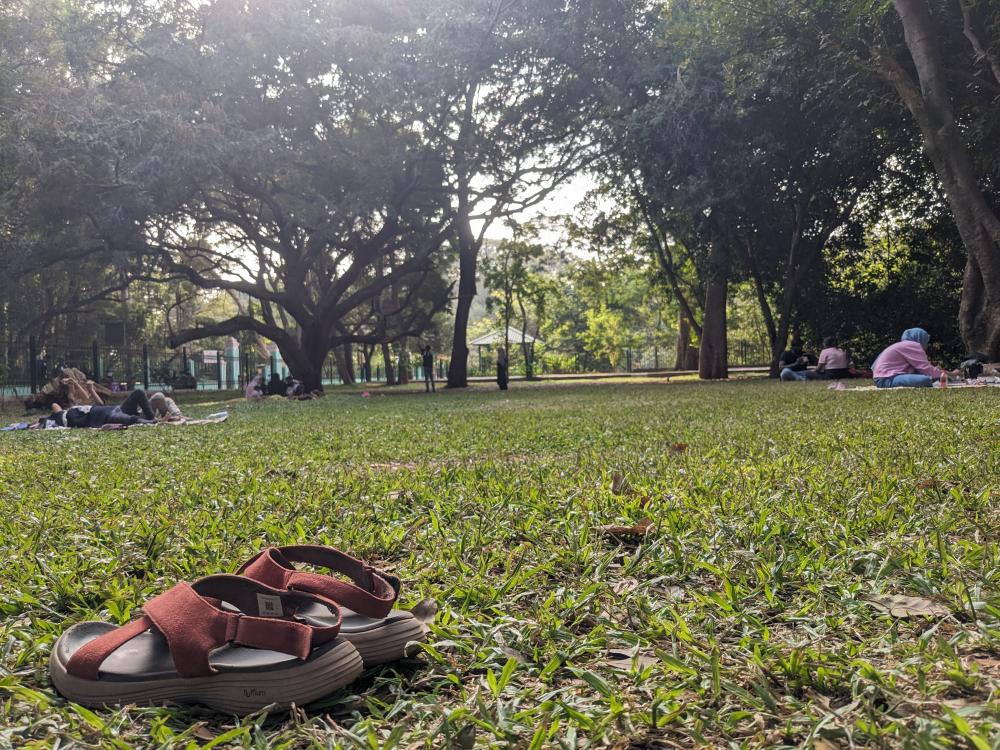
Would I Ever Want a Home Of My Own?
At some point, Sagar and I do want a home. But rather than a rented place, we will plan towards our own home squeezed between a forest on a land with space for natural ponds, an outdoor kitchen, garden, playground, a writing cottage for me, and so on.
Where? We don’t know.
When? In the coming few years.
Wish us good luck.
At the beginning of the post, I was talking about being restless in Bangalore. I started writing this article there. Here’s another diary entry from Bangalore that is relevant to this piece.
January 2024, Cubbon Park, Bangalore
Initially, the large green oasis of Bangalore that is Cubbon Park had become suffocating for me. People were everywhere, some were bothering me, a condom lay near a trunk I leaned upon, a man walked right into my space and pretended to ask for water, and so on. Now, I have found a quiet space. It is peaceful, safe, and perhaps just what I needed. The traffic I was running away from, in the lack of another quiet grassy place, seems to be in the background. I don’t notice it anymore. I have written here well, and I feel better than I did in the room.
A minute later.
A man walking a husky walked straight to me. I didn’t understand why were they getting so close and was amazed at the walker’s indifference. Only when I opened up my hands to express how ridiculous this was, he pulled the dog who was sniffing my laptop sleeve on the grass. Ah, well! A happy ending is a myth.
Now this is life, and as with all lives, it is imperfect but mine.
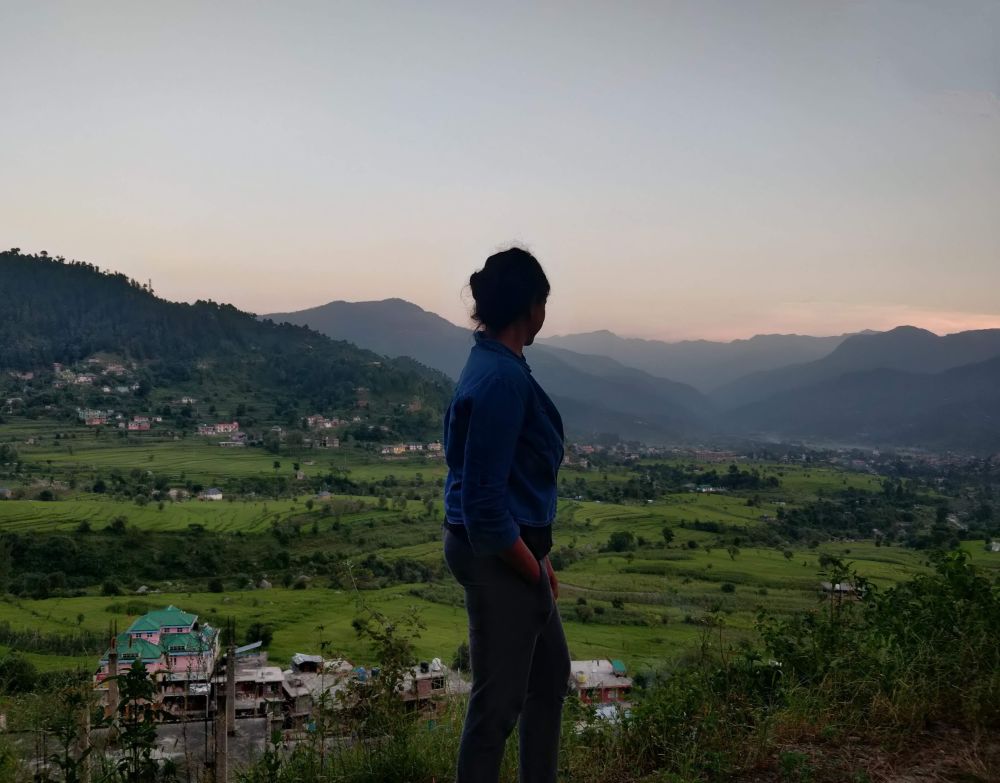
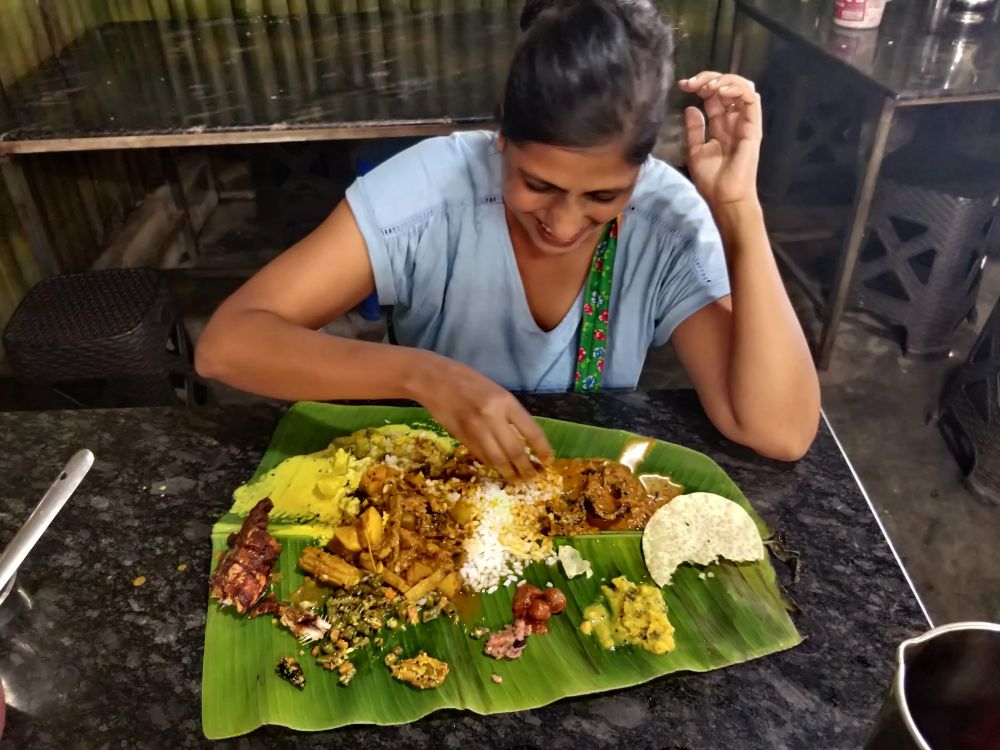
Oh, we do what is convenient for us. Not everything has to be right or wrong. Sometimes we save the extra food from breakfast in boxes. Not just to save money but to have something with us. Maybe, we get hungry again or one of us falls sick, needs food, and there is nothing nearby. Who knows what happens by the end of the day?
Things are not black and white. One does what needs to be done. That is all.
Do Give Me a Shout Out
Leave the name of your hometown in the comments, and when I visit the place, I will give you a shout-out. Optionally, subscribe to my newsletter Looking Inwards—which is a weekly Behind the Scenes and so much more, and you will get to know my whereabouts. Let me know when I am in your town. We will catch up.
Would You Want To Try The Life Of a Digital Nomad?
MY FIRST BOOK
Journeys Beyond and Within...
IS HERE!
In my vivid narrative style (that readers love, ahem), I have told my most incredible adventures, including a nine-month solo trip to South America. In the candid book, the scoldings I got from home for not settling down and the fears and obstacles I faced, along with my career experiments, are laid bare. Witty and introspective, the memoir will make you laugh and inspire you to travel, rediscover home, and leap over the boundaries.
Sikkim Express: "Simple, free-flowing, but immensely evocative."
The Telegraph Online: "An introspective as well as an adventurous read."
Grab your copy now!
The memoir is available globally. Search for the title on your country's Amazon.
Or, read a chapter first. Claim your completely free First Chapter here.
Want similar inspiration and ideas in your inbox? Subscribe to my free weekly newsletter, Looking Inwards.
Thank you for writing this great blog , very inspirational. Just finished my own solo traveling through Kerala and Tamil Nadu for two months I get a better feeling of your experiences. Being much older I couldn’t stay in too remote places or take treks on my on for safety concerns. The chance of getting an injury or illness being all alone in a foreign country is a risk I don’t want to take . Hut by staying in hostels and homestays with more people around gave me the chance to meet interesting people , mainly Indians , and having great conversations and short time travel partners. Traveling on local buses relating on helpful people everywhere makes you realise that kind people exist everywhere and as long as you respect them and being humble .
About the fasting , nearly my whole mature life I lived with having 2 meals a day , a meal between 10-12am and dinner at around 7pm . Having a meal when you feel hungry has always made more sense to me then eating at set times .
Thank you for reading and sharing your experiences, Eduard. I am happy to hear your trip went well and that you met lots of people. Yes, someone or the other always helps us out. Thanks for sharing your eating habits. Yes, two meals is great. Your schedule sounds good, especially because you farm. These days I am eating two meals, too, though, sometimes I sneak in the delicious desserts of Turkey and Georgia in between. Hope you are well and always good to hear from you 🙂
This was a really honest and refreshing read. It’s easy to romanticize the digital nomad life, but you’ve captured both the freedom and the practical challenges so well. The way you talk about creating a sense of home despite constant movement really stands out. It’s journeys like these that show travel is more about perspective than just destinations. Interestingly, more people are now seeking slower, meaningful experiences in places like Bhutan as well, through curated trips
Thank you, Armaan. Glad you enjoyed the narrative 🙂
This was such an honest and relatable read. The way you’ve described the uncertainty of finding good stays, balancing work, and dealing with inconsistent hospitality really shows the less glamorous side of digital nomad life in India. It’s not always easy, but the perspective you gain feels worth it. Finding the right place to stay makes a huge difference in this lifestyle—I recently came across some peaceful options here: that seem perfect for slow travel.
Thank you for reading and for the suggestions 🙂
Inspiring journey and honest storytelling about life on the road in India. Loved how it beautifully captures real travel experiences, challenges, and personal growth.
This was a deeply honest and immersive read. The way you articulate transience, belonging, and the emotional undercurrents of long-term nomadic living goes far beyond surface-level travel writing. The reflections on identity, work, and home felt especially powerful and relatable. Thank you for sharing such an unfiltered perspective-this piece truly stays with the reader.
Thank you. I am glad you enjoyed it 🙂
Truly inspiring journey. Five years of living as a nomad in India is no small feat, and your behind-the-scenes perspective adds real depth to the narrative. Thank you for sharing such an honest and grounded experience-it’s both insightful and motivating.
Thank you so much. Glad you enjoyed the article.
Your journey is truly inspiring, thanks for sharing this
I just saw your blog and am really impressed by your dedication to writing and sharing your experiences. The quality of your work is outstanding, and it’s clear how much effort you put into it. Truly inspiring!
Amazing read and so well written straight from the heart! Took a while to finish this but what a treat. I’m in Seattle so do give a shout whenever you find yourself in the area.
Thank you, Kaushal, for reading. I hope you are well and I’ll definitely give a shout out.
have fun.
I would love to travel to India some day! Seeing the traditions and the food! I reaaly love Indian food haha, I bet you enjoyed it!
Thank you, Jean. I hope you do get to travel India one day. Yes, I have been loving the food. Lucky me.
Thanks for this well written and straight from the heart thing.i have been reading you for last 3 years.this one is surely topping the charts and converted me to your big fan.keep it up. Give me a shout if you happen to pass punjab for himachal. I am at one of the bordering city hoshiarpur
Thank you, Rahul, for reading and this generous comment. Don’t be my fan, take from my journey what you need, and what you think isn’t so great, leave it behind. I’ll definitely give a shout out if I cross Punjab. I keep visiting Himachal.
Have a great summer.
Perfect blog. I really appreciate the transition in your life. It was great reading this. I hope you enjoy and buy a home soon as per your expectations. Probably in middle of the forests 🙂
Hi Atul. Thank you for reading and your kind comment. I hope so, too.
Regards
Priyanka